Quick answer
Most private music teachers need general and professional liability insurance, often $1 million per claim, because homeowners and renters policies typically exclude business activity. Add instrument coverage for gear you teach on, abuse and molestation coverage if you teach minors, workers’ comp once you hire, and the right auto coverage if you drive to students. Insurance Canopy publishes a teacher policy from $229 a year.
Key takeaways
- Homeowners and renters policies typically exclude business liability. Triple-I says a home policy usually covers only $2,500 of business equipment at home and $250 away from it.
- Insurance Canopy’s music teacher policy, with general and professional liability of $1 million per occurrence and $2 million a year, starts at $229 a year paid annually (as of November 13, 2026).
- MTNA members can buy general liability with $100,000 of abuse and molestation coverage through MTNA’s member program. Prices are behind the member login.
- A certificate of insurance only proves coverage. Connecticut’s insurance department says a landlord or school becomes an additional insured only through the policy, usually by endorsement.
- California requires workers’ compensation for even one employee, so check your state’s rules before you hire your first teacher.
On this page
- Do private music teachers need insurance?
- What coverage does a music teacher need?
- What do landlords, schools, churches and venues require?
- Where can music teachers buy insurance, and what does it cost?
- Which music teacher insurance fits your situation?
- How do you buy music teacher insurance?
- Is music teacher insurance a business expense?
- The bottom line
- Questions
Music teacher insurance is a set of business policies that pay if a student is hurt at your lesson, if a family says your teaching cost them money, or if your instruments are damaged or stolen. Most private teachers start with general and professional liability, often at $1 million per claim, because a homeowners or renters policy typically excludes business activity. Then they add what their situation calls for: instrument coverage, abuse and molestation coverage for teaching children, workers’ compensation once they hire, and the right auto coverage if they drive to students. Published policies for teachers start at $229 a year (Insurance Canopy, as of November 13, 2026). This guide is general information, not legal or insurance advice. Coverage varies by state and by policy, so read the policy and ask a licensed agent.
Do private music teachers need insurance?
For a solo teacher, liability insurance is usually a choice rather than a legal requirement: the SBA lists workers’ compensation, unemployment and disability insurance as what businesses with employees must carry. But the risks are real, and the policy you already have probably doesn’t cover them. MTNA’s Business Digest puts it bluntly: many teachers assume their home policy protects their studio, instruments or travel, and “these are generally false assumptions.”
Three things usually push a teacher to buy insurance:
- Someone could get hurt. A student trips on a power cord, or a parent slips on a wet floor while waiting.
- Someone asks for proof. A landlord, school, church or venue wants a certificate of insurance before you teach there.
- Your instruments are your business. A dropped guitar or a water-damaged piano can cost more than a month of tuition.
Insurance Canopy lists sample claims on its music teacher page, which it labels as estimates: $100,000 for a parent who slipped on a wet studio floor, $20,000 for a student who tripped over an amplifier cord and broke an arm, and $10,000 for a student who sued over audition preparation. You don’t need to believe every figure to see the point. One claim can cost more than years of premiums.
What coverage does a music teacher need?
Start with liability, then add coverage for your own property and for the way you work. Here is what each type does and when it matters.
General liability: a student trips in your studio
General liability pays for bodily injury and property damage you cause to other people. The SBA describes it as protection against “financial loss as the result of bodily injury, property damage” and the lawsuits that follow. It’s the coverage that answers “what if a student falls on my front steps?”
Teacher policies usually bundle related parts. Insurance Canopy’s policy, for example, includes products-completed operations, personal and advertising injury, damage to premises rented to you ($300,000) and no-fault medical expense up to $5,000 per person, as of November 13, 2026.
Professional liability: a family says your teaching cost them
Professional liability, also called errors and omissions, covers claims that your advice or instruction was negligent. The SBA describes it as protection against “malpractice, errors, and negligence.” For a teacher, think of a student who fails an exam after you gave wrong information about it. Insurance Canopy’s page uses that exact example, at an estimated $2,000.
Many teacher policies sell general and professional liability together. Thimble and Insurance Canopy both do, with Thimble offering limits of $1 million or $2 million.
Business property and music instrument insurance for teachers
Liability insurance does not pay for your own gear. Thimble says plainly that equipment is not covered by its general liability policy. For your instruments, you have two main options:
- An equipment add-on (inland marine) on your teacher policy. Insurance Canopy charges $2.17 a month for up to $4,000 of coverage a year, as of November 13, 2026. It covers instruments, gear and teaching materials damaged or stolen during lessons or on the way to them. The page notes this add-on is temporarily unavailable to new customers in Alabama, Florida, Louisiana and Mississippi.
- A stand-alone instrument policy. These suit a valuable piano, a fine string instrument or a large collection of gear. More on these below.
MTNA’s Business Digest warns that personal property floaters on a homeowners policy “typically only cover personal use of the instrument.” If you teach on it, ask your agent whether business use is covered.
Home-based business endorsement, or a separate policy
If you teach at home, this is the gap that matters most. Triple-I says “most homeowners policies specifically exclude business liabilities,” so a visitor hurt on a business errand would probably not be covered. It adds that the usual limit for business equipment is $2,500 at home and $250 away from it. The NAIC says many renters and homeowners policies limit office equipment to $2,500, and it warns that not telling your insurer about a substantial home business can lead to a denied business claim or a policy that isn’t renewed.
Triple-I describes three ways to close the gap:
| Option | What Triple-I says about it | Good fit |
|---|---|---|
| Endorsement (rider) on your homeowners policy | May cost less than $20 a year and can double business equipment coverage from $2,500 to $5,000. Usually limited to businesses with receipts around $5,000 a year. | A very small side studio |
| In-home business policy | Generally less than $300 a year. About $10,000 of business property and $300,000 to $1 million of liability. | A home studio with steady students |
| Businessowners policy (BOP) | Bundles broader property and liability coverage in one policy. | A bigger studio or one with rented space |
Triple-I’s figures are general industry ranges, not quotes, and its page is not dated. A teacher-specific liability policy, like the ones in the price table below, is a fourth route that many independent teachers take. Whichever you choose, tell your home insurer you teach at home, and get its answer in writing.
Commercial auto for traveling teachers
If you drive to students’ homes, check your car insurance. Triple-I says a personal auto policy “probably provides coverage for some business use,” but is unlikely to cover a vehicle used mainly for business. The Utah Insurance Department says that if you use your car for anything beyond commuting and pleasure, you “may need a commercial auto policy,” and suggests asking whether your personal policy can be endorsed for your specific business use. Tell your agent how many students you visit each week.
Workers’ compensation once you have employees
Workers’ comp pays for employees’ work injuries, and states set the rules. Thimble notes that its general liability policy doesn’t cover staff like a lesson coordinator or substitute teacher, and that workers’ comp is “required in most states.” California, for example, requires it for all employers, “even those with ‘one employee’,” and uses the ABC test to decide whether a worker paid as a contractor is really an employee. If you plan to pay other teachers, read your state’s rules first. Our guide on how to start a music studio covers the other steps that come with your first hire.
Abuse and molestation coverage for teaching minors
If you teach children one-on-one, ask about sexual abuse and molestation (SAM) coverage. MTNA’s Business Digest lists it as a separate type of coverage, and insurers sell it as a separate line or add-on. Insurance Canopy sells a SAM add-on with a $300,000 limit, starting at $10.34 a month or $124 a year, which it describes as paying for your defense against false allegations. MTNA’s member program includes $100,000 of abuse and molestation coverage, with higher limits available. Ask any insurer whether its general liability policy excludes abuse claims, and get the answer in writing.
Cyber liability, if you hold families’ data
If you store families’ payment details or personal information, some insurers sell cyber liability. Insurance Canopy lists it from $8.25 a month as an add-on, as of November 13, 2026. Ask about it if you keep sensitive records yourself.
What do landlords, schools, churches and venues require?
When you teach in someone else’s space, the owner will usually ask for two things: a certificate of insurance and to be named an additional insured.
A certificate of insurance (COI) is a one-page summary of your policy. Connecticut’s insurance department explains that it “generally serve[s] only as evidence of insurance” and is a snapshot of your coverage on the day it was issued. It gives the holder no rights under your policy, and the holder isn’t owed notice if the policy is canceled. Thimble and Insurance Canopy both issue a certificate right after purchase.
An additional insured is a person or organization your policy also protects for claims that come from your work. Insurance Canopy says it’s common for landlords and venues to require it, and that a school may ask for it before hiring you as a contractor. A certificate alone doesn’t create that status: Connecticut’s bulletin says the holder must be named an additional insured by endorsement or under the policy’s terms, and that this protection can cost extra. Both Thimble and Insurance Canopy add additional insureds for free.
Requirements can be much higher than a basic teacher policy. Chappaqua Central School District in New York asks facility users for general liability of $1 million per occurrence and $2 million aggregate, a $10 million umbrella, the district named as an additional insured on a specific endorsement form, and a certificate before using the space. A commercial landlord, MTNA’s Business Digest notes, will usually require you to carry commercial general liability insurance.
Before you sign a room rental or teaching agreement:
- Ask for the insurance requirements in writing: limits, who must be named and the exact wording.
- Send them to your insurer or agent before you buy, not after.
- Check whether the requirement includes an umbrella, workers’ comp or a specific endorsement form.
- Put the renewal date in your calendar, and send a new certificate every year.
If a family or venue requires rules for waiting siblings, studio instruments or damage to borrowed books, write them into your music studio policy, so the expectations are clear before anything goes wrong.
Where can music teachers buy insurance, and what does it cost?
Here are the providers and programs that sell to music teachers, with the prices they publish. All were checked on November 13, 2026. Where a provider publishes no price, the table says so.
| Provider or program | What it sells | Published price | Notes |
|---|---|---|---|
| Insurance Canopy | General and professional liability for music teachers, $1M per occurrence / $2M aggregate | From $229 a year paid annually, or $21.08 a month ($253 a year) | Add-ons: equipment $2.17 a month, SAM from $10.34 a month, cyber from $8.25 a month. Free additional insureds. |
| Thimble | General and professional liability, $1M or $2M limits | Not published; quote online | Buy by the hour, day or month. Free additional insureds. |
| MTNA member program (FLD) | General liability with abuse and molestation for MTNA members | Not on the public page; members-only | $1M each occurrence, $3M aggregate, $100,000 abuse and molestation |
| MTNA with TIE / Forrest T. Jones | Professional liability for educators, with abuse and molestation | Not published | Enrollment through MTNA’s members-only page |
| Clarion Associates | Stand-alone musical instrument insurance | Not published | MTNA says Clarion offers a discount to MTNA members |
| MusicPro | Instrument and equipment insurance, plus studio liability | “As low as $175 per year” | Its example estimate: $175 a year for $3,200 of gear |
| Anderson Group | All-risk instrument insurance | Not published; quote online | Covers musicians, students and collectors |
| TMEA (Texas) | Educator liability for TMEA members | $30 a year | Private instructors only under an agreement with a school, on its property |
Some details worth knowing:
- Insurance Canopy’s pages don’t all agree. Its headline price is $229 a year, but one FAQ on the same page says $299 a year, and its cost page lists higher premiums for teachers with more income. Confirm the price at checkout. Its cost page also says monthly plans carry a $2 fee.
- MTNA’s own general liability policy doesn’t cover your lessons. MTNA pays for a policy that covers events run by its state and local affiliates, but it says the policy is not available to individuals and excludes members’ own lessons and studio recitals.
- NAfME and state associations. We couldn’t confirm a current NAfME insurance program today. If you belong to a state music educators association, read who its policy covers: TMEA’s is built for school music educators.
- General small-business insurers. For comparison, Insureon says small businesses pay a median of about $45 a month for general liability, and 85% choose limits of $1 million / $2 million. That figure covers all kinds of small businesses, not music teachers.
Music instrument insurance: stand-alone policies
A stand-alone policy is worth pricing if your instrument costs more than an add-on’s limit. Clarion lists “professional usage” as covered and says homeowners insurance never covers it. It also lists breakage, earthquake and flood. MusicPro covers instruments and gear worldwide, including theft from a vehicle, with deductibles from $100 per loss, and its Classical plan names music educators. Anderson warns that homeowners policies often treat paid playing as business use, which can void coverage.
Before you buy, list each instrument with its value, and ask whether the policy pays replacement cost or a depreciated value.
Which music teacher insurance fits your situation?
This table matches common teaching setups with the coverage to ask about. It reflects the sources above, not a quote, and your agent may suggest more or less.
| Your situation | Main risks | Coverage to ask about | Watch for |
|---|---|---|---|
| Home studio | Students and parents injured on your property; damage to your instruments | General and professional liability; equipment or instrument coverage; tell your home insurer and ask about an endorsement | Home policies that exclude business liability; the $2,500 business property limit Triple-I and the NAIC describe |
| Traveling teacher | Damage in students’ homes; accidents while driving; gear stolen from the car | General and professional liability; equipment coverage that applies in transit; ask about business use on your auto policy | Personal auto policies that don’t cover mainly business driving |
| Rented room (store, church, community center) | Injuries on someone else’s premises; damage to the room | General liability with damage to premises rented; additional insured status for the owner | The owner’s limits, endorsement wording and certificate deadlines |
| Studio or school with staff | Staff injuries; claims about any teacher’s conduct; a bigger space | Workers’ comp; general and professional liability for the business; SAM coverage; a BOP | State rules on employees and contractors, such as California’s ABC test |
| Online only | Claims about your advice; data you store | Professional liability; equipment coverage for your setup; cyber liability if you hold families’ data | Coverage gaps if you start seeing students in person |
If you teach minors in any of these setups, add abuse and molestation coverage to the list.
How do you buy music teacher insurance?
The SBA’s steps fit a teacher well: assess your risks, find a reputable licensed agent, and shop around, because rates and terms vary. Online teacher policies are quick to buy (Insurance Canopy calls its application a 10-minute form), but read the terms before you pay.
Questions to ask before you buy
- Does the policy cover lessons at my home, at students’ homes, at rented rooms and online?
- What are the limits per occurrence and per year? Do they meet what my landlord or school requires?
- Is professional liability included, or a separate policy?
- Does it exclude abuse and molestation claims? If so, what does SAM coverage cost?
- Are my instruments covered? Up to what amount, with what deductible, and at replacement cost or a depreciated value?
- Is the policy “occurrence” or “claims-made,” and what happens if a claim comes after I cancel?
- Can I add additional insureds, and is there a charge?
- How fast can I get a certificate, and can I download it myself?
- Does it cover recitals and studio events I host?
- What changes when I hire my first teacher?
What to do once you have a policy
- Save the policy and the certificate somewhere you can find in a minute.
- Send each landlord or school the certificate it asked for, with any endorsement.
- Tell your homeowners or renters insurer that you teach at home.
- Review the coverage every year, and again whenever you add a room, a teacher or an expensive instrument.
Is music teacher insurance a business expense?
Generally, yes. IRS Publication 334 says you can generally deduct premiums for insurance related to your business, including liability, malpractice, fire and theft, and workers’ compensation. Car insurance is the exception to watch: you deduct only the business share if you also drive the car for personal use, and you can’t deduct car insurance at all if you use the standard mileage rate. Ask your accountant how this applies to your studio.
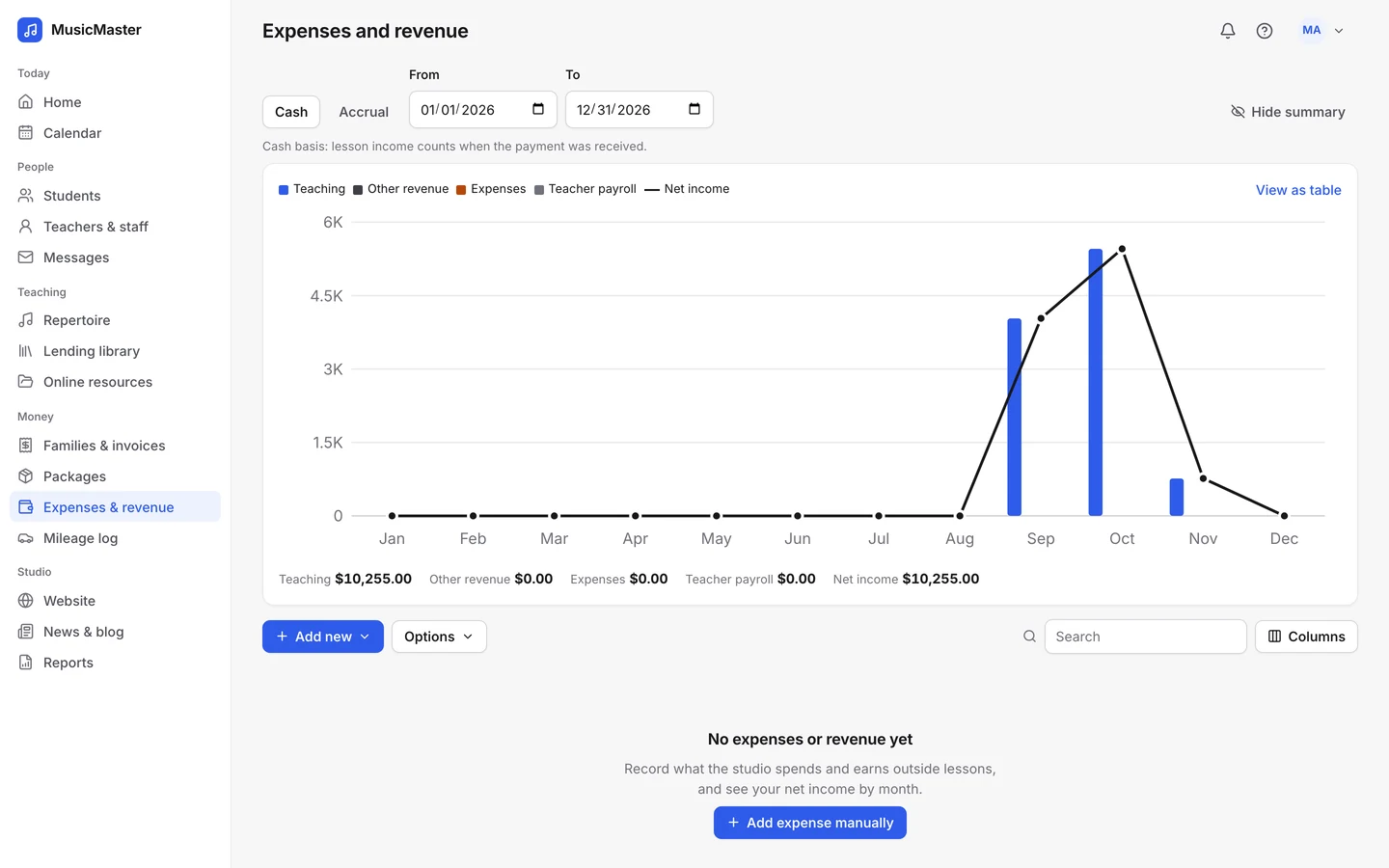
Record the premium as a studio expense when you pay it, along with the receipt. In Sonely, you can add it from a photo or PDF of the receipt and repeat it each month if you pay monthly, so it shows up next to tuition in your revenue and expense chart.
The bottom line
Start with general and professional liability, and check what your home and auto policies leave out. Add instrument coverage for gear you teach on, and abuse and molestation coverage if you teach children. Get workers’ comp before you hire. Ask for every landlord’s and school’s requirements in writing, and send them to your insurer before you buy. Prices change, so treat the figures here as a starting point and get your own quotes.
This guide is general information, not legal, tax or insurance advice. Coverage and requirements vary by state and by policy. A licensed agent in your state can tell you what applies to you.