Quick answer
To start a music studio, choose where you’ll teach (your home, students’ homes, online or a rented room), set your rates and a written studio policy, and handle the business basics: registration, a separate bank account, taxes and insurance. Then set up scheduling and billing, publish a simple website, fill your first slots with trial lessons and plan your first term on the calendar.
Key takeaways
- Choose your format first (your home, students’ homes, online or a rented room), because it sets your costs and how many lessons fit into an afternoon.
- If you start teaching without forming anything, the SBA says you are automatically a sole proprietorship, and most states require you to register a studio name as a DBA.
- An EIN is free from the IRS, which warns that you never have to pay a fee for one.
- The IRS says self-employed people must file a return once net self-employment earnings reach $400, and because nobody withholds tax from tuition, it expects quarterly estimated payments.
- Write your studio policy before your first student, and block holidays on the calendar before you book a single family.
On this page
- How to start a music studio in 9 steps
- Step 1: Choose where you’ll teach
- Step 2: Decide who and what you’ll teach
- Step 3: Set your rates
- Step 4: Write your studio policy
- Step 5: Set up your music teacher business (US)
- Step 6: Set up your studio tools
- Step 7: Put up a simple website
- Step 8: Find your first students
- Step 9: Plan your first term
- How much does it cost to start a music studio?
- Questions
Here is how to start a music studio in the US: decide where you’ll teach, set your rates and a written policy, take care of a few business basics, and set up a simple way to schedule and bill lessons. Then put up a small website and fill your first slots with trial lessons. None of it needs a big upfront investment: the SBA says registering a business usually costs less than $300 in total, and an EIN from the IRS is free. The same steps answer how to start teaching music lessons on the side: begin with a few students and add the rest as the studio grows. (This guide is about a teaching studio, where you give lessons; building a recording studio is a different project.)
How to start a music studio in 9 steps
Each step has its own section below, in the order to do them.
- Choose where you’ll teach: your home, students’ homes, online or a rented room.
- Decide who and what you’ll teach.
- Set your rates.
- Write your studio policy.
- Set up your music teacher business: registration, an EIN, a separate bank account, taxes and insurance.
- Set up your studio tools for scheduling and billing.
- Put up a simple website.
- Find your first students, starting with trial lessons.
- Plan your first term on the calendar.
Step 1: Choose where you’ll teach
Your format decides your costs, your schedule and how many lessons you can fit into an afternoon. You can start with one and add a second later.
| Format | Startup cost | Good for | Watch out for |
|---|---|---|---|
| Home studio | Low: a room and your instrument | Back-to-back lessons with no travel | Zoning, lease or HOA rules, parking, a place for parents to wait, privacy |
| Traveling to students’ homes | Low, plus car costs | Families who want lessons at home; teachers without a teaching room | Travel time between lessons, mileage, the quality of each student’s instrument |
| Online | Low: camera, microphone, stable internet | Adult learners, rural students, students who move away | Audio quality, young beginners who need hands-on help, time zones |
| Rented room (music store, church, community center) | Rent by the hour or month | Teachers who can’t teach at home | Paying rent before you have students, fixed hours, the venue’s own rules |
Teaching music lessons from home? The SBA notes that zoning ordinances can still apply to home-based businesses and are set locally, so call your city or county planning department before you open. Choose a room with a door, away from household noise, with a chair for a parent who waits; a rug and curtains soften the sound for you and the neighbors. Traveling? Keep a mileage log from the first day, because the drive between students is a business cost. Teaching online? See Sonely for online teaching for how lesson links and reminders work.
Step 2: Decide who and what you’ll teach
Pick your instruments, the ages and levels you teach, and the lesson lengths you offer. A clear “who” makes everything after it easier: your rates, your website and your flyers can all speak to one kind of family.
A simple starting menu works well: 30-minute lessons for young beginners, 45 and 60 minutes for older or more advanced students. Decide now whether you’ll add group classes later, because they change how you price and schedule.
Choose your teaching materials at the same time: a method series for each age group and a few supplements, so every new student starts on a plan. A short beginner package, such as four lessons, gives hesitant families a low-commitment way in before they sign up for a term.
Do you need a credential? It is optional, but it can reassure parents. The Music Teachers National Association’s professional certification, Nationally Certified Teacher of Music (NCTM), is open to all music teachers actively engaged in the profession; teachers outside colleges earn it by completing five Teacher Profile Projects. In MTNA’s 2024 member survey, 33.4% of respondents held it.
Step 3: Set your rates
Set your rates from your local market and your own numbers, not from a guess. Look up what teachers near you charge for the same lesson length, then place yourself by experience and format. Our guide on how much to charge for music lessons walks through it step by step.
Then check the price covers your goal. Here is the math with example numbers (yours will differ):
- Yearly income you want from teaching: $30,000.
- Yearly studio costs (books, software, insurance, travel): $3,000.
- Weeks you teach a year: 40.
- ($30,000 + $3,000) ÷ 40 = $825 a week.
- At 25 lessons a week, that is $33 a lesson.
That figure is before taxes. Self-employed teachers generally pay self-employment tax as well as income tax (see step 5), so ask an accountant how much to set aside. Our free lesson rate calculator runs the same math with self-employment tax, your income tax estimate, driving and card fees added. Decide too whether you’ll charge monthly tuition or per lesson. Monthly tuition gives you steadier income, because a missed lesson doesn’t change the bill, and the tuition calculator turns a per-lesson rate into equal monthly payments.
Step 4: Write your studio policy
Write your policy before your first student, not after your first problem. It should cover tuition and due dates, late fees, cancellations and make-ups, holidays, illness, recitals, photo consent and how families stop lessons. Our free music studio policy template covers all of it, with an enrollment agreement for families to sign.
Step 5: Set up your music teacher business (US)
In the US, a one-teacher studio is simple to set up, but a few things need doing in the right order. What follows is general information from the SBA and IRS, not tax or legal advice. An accountant who works with small businesses can tell you what applies in your state.
Choose a structure and register
If you start teaching without forming anything, the SBA says you’re automatically a sole proprietorship. Teach under your own legal name and you may not need to register anywhere. Use a studio name instead, and most states require you to register it as a DBA (“doing business as”), also called a trade name or assumed name. An LLC is registered with your state. The SBA puts the total cost of registering a business at less than $300 in most cases, depending on your state and structure.
Get an EIN if you need one
An Employer Identification Number (EIN) is a federal tax number for a business. It’s free from the IRS, which warns: “You never have to pay a fee for an EIN.” Apply on IRS.gov, never through a site that charges for it. You need one to hire employees, for example. A sole proprietor without employees may not, so ask your accountant.
Open a separate bank account
Put every tuition payment into one account and pay every studio expense from it. The SBA lists the reasons: families can pay your business rather than you personally, and business funds stay separate from personal funds. It also makes tax time much simpler. The SBA notes a sole proprietor can open one with a Social Security number instead of an EIN.
Plan for taxes
The IRS says self-employed people generally must pay self-employment tax (Social Security and Medicare) as well as income tax, and must file a return if net earnings from self-employment are $400 or more. Nobody withholds tax from tuition, so the IRS expects quarterly estimated payments (Form 1040-ES). Sole proprietors report studio income on Schedule C. If you teach at home, the home office deduction requires that you use part of your home regularly and exclusively for business, so a living room with the family piano may not qualify. Ask your accountant.
Do you need a business license to teach music lessons?
Probably not a federal one: music teaching isn’t among the activities the SBA lists as needing a federal license, such as aviation, alcohol or broadcasting. State, county and city licenses and permits depend on your business activities and location, so the SBA suggests starting at your Secretary of State’s website, and asking your local planning department about zoning.
Get insurance
The SBA describes general liability insurance (bodily injury and property damage), professional liability insurance (errors and negligence), a home-based business rider on a homeowner’s policy, and a business owner’s policy that bundles common coverage. The SBA notes a rider protects only a small amount of business equipment, so ask an agent what would happen if a student tripped on your front steps. The SBA advises speaking to licensed agents and comparing quotes, because prices and benefits vary a lot.
A homeowners or renters policy often excludes business activity, so check your cover before students arrive: music teacher insurance explains liability, instrument and home-studio policies.
Step 6: Set up your studio tools
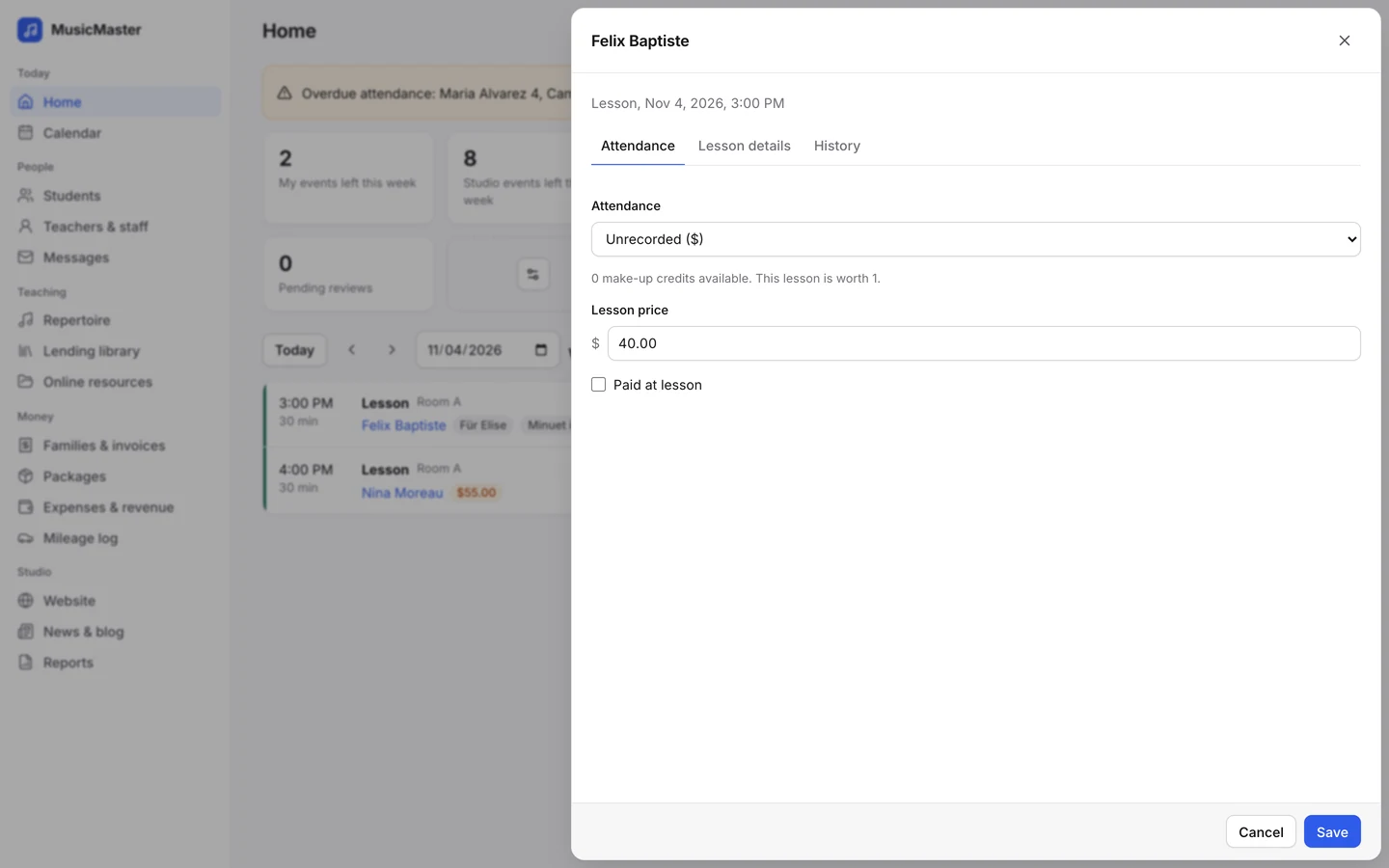
From the first lesson you need four things: a calendar, a way to send invoices, a way to take payments and a record of attendance. A spreadsheet and a paper diary work for three students, but make-up credits and partial payments get tangled quickly after that.
Studio management software puts all four in one place. Sonely, which we make, is free for one teacher with every feature and unlimited students. Weekly lessons repeat on the calendar until you stop them, attendance decides what is billed and what earns a make-up credit, and invoices go out on their own. Families pay through your own Stripe or PayPal account, and Sonely takes no cut. Stripe’s standard US price for domestic cards is 2.9% + 30¢ per successful payment, as of November 2026. Sonely for new studios shows the setup in order, including importing students from a spreadsheet.
Step 7: Put up a simple website
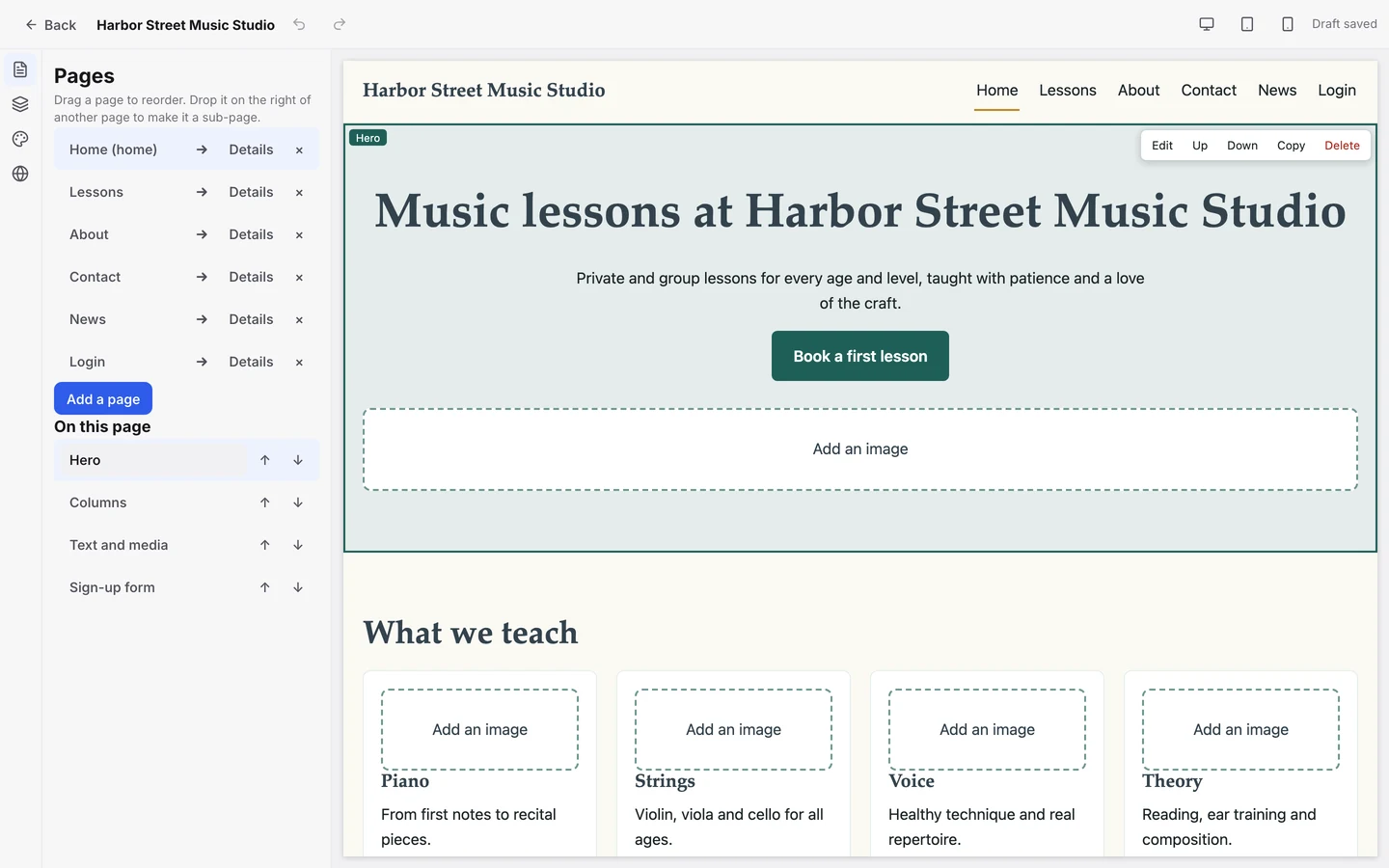
A one-page website that answers a parent’s first questions is enough to start. It should say:
- What you teach, and to which ages and levels
- Where you teach (your neighborhood, not your street address, if you travel)
- A short bio and a photo of you teaching
- Your price, or a “lessons from” price
- How to book a trial lesson, as a button rather than “email me”
Buy a domain in your studio’s name. Porkbun, for example, lists a .com at $11.81 a year for registration and renewal, as of November 2026. Sonely’s website builder is included in the free plan: five templates, your own domain, and sign-up and booking forms built in. For what to put on each page, see how to build a music teacher website.
Step 8: Find your first students
Start with people who already know you, then make it easy for strangers to find and book you. Established teachers lean on the same channels: in MTNA’s 2024 member survey, 85% of independent teachers used word of mouth to find students, 77% referrals from current students and 45% a website.
- Tell everyone: friends, family, your old teacher, your church or community groups, and parents at your children’s schools.
- Talk with each family before the first lesson, by phone or in person, to check goals and fit. In the same survey, 79% of independent teachers interviewed students before accepting them.
- Set up a free Google Business Profile so you show up in local searches.
- Offer a trial lesson, free or paid, that families can book online. Sonely’s online booking lets them pick a time from your availability and pay at booking if you charge.
- Introduce yourself to school music teachers, whom parents ask for private teacher recommendations.
- Ask every new family who else might want lessons.
How to get more music students covers each channel in detail, with flyer copy and a referral message you can use.
Step 9: Plan your first term
Plan the term on the calendar before you book a single family. It decides how many lessons you can sell and when you’ll be paid.
- Pick term dates that follow your local school calendar.
- Block holidays and breaks before you add lessons, so weekly lessons skip them.
- Set your teaching hours. School-age students need after-school times, so offer daytime slots to adults, homeschoolers and preschoolers.
- Leave five minutes between lessons for notes, water and the next student’s arrival.
- Keep a few open slots for make-ups and trial lessons.
- Pick a recital date so students have a goal from the first week.
- Send the policy, the enrollment agreement and the first invoice before the first lesson.
How much does it cost to start a music studio?
A one-teacher home studio can open for very little. If you already own your instrument, the fixed cash costs are a domain name (about $12 a year), any state filing fee and insurance; the rest grows with your students. Most of a new studio’s cost is your time.
| Item | Typical cost | Notes |
|---|---|---|
| Business registration | $0 for a sole proprietor under their own name; state fees vary | The SBA says registering usually costs less than $300 in total |
| EIN | Free | Only from IRS.gov |
| Business bank account | Varies by bank | Compare monthly fees and minimum balances |
| Liability insurance | Get quotes | Ask about a home-business rider or a business owner’s policy |
| Domain name | About $12 a year | $11.81 for a .com at Porkbun, as of November 2026 |
| Website | $0 to a monthly fee | Included in Sonely’s free plan |
| Studio software | $0 for one teacher | Sonely: $5 a month for each extra teacher, admin or staff seat |
| Card payments | 2.9% + 30¢ per payment | Stripe’s US price for domestic cards; ACH bank payments are 0.8%, capped at $5 (as of November 2026) |
| Teaching materials | Varies | Method books, printing, a metronome, stickers for young students |
| Online teaching setup | Varies | A better microphone and a second camera |
| Marketing | Varies | Flyers, business cards, a recital venue |