Quick answer
A music studio policy template is a ready-made agreement that sets out how lessons are scheduled, paid for, cancelled and made up. The free template below, also a PDF and Word file, covers tuition, late fees, make-ups, teacher cancellations, bad weather, holidays, illness, recitals, studio etiquette, photo consent and withdrawal notice. Fill in the [brackets], send it before the first lesson and have families sign the enrollment agreement.
Key takeaways
- A complete music studio policy covers thirteen topics, from tuition and late payments to make-ups, bad weather, illness, studio etiquette, photo consent and withdrawal notice.
- Ask for at least 24 hours’ notice to cancel, through one named channel, so you have time to offer the slot to another student as a make-up.
- Whatever make-up option you choose, limit it with a notice period, a maximum number of credits and an expiry date.
- Have every family sign a short enrollment agreement saying they have read the policy, and collect it again whenever the policy changes.
- Give current families at least 30 days’ notice of a new policy, then apply it from the first week.
On this page
- Why does a music studio need a written policy?
- What should a music studio policy include?
- What should you decide before writing a studio policy?
- How do you write a studio policy families will read?
- The music studio policy template
- Enrollment agreement and acknowledgment
- How do you introduce a policy to families you already teach?
- Let your studio software apply the policy
- Questions
A music studio policy is a short written agreement that tells families how lessons are scheduled, how tuition is paid and what happens when someone cancels. The music studio policy template below covers all of it and works as a piano studio policy or for any other instrument, with [brackets] where your studio’s details go, plus a one-page enrollment agreement for families to sign. Copy both, choose your make-up rules and send them before the first lesson.
Why does a music studio need a written policy?
A written policy turns the hardest conversations in teaching into rules that everyone agreed to before they mattered. When a parent texts at 3:40 to cancel a 4:00 lesson, you don’t have to decide on the spot whether to reschedule, refund or charge. The policy already says. It protects your income (tuition pays for a reserved weekly time), your week (make-ups don’t spill into evenings) and fairness (every family gets the same answer).
The Music Teachers National Association’s Code of Ethics puts it in one line: “The teacher shall clearly communicate the expectations of the studio.” A written policy, signed at enrollment, is the simplest way to do that.
What should a music studio policy include?
A complete music studio policy covers thirteen topics. Each is a numbered section in the template below.
- Lessons and scheduling: length, the weekly time, the term and lesson location.
- Tuition and payment: the price, what it pays for, due dates and payment methods.
- Late payments: the late fee and when lessons pause.
- Student cancellations and make-ups: the notice period and what a missed lesson earns.
- Teacher cancellations and bad weather: what families get when you cancel or the roads close.
- Holidays and breaks: studio closures, summer and family vacations.
- Illness: when to stay home and when a lesson moves online.
- Recitals and events: how many, whether students perform and what they cost.
- Materials and practice: books, instrument and practice expectations.
- Communication: the one channel for messages and how fast you reply.
- Studio etiquette and property: arrival, waiting siblings, shoes, studio instruments and borrowed books.
- Photo and video consent: what you share and how families opt out.
- Withdrawals and notice: how much notice to stop lessons, and refunds.
What should you decide before writing a studio policy?
Make these six decisions first, and the wording follows.
Monthly tuition or pay per lesson?
Decide how you bill first, because it changes every other section. With monthly or term tuition, families pay for a reserved weekly time, so a missed lesson does not reduce the bill. With pay per lesson, every cancellation becomes a question about money. Monthly tuition vs pay per lesson compares the two.
Music lesson cancellation policy: how much notice?
Ask for at least 24 hours, which gives you time to offer the slot to another student as a make-up. A 48-hour rule is stricter and suits studios with long waitlists. Name one channel for cancellations (a portal, an email address or a text number) so a message on social media doesn’t count as notice.
Music lesson make-up policy: what happens to a missed lesson?
This is the decision families care about most. Pick the option you can keep up for a whole year without resentment.
| Make-up option | How it works | Pros | Cons | Works best for |
|---|---|---|---|---|
| No make-ups | Tuition reserves a weekly time. Missed lessons are not rescheduled or refunded. | Protects your income and your week. Easy to apply. | Can feel strict, especially for illness. | Full studios with a waitlist |
| Make-up credits that expire | A lesson cancelled with notice earns a credit, used within a set number of days, up to a limit. | Fair to families, with a cap on your extra hours. | You track credits and keep open slots. | Private studios that want some flexibility |
| Swap list | Families trade lesson times with each other from a shared list. Your schedule stays the same. | No extra teaching hours. | Needs consent to share contact details, and enough families. | Larger studios with similar lesson lengths |
| Make-up weeks | One or two lesson-free weeks a year are set aside for make-ups. | Predictable and planned into the calendar. | Students may wait weeks for a make-up. | Teachers who prefer a fixed calendar |
| Online alternative | A student who can’t come in takes the lesson online at the usual time. | Nothing has to be rescheduled. | Not every student or instrument suits it. | Studios already teaching online |
Whatever you choose, put limits on it: a notice period, a maximum number of credits and an expiry date. Unlimited make-ups that never expire can quietly take over your week.
Late fees and payment deadlines
A late fee works best when it is small, predictable and added the same way every time. Choose a due date, a grace period, a flat fee or a percentage, and the point at which lessons pause. For scale, the published handbook of Creative Keys, a piano studio, adds $25 to a late invoice, charges $30 for a returned check and requires auto-pay after more than one late payment. If you are unsure how large a fee can be where you live, ask a local lawyer.
Bad weather: follow the schools or move online?
Decide this before the first storm, not on the morning of it. The simplest rule, and the one Music Studio Startup suggests, is to follow your local school district: when schools close for weather, so does the studio. Then say what a closure means (lessons move online at the usual time, or are credited), and how and by when you will tell families.
Photo and video consent: will you post students?
Decide whether you will share photos or videos of students at all before anyone enrolls, because the consent belongs on the form families sign. A written media release says where images may appear (your website, social media, newsletters), whether a first name goes with them, and how a family changes its mind. Section 12 of the template and the three boxes on the enrollment agreement cover all of it. Offer a clear “no”, keep a list of the students not to post, and never publish last names or schools. Rules on publishing images of children differ by state and country, so ask a local lawyer before you post publicly.
How do you write a studio policy families will read?
Write it for a parent reading on a phone between drop-offs: numbered sections, one rule per line and a number in every rule. A clear policy is what lets you apply it calmly, because the wording does the explaining.
- Open with a short welcome. Two or three sentences on what families get (a reserved weekly time, planned lessons, recitals) and why the rules exist, so the policy reads as how the studio works, not as a list of penalties. The “About the studio” line at the top of the template is the place for it.
- Put money and missed lessons first. Tuition, late payments, cancellations and make-ups are what families ask about and what disputes are about, which is why they are sections 2 to 4.
- Write numbers, not judgment words. “At least 24 hours before the lesson” can be applied the same way to every family; “reasonable notice” can’t.
- Use the same words everywhere. If the policy says “make-up credit”, your invoices, emails and calendar should say it too, not “lesson credit” in one place and “rain check” in another.
- Keep what needs a signature separate from what is good to know. Rules about money and notice go in the policy and the signed agreement. Parking, the waiting area and what to bring can also go in a welcome email.
- Test it against last year’s questions. Read the texts and emails families sent you. Any question that came up twice deserves its own line, and any rule you keep explaining case by case is worded too vaguely.
The music studio policy template
Copy the policy into Word or Google Docs, or download the Word file under it, ready to edit. Replace everything in [brackets] and delete what you don’t use, then save it as a PDF to send and print. Would you rather fill it in by hand? The printable PDF has lines in place of the brackets. Section 4 uses make-up credits that expire. For another make-up rule, swap in one of the alternative clauses below it (the Word file has them on its last page).
This template is a practical starting point, not legal advice. If you have questions about contracts, fees or consent where you teach, ask a local lawyer to review your final version.
[STUDIO NAME] STUDIO POLICY
[Term or school year, for example September 2026 to June 2027]
Teacher: [Your name] | [Email] | [Phone] | [Website]
About the studio: [One or two sentences on who you teach and how, for example “Piano lessons for students aged 6 to adult, built on reading, technique and music they love.”]

1. LESSONS AND SCHEDULING
- Lessons are [30 / 45 / 60] minutes, once a week, at a regular time agreed at enrollment.
- The [term / school year] runs from [start date] to [end date] and includes [number] lessons. The studio calendar, with holidays and breaks, is at [link].
- Lessons take place at [address / online through [platform]].
- A lesson that starts late because of a late arrival still ends at the scheduled time.
- Students under [age] are dropped off and picked up by an adult, no more than [5] minutes before or after the lesson.

2. TUITION AND PAYMENT
- Tuition is [$amount] per [month / term / lesson].
- [Monthly tuition is the year’s total divided into [number] equal payments.]
- [Tuition reserves a weekly lesson time for your student and is not reduced for lessons the student misses.]
- Tuition pays for lesson time and for the work around it: lesson planning, [recital costs], [studio materials], instrument upkeep and the studio’s running costs.
- A registration fee of [$amount] is due at enrollment [and each year on [date]]. It covers [materials / recital costs / administration] and is not refundable.
- Invoices are sent on the [day] of each [month / term] and are due by the [day].
- We accept [card / bank payment / PayPal / check / cash]. [Families on auto-pay are charged on the due date.] [A convenience fee of [amount or %] applies to card payments.]
- [Siblings receive a [number]% discount on each additional student’s tuition.]

3. LATE PAYMENTS
- Payments received after the [day] are late, and a late fee of [$amount] is added once per invoice.
- If an account is more than [number] days overdue, lessons pause until it is paid, and the weekly time may be offered to another student.

4. STUDENT CANCELLATIONS AND MAKE-UP LESSONS
- To cancel, please tell us at least [24] hours before the lesson through [the family portal / email / text to [number]]. Other channels do not count as notice.
- A lesson cancelled with at least [24] hours’ notice earns one make-up credit. Lessons cancelled with less notice, and lessons missed without notice, are not made up or refunded.
- Make-up credits must be used within [60] days. A student can hold up to [2] credits at a time and earn up to [number] per [term / year].
- Make-up lessons are booked into open times on the studio calendar. A missed make-up is not rescheduled.
- Credits have no cash value and are not refunded when a student withdraws.

5. TEACHER CANCELLATIONS AND BAD WEATHER
- If [the teacher / the studio] cancels a lesson, you will be offered a make-up lesson[, a substitute teacher] or a credit of [the lesson price] on your next invoice.
- We will give at least [24] hours’ notice, except in an emergency.
- When [school district] closes schools for weather, the studio closes too. Lessons that day [move online at the usual time / are made up or credited as in the first point].
- Weather closures are announced by [text / email / the family portal] by [time] on the day.

6. HOLIDAYS AND BREAKS
- The studio is closed on [holidays and breaks]. These dates are on the studio calendar and already accounted for in tuition.
- [Summer lessons are [optional / needed to keep your weekly time for the fall] and are scheduled [flexibly / as a package of [number] lessons].]
- Family vacations do not reduce tuition. Please tell us [two weeks] ahead so your time can be offered as a make-up to another student.

7. ILLNESS
- Please do not come to a lesson with a fever, a contagious illness or new symptoms.
- If the student is well enough to play but should stay home, the lesson can move online at the usual time with [one hour’s] notice.
- Lessons missed for illness follow the make-up rules in section 4. [The notice period is waived for sudden illness once per term.]

8. RECITALS AND EVENTS
- The studio holds [number] recitals a year, in [months]. Students are [encouraged / expected] to perform.
- A recital fee of [$amount] covers [the venue, accompanist and programs] and is added to the [month] invoice.
- [Festivals, exams and competitions have their own entry fees.]

9. MATERIALS AND PRACTICE
- Students need [method books / a notebook / a metronome / an instrument in good working order] by the first lesson.
- [Books are ordered by the studio and added to your next invoice at cost. / Families buy books from [store or link].]
- [Piano students need a tuned acoustic piano, or a full-size digital piano with weighted keys and a sustain pedal, at home.]
- Students are expected to practice [number] days a week for about [number] minutes.

10. COMMUNICATION
- The best way to reach the studio is [email / text / the family portal]. Messages are answered within [one business day], not during lessons or after [time].
- Reminders and news are sent by [email / text / the family portal]. Please keep your contact details up to date.
- To talk about progress or concerns, please ask for a call rather than using another student’s lesson time.

11. STUDIO ETIQUETTE AND PROPERTY
- Please park [where], and wait [in the waiting area / in the car] until the lesson before yours has finished.
- [Siblings may wait quietly in [the waiting area] with an adult. / Please do not bring siblings into lessons.]
- [Please remove shoes and wash hands before playing.] Phones are silenced during lessons.
- Food and drink stay [in the waiting area / outside the studio], except water in a closed bottle.
- Studio instruments, equipment and lending-library books are handled with care. Lost or damaged items are [replaced / charged at replacement cost].
- Copyrighted music is not photocopied for students, except as the law allows.

12. PHOTO AND VIDEO CONSENT
- The studio sometimes takes photos and videos at lessons and recitals for [the studio website / social media / newsletters].
- On the enrollment form you choose whether your student may appear, and with or without their first name.
- You can change your choice at any time by writing to [email]. We never share students’ last names or schools online.
- Families may record their own child at recitals for personal use, and should not post other students without their parents’ permission.

13. WITHDRAWALS AND NOTICE
- Please give [30 days’ / one month’s] written notice to stop lessons. Tuition is due for the notice period, whether or not lessons are attended.
- [Registration fees and lesson packages are not refundable. / Prepaid lessons not yet taught are refunded.]
- The studio may end lessons with [number] days’ notice, for example if tuition is unpaid or this policy is not followed, and will refund prepaid lessons not yet taught.

14. CHANGES TO THIS POLICY
- This policy is reviewed every [year / term]. Any change is sent in writing at least [30] days before it takes effect.
Alternative make-up clauses
Replace the bullets in section 4 with one of these if you chose a different make-up option.
NO MAKE-UPS
- Tuition reserves a weekly lesson time for your student, and that time is held whether or not the lesson is attended. Missed lessons are not made up, credited or refunded. Lessons cancelled by the teacher are always made up or credited.

SWAP LIST
- If you can’t make your lesson, you may trade times with another family on the studio swap list. Please arrange the swap yourselves and tell the teacher at least [24] hours before both lessons. Families who join the swap list agree to share their name and contact details with other families on it.

MAKE-UP WEEKS
- Lessons cancelled with at least [24] hours’ notice are made up during the studio’s make-up weeks, [dates]. Make-up lessons are booked in the order cancellations were received. Lessons not made up during make-up week are not credited or refunded.
Enrollment agreement and acknowledgment
Ask every family to sign a short enrollment agreement saying they have read the policy. It collects the details you need and records each family’s photo choice in one place. Collect it at enrollment and again whenever the policy changes, and keep the signed copies with each student’s records.
Have it signed and dated by the adult who pays for lessons, or by the student if they are an adult, so it is clear who agreed. For the lines most disagreements are about (tuition isn’t reduced for missed lessons, the cancellation notice and the withdrawal notice), some teachers also ask families to initial each one in the policy itself. If you want a formal contract rather than a policy and an acknowledgment, have a lawyer draft it: a contract usually adds legal clauses this template leaves out.
[STUDIO NAME] ENROLLMENT AGREEMENT

Student name: ______________________   Age: _____   Instrument: ______________
Parent or guardian (if the student is under 18): ______________________
Email: ______________________   Phone: ______________________
Emergency contact and phone: ______________________
Allergies or medical notes the teacher should know: ______________________

Lesson length: [30 / 45 / 60] minutes   Day and time: ______________
Tuition: [$amount] per [month / term]   First lesson: ______________

Photo and video consent (choose one):
[ ] Yes, photos and videos may be shared with my student’s first name
[ ] Yes, but without my student’s name
[ ] No photos or videos of my student may be shared

I have read the [Studio name] Studio Policy dated [date] and agree to follow it, including its tuition, cancellation, make-up and notice terms. I understand that tuition reserves a weekly lesson time and is not reduced for lessons my student misses.

Parent or adult student signature: ______________________   Date: ___________
Printed name: ______________________
Student signature (age [12] and up): ______________________   Date: ___________
Teacher signature: ______________________   Date: ___________
A student who signs too is more likely to own the practice and arrival rules. Your own signature turns the page into a two-way agreement: you commit to the teacher-cancellation and notice terms as well.
How do you introduce a policy to families you already teach?
Give current families the notice your policy promises, and explain the change before you enforce it.
- Send it at least 30 days ahead, at a natural break such as a new term.
- Lead with what changed and why, in two plain sentences: “Starting in January, make-up credits expire after 60 days so every family can find an open time.”
- Ask for the signed agreement by a date, as a condition of keeping the weekly time.
- Apply it from the first week. The first exception you make becomes the new policy in families’ minds.
- Review it once a year, answering the questions families asked in the next version.
Let your studio software apply the policy
A policy only works if you apply it the same way every time. In Sonely, the attendance statuses match the choices above: Absent, notice given takes the charge off, Absent, no make-up ($) bills the lesson, and Absent, issue make-up ($) bills it and gives the student a credit. Credits can expire after the number of days you choose, and you can limit how many credits cancellations in the portal can earn. See attendance and make-up credits.
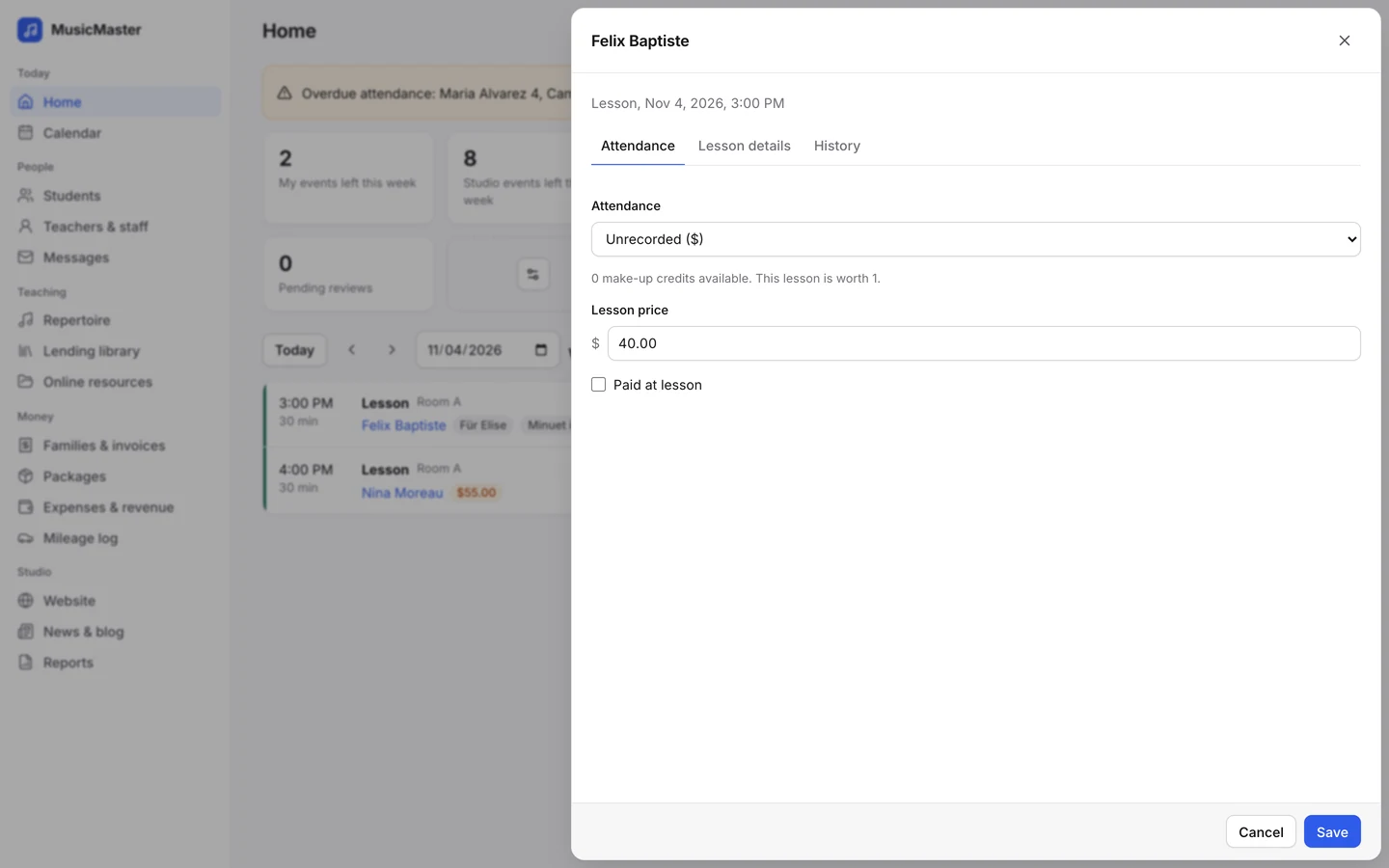
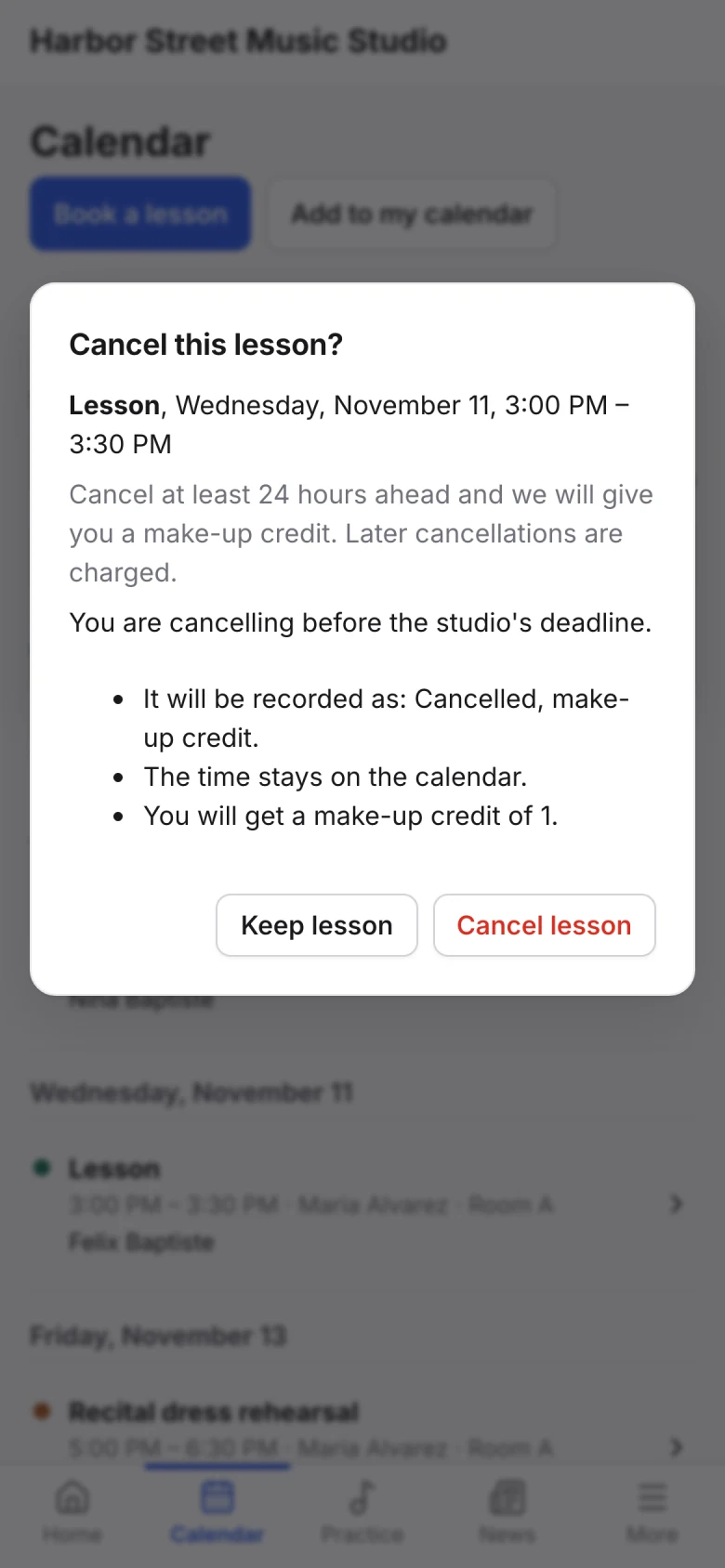
If you allow it, families cancel in the family portal and see your policy, and what will happen, before they confirm.
Late fees, a fixed amount or a percentage, are added once an invoice is a set number of days overdue. Signed agreements can go in each student’s Attachments tab, so the copy is with the student, not in a drawer. Sonely is free for one teacher, with every feature.
For recording each case day to day, see tracking attendance, cancellations and make-ups. Still setting up? How to start a music studio puts the policy in order with everything else, and how to plan a studio recital covers section 8.