Quick answer
A balance forward is the amount left over from your last bill that carries into the new one. It is the previous balance minus the payments and credits since. A positive balance forward means you still owe that money, and it is added to the new charges. A negative one is a credit that lowers what you owe now.
Key takeaways
- A balance forward is the amount carried from one billing period into the next: the last bill’s balance minus the payments and credits received since.
- Previous balance $300, payment $200 and new charges $180 make a balance forward of $100 and an amount due of $280.
- A negative balance forward is a credit, and federal credit card rules say a credit balance must be shown so you can tell it isn’t money owed.
- Balance forward billing rolls everything into one running amount, while open-item billing matches each payment to a specific invoice.
- To check a balance forward, compare it with your last bill and your payments, then ask the billing office for an itemized list if the numbers don’t match.
On this page
- What does balance forward mean in accounting?
- What does balance forward mean on a bill?
- How is a balance forward calculated? A worked example
- What if the balance forward is a credit?
- Balance forward billing vs open-item billing: what is the difference?
- How is a statement different from an invoice?
- What should you do if your balance forward looks wrong?
- How should music teachers show a balance forward on lesson invoices?
- Questions
Balance forward means the amount left over from your last bill that has been carried into the current one. It is your previous balance minus any payments and credits received since. If the number is positive, you still owe it, and it is added to this period’s new charges to make the amount due. If it is negative, it is a credit that lowers what you owe. If you paid your last bill in full before it closed, your balance forward is $0.
What does balance forward mean in accounting?
In accounting, a balance forward is the closing balance of one period that becomes the opening balance of the next. Rentec Direct defines it as “the balance on an account or ledger as of the end of one reporting period,” which then becomes the starting balance for the next period. Stripe puts it more simply: “A balance forward is the amount that carries over from one billing period to the next.”
The verb behind it is carry forward. In the American Heritage idiom quoted on Dictionary.com, to carry forward is to “transfer a bookkeeping entry to the next column, page, another account, or the next accounting period.” Collins, on the same page, gives the accounting sense as “to transfer (a balance) to the next page, column, etc.” A bookkeeper carries the balance forward, and the new page or statement opens with it.
The same idea shows up anywhere an account runs from month to month: a bank ledger, a rent ledger, a credit card, a utility account, a school account or a family’s music lesson account. The label changes from biller to biller. Stripe notes that it is often printed as “balance forward” or “previous balance.”
What does balance forward mean on a bill?
On a bill, the balance forward is the part of your total that comes from earlier bills rather than from this period. Most bills build the amount due in the same order:
- Previous balance: what the last bill said you owed.
- Payments and credits: what you paid, and anything the biller credited, since that bill.
- Balance forward: the previous balance minus those payments and credits.
- New charges: what you used or bought this period.
- Amount due: the balance forward plus the new charges.
Utility bills show this plainly. Phoenix’s sample City Services bill has an account summary that, in the city’s words, “provides a quick summary of your previous balance, recent charges, payments and total amount due,” with lines for Previous balance, Payments received, Balance forward and Current charges. The City of Cotati describes its Balance Forward line as showing “any outstanding balance on the account,” and says that “the total due will include any balance forward and the current billing cycle.”
Credit card statements follow federal rules on this. Regulation Z, which the Consumer Financial Protection Bureau (CFPB) publishes, defines the previous balance on a card statement as “the account balance outstanding at the beginning of the billing cycle.” The statement must also list credits to the account during the cycle, with dates, and the balance on the closing date. Those rules cover credit cards and other open-end credit. Medical, school and lesson bills set their own formats, but most follow the same logic.
A balance forward isn’t a fee or a penalty in itself. It is money that was already on the account. A late fee is a separate charge: Phoenix, for example, says accounts with past-due balances “will incur a 3% Late Payment Fee.”
How is a balance forward calculated? A worked example
Here is a balance forward on a music lesson invoice. The Rivera family’s September invoice was $300.00. They paid $200.00 on September 28. Their October invoice adds four weekly lessons and a recital fee.
| Invoice line | Amount | What it means |
|---|---|---|
| Previous balance (September invoice) | $300.00 | What the last invoice said was due |
| Payment received, September 28 | −$200.00 | Money paid since that invoice |
| Balance forward | $100.00 | Still unpaid from September |
| October tuition: 4 lessons, 30 minutes | $160.00 | New charges for this period |
| Fall recital fee | $20.00 | New charges for this period |
| Amount due | $280.00 | Balance forward plus new charges |
The arithmetic is always the same: previous balance − payments and credits = balance forward, then balance forward + new charges = amount due. Here that is $300 − $200 = $100, and $100 + $160 + $20 = $280.
Notice what the October invoice doesn’t do. It doesn’t list the September lessons again. Stripe describes this as the point of a balance forward: older activity is summarized in one carried amount, so the new invoice stays short.
What if the balance forward is a credit?
A balance forward can be negative. That means the account is in credit: you paid more than you owed, or the biller credited your account, for example after a cancelled service or a billing correction.
Suppose the Rivera family had paid $320.00 against the $300.00 September invoice. Their October invoice would look like this:
| Invoice line | Amount |
|---|---|
| Previous balance (September invoice) | $300.00 |
| Payment received, September 28 | −$320.00 |
| Balance forward (credit) | −$20.00 |
| October tuition: 4 lessons, 30 minutes | $160.00 |
| Amount due | $140.00 |
A credit should never look like a debt. Regulation Z’s official commentary says that when a card’s previous balance is a credit, it “must be disclosed in such a way so as to inform the consumer that it is a credit balance, rather than a debit balance.” Outside of credit cards, that is still good practice: write the word “credit,” or use a minus sign and say what it means.
What happens to the credit is the biller’s call. Hiveage lists three common options for a negative balance forward: apply it as a credit on the next invoice, refund it to the customer’s bank account, or issue a negative charge against the next bill. If you would rather have the money back, ask.
Balance forward billing vs open-item billing: what is the difference?
Balance forward billing keeps one running account and carries whatever is unpaid into each new bill. Open-item billing keeps every invoice separate and matches each payment to the invoice it pays.
Oracle’s utility billing documentation draws the line clearly. With open items, “payments are matched to bills and only unpaid bills and adjustments (i.e., open items) affect aged debt.” With balance forward, “payments are not matched to bills,” and they “implicitly relieve a customer’s oldest debt.” Infor’s documentation says the same thing from the customer’s side: under balance forward processing, customers pay the total outstanding balance rather than individual transactions.
| Balance forward billing | Open-item billing | |
|---|---|---|
| What each bill shows | One carried balance plus this period’s charges | Each unpaid invoice as its own line |
| Where a payment goes | Against the oldest unpaid amount | Against the invoice the payer chooses |
| Bill length | Stays short | Grows as unpaid invoices pile up |
| Disputes | One disputed charge can hold up the whole balance | The rest can be paid while one item is disputed |
| Best for | Ongoing, recurring accounts | One-off sales and payers who approve each invoice |
Stripe sums up the fit: balance forward “tends to work best for ongoing, recurring billing relationships,” and open-item billing “fits transactional or approval-driven payment environments.” It also notes the main drawback of balance forward: it is harder for customers who regularly pay some charges but not others.
Which one suits a music studio?
For most lesson studios, balance forward is the natural fit. Families come every week, you bill every month, and one running account per family is easier for everyone to follow. A parent sees one number to pay, and anything they missed is on the next invoice instead of on a forgotten one.
Open items make more sense in a few cases:
- Someone else pays some charges. A grandparent covers summer camp, or a school or employer reimburses a specific invoice and needs it on its own.
- A family disputes one charge. With open items they can pay the lessons while you sort out the disputed fee.
- One-off students. An adult who books a single lesson or a short package doesn’t need a running account.
You can run both. Bill weekly families with a balance forward, and send a separate, standalone invoice when a payer needs one. Whatever you choose, write it into your studio policy so families know what to expect.
How is a statement different from an invoice?
An invoice asks for payment for specific charges. A statement summarizes an account over a period. AccountingTools puts it this way: an invoice identifies “a transaction for which the customer owes payment to the issuer,” while “a customer statement summarizes activity in a customer’s account during a specified period.” Invoices go out after each sale; statements are issued at set intervals, such as month-end.
A statement of account, per AccountingTools, usually contains:
- the beginning balance of unpaid invoices,
- each invoice issued in the period, with its number, date and amount,
- each credit and each payment received,
- the ending balance, and
- often an aging of what’s unpaid, in buckets such as 0–30, 31–60, 61–90 and 90+ days.
AccountingTools also warns that “it can be unwise to treat a statement as an invoice and pay items listed on the statement,” because some items may already be paid.
A balance forward invoice mixes the two. Like a statement, it opens with what was carried in and shows the payments since. Like an invoice, it lists this period’s charges and asks for a total by a due date. That is why most utility bills and most music lesson invoices take this form: one document tells the family both where the account stands and what to pay now.
What should you do if your balance forward looks wrong?
Most balance forward surprises come from timing, such as a payment that arrived after the old bill closed. Some are real errors. Work through these steps in order.
- Find your last bill. The CFPB’s guide to fixing credit card mistakes starts here: “Compare your starting balance with the previous month’s bill.” The previous balance on the new bill should match the total on the old one.
- List what you paid since. Check your bank or card records for every payment after the old bill’s date. Previous balance minus those payments should equal the balance forward.
- Check the dates. A bill counts activity up to its closing date. A credit card statement, for example, shows the balance on that closing date under Regulation Z. A payment made after that date will appear on the next bill, not this one.
- Call the billing office. For medical bills, the CFPB says to “talk to the accounting or billing office of your provider,” whose number is on the statement. The same works for any biller.
- Ask for an itemized list. The CFPB’s medical bill guidance says: “If something doesn’t look right, ask for an itemized list of charges.” Look for the same service billed twice.
- Put a credit card dispute in writing. The CFPB says to send a written notice “no later than 60 days after the credit card company sent the statement where the error first appeared,” using the dispute address on your bill, which may differ from the payment address. You don’t have to pay the disputed amount during the investigation, but you still have to pay the correct charges on time. Keep a copy of your letter.
Move quickly either way. The CFPB notes that resolving a medical bill fast helps you avoid late fees and interest, and the same is true of any account that carries a balance forward.
How should music teachers show a balance forward on lesson invoices?
Parents read a lesson invoice in a few seconds. A balance forward confuses them only when it appears without explanation. Build every invoice so the carried amount explains itself.
- Use the words families know. “Previous balance” is clearer to most parents than “balance forward” or “brought forward.”
- Show the arithmetic. Put the previous balance, each payment received with its date, then the new charges and the total due, in that order, like the worked example above.
- Name each new charge. One line per student and item, such as “October tuition: Ava, piano, 30 min weekly,” so siblings’ lessons are easy to tell apart.
- Mark credits as credits. Write “credit” next to a negative amount, and say whether it comes off this invoice or will be refunded.
- Keep the invoice dates regular. Bill on the same day each month, so a payment made just after an invoice reliably shows on the next one.
- Put a note on the first carried balance. A short sentence such as “Includes $100 unpaid from September” heads off most questions.
- Be consistent. Show the previous balance on every invoice, even when it is $0.00, so families get used to where to look.
For what else belongs on a lesson invoice, from due dates to late fees and sibling discounts, see how to bill for music lessons.
If you use Sonely, a carried balance works like this. Each invoice, including automatic invoices, has an Include previous balance and payments option, which is on by default. With it on, the invoice adds a Previous balance line: what the family owed at the end of the day before the invoice’s dates begin. The invoice then lists the charges, discounts and payments dated within its dates, and the total due is the previous balance plus those lines. Siblings share one family account, so all their lessons add up on one invoice.
When a family has paid more than it owes, its account in Sonely is marked as a credit, and the next invoice that includes the previous balance subtracts it. You choose how an invoice with a negative total reads: $0 due, the default, or Balance remaining with the credit amount printed. An invoice is a fixed snapshot once it is made. If you change a charge or a lesson’s attendance afterward, the invoice already sent stays as it was, and the correction reaches the family through the next invoice’s previous balance. Families can see and pay their invoices in the family portal.
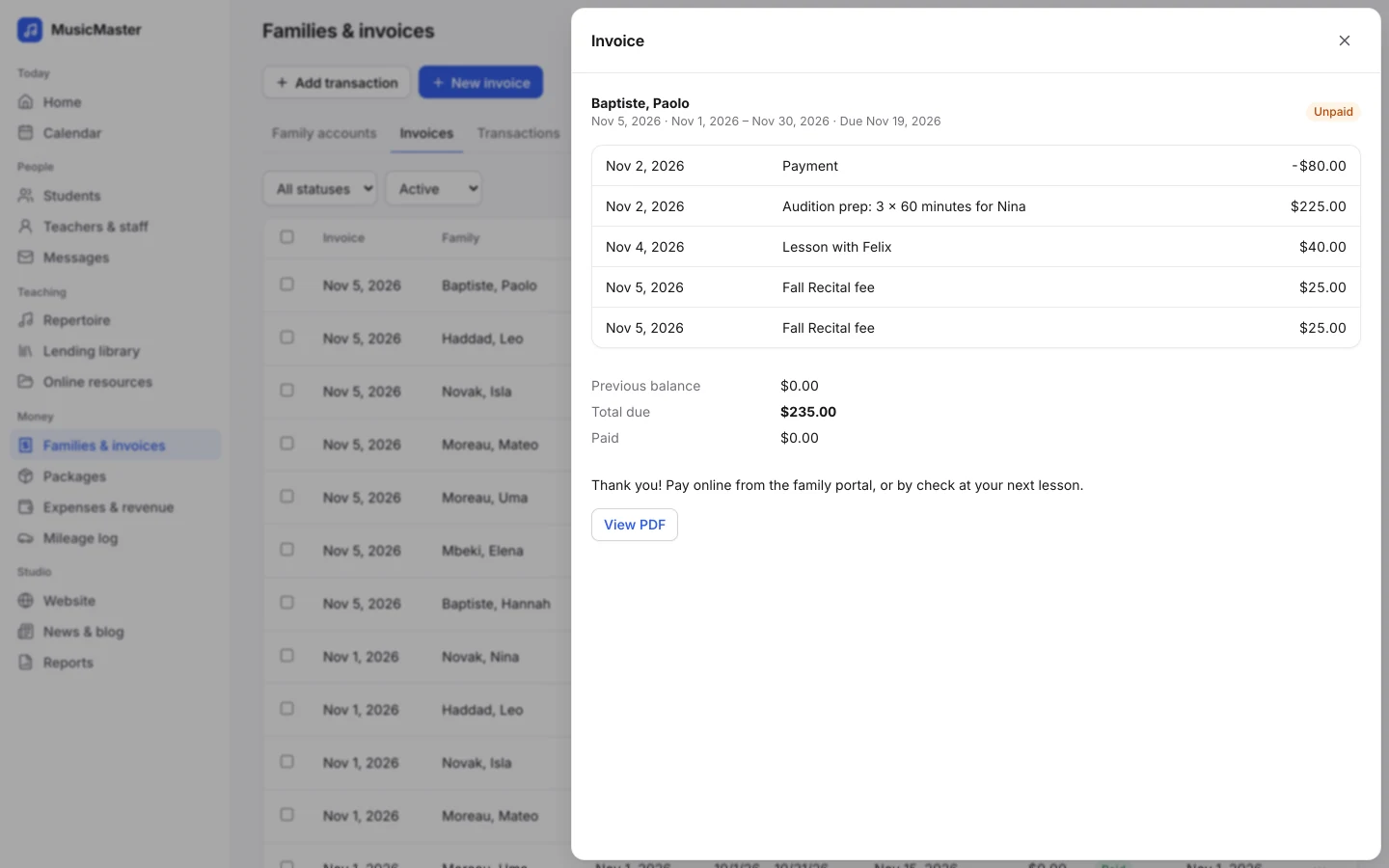
Whatever tool you use, check one invoice by hand each month: last invoice’s total, minus payments, plus new charges. If that matches the total due, your families will see a balance forward that makes sense.