Quick answer
For weekly students, monthly tuition usually works best: add up the year’s lessons, multiply by your rate and divide into equal monthly payments collected by autopay. Pay per lesson suits adults with irregular schedules, and packages suit flexible students. Put a registration fee, a small late fee and any sibling discount in your policy, and encourage bank payments, which cost far less to process than cards.
Key takeaways
- For weekly students, monthly tuition works best: count the lessons in your year, multiply by your rate and divide into equal monthly payments collected by autopay.
- At $40 a lesson and 38 lessons a year, tuition is $1,520: $126.67 a month over 12 months or $152 over 10.
- Prorate a mid-month start by lessons, not days, charging the per-lesson value of tuition for each lesson left in the month.
- Published registration fees run from $20 to $50, and MacPhail and the University of Georgia program each charge a $25 late fee.
- On a $170 tuition payment, Stripe charges $5.23 for a card and $1.36 for an ACH bank debit, at its published US rates.
On this page
- How to bill for music lessons in 6 steps
- Monthly tuition vs pay per lesson: which is better?
- How to bill for music lessons with monthly tuition
- How to prorate tuition for a mid-month start
- How to switch your studio to monthly tuition
- Should you charge a registration fee?
- Late fees for music lessons
- How to give a sibling discount
- Card vs bank payments: what do processing fees cost?
- Should you add a convenience fee?
- Autopay for music lessons
- What tools can you use to bill for music lessons?
- Music lesson invoice template
- Questions
How to bill for music lessons depends on how often each student comes. Bill weekly students with monthly tuition: count the lessons in your year, multiply by your rate, divide into equal monthly payments and collect them by autopay. Charge pay-per-lesson only for students who don’t come every week, such as adults with shifting schedules, and sell packages to students who want flexibility. Whatever you choose, write it into your policy with your registration fee, late fee and discounts, so every family is billed the same way.
How to bill for music lessons in 6 steps
- Pick a billing model for each kind of student: monthly tuition for weekly students, packages or pay per lesson for adults with changing schedules (compare the models).
- Set the tuition: count the lessons in your year, multiply by your rate and divide by the number of payments (worked example).
- Write your fees into the studio policy: a registration fee, a late fee, any sibling discount and what a missed lesson costs.
- Choose how families pay: bank payments cost far less than cards (fee table), and autopay means nobody has to remember.
- Send each invoice before the lessons it covers, with the items, the due date and how to pay (invoice template).
- Keep attendance, so make-up credits and late cancellations show up on the next invoice.
Monthly tuition vs pay per lesson: which is better?
Monthly tuition is better for most weekly students because it pays for the time you reserve, not for each lesson that happens. With pay per lesson, every cancellation becomes a question about money and your income moves with attendance. Here is how the common models compare.
| Model | How it works | Your income | Missed lessons | Real example |
|---|---|---|---|---|
| Pay per lesson | Families pay for each lesson, before or at it | Rises and falls with attendance | Each cancellation is a negotiation | A Manhattan piano teacher in Thumbtack’s 2020 guide charges $65 for ongoing students and $80 for a one-off lesson |
| Monthly flat tuition | A year’s lessons divided into equal monthly payments | The same every month | Handled by your make-up policy | Community Music School of Springfield: 35 lessons in 10 autopayments, $170 a month for 30 minutes |
| Semester or annual tuition | One price per term, often in installments | Large payments at term start | Make-up week or credits | Community School of Music and Arts: $1,179 for a fall 2026 semester of 30-minute lessons, in up to 4 installments |
| Packages | A prepaid block of lessons used within a set time | Up front but irregular | Lessons are used when taken | A guitar studio on Thumbtack sells five 30-minute lessons for $100 |
| 28-day blocks | Four lessons billed every 28 days until cancelled | Steady, like a subscription | 24 hours’ notice; unused lessons expire after 90 days | Guitar Center and Music & Arts |
You can run two models side by side: monthly tuition for children on a weekly slot, and packages or pay per lesson for adults. Thumbtack’s guide to children’s guitar lessons says packages typically save families 10% to 20% per lesson, a reasonable trade for the commitment you get.
How to bill for music lessons with monthly tuition
Monthly tuition is your per-lesson rate times the lessons in your year, divided by the number of payments. It is the same every month, so families don’t pay more in a month with five lessons.
- Count the lessons in your teaching year on the calendar, leaving out holidays and breaks. Say 38.
- Multiply by your per-lesson rate. At $40 for 30 minutes, 38 × $40 = $1,520 a year.
- Divide by the payments. Over 12 months that is $126.67 a month; over 10 months, September to June, $152.
- Publish the calendar with the tuition, so families can see that a four-lesson month and a five-lesson month cost the same.
Pick whole-dollar tuition where you can. Rounding $126.67 to $127 is simpler for families and for your records. Our free music lesson tuition calculator runs these steps with your own numbers, adds a sibling discount and a registration fee, and writes the tuition line to send families. To choose the per-lesson rate itself, see how much to charge for music lessons, or work it out from your costs with the lesson rate calculator.
How to prorate tuition for a mid-month start
Prorate by lessons, not days: charge the per-lesson value of the tuition for each lesson left in the month. With the tuition above, each lesson is worth $40 ($1,520 ÷ 38). A student who joins with two lessons left in October pays $80 for October and full tuition from November.
Avoid prorating by the month’s own lesson count (two of four lessons is half of $126.67, or $63.33). Because monthly tuition averages the year, that method gives a different price for the same lesson depending on the month. The tuition calculator prorates by lessons for you: give it a first lesson date and it counts the lessons left that month.
Use the same rule in reverse when someone leaves. Ask for written notice, such as 30 days, and bill to the end of it. Schools set firm rules here: the University of Georgia Community Music School charges a student who withdraws mid-semester for all lessons received, including ones they cancelled, plus a $50 administrative fee.
How to switch your studio to monthly tuition
Switch at a natural break, such as September or January, and tell families at least 30 days ahead. A change of billing lands better when the lesson time, teacher and rate stay the same.
- Pick the start date and count the lessons from then to the end of your teaching year.
- Set the monthly amount with the steps above, rounded to whole dollars.
- Update the studio policy: what tuition covers, the make-up rule, why five-lesson months cost the same and how to stop lessons.
- Tell families in person, then in writing, with the policy attached. Give the reason once: their weekly time is reserved for them, and the bill is the same every month.
- Collect a saved card or bank account before the first tuition date, so autopay works from the first invoice.
- Check the count halfway through the year. If you have taught fewer lessons than tuition covers, schedule the missing ones before the year ends.
An announcement you can adapt:
Subject: Monthly tuition from [month]

Dear [Parent name],

Starting [date], the studio is moving from paying per lesson to monthly tuition. [Student name]’s [length] lesson on [day] at [time] stays exactly the same.

How it works:
- Tuition covers [number] lessons from [start date] to [end date], in [number] equal payments of [$amount].
- You pay the same amount every month, including months with five lessons. Every lesson and break is on the studio calendar: [link]
- Missed lessons: [your rule, e.g. "cancel 24 hours ahead and you get a make-up credit"].
- The first invoice goes out on [date]. You can save a card or bank account for autopay here: [link]

The change reserves [Student name]’s time every week and saves us both from counting lessons each month. The updated studio policy is attached.

If you have any questions, reply to this email or catch me after a lesson.

Warmly,
[Your name]
[Studio name]
Should you charge a registration fee?
A registration fee covers the work of setting up a new student and holds the place. Published fees are modest:
| Program | Registration fee |
|---|---|
| Community School of Music and Arts (California) | $20, non-refundable |
| University of Georgia Community Music School | $25 for new private-lesson students, non-refundable |
| Music & Arts stores | $30 one-time, per new student |
| Community Music School of Springfield (Massachusetts) | $50 per family, waived for early re-enrollment |
| A piano academy in Thumbtack’s piano guide | $25 a year per student, $35 per family |
Charging per family keeps siblings from paying twice, and waiving the fee for early re-enrollment, as Springfield does, gives families a reason to commit to next year early. In Sonely you can take a registration fee on your sign-up form when a family enrolls.
Late fees for music lessons
A late fee works when it is small, written in your policy and applied the same way every time. Examples from published policies:
- MacPhail Center for Music: $25 for payments received after the payment-plan deadline, and $25 for a returned check.
- University of Georgia Community Music School: $25 on balances not paid by the due date; lessons are discontinued when payment is two weeks late.
- Dr. Kim Piano Academy in San Diego (in Thumbtack’s piano guide): $15 for each month paid after the 7th, and $20 plus bank charges for a returned check.
Give a short grace period, send a reminder before the fee applies and say when lessons pause. If you are unsure how large a late fee can be where you teach, ask a local lawyer. In Sonely, late fees are a fixed amount or a percentage of what’s unpaid, added once when an invoice is a set number of days overdue, and overdue reminders go out by email and text.
How to give a sibling discount
A sibling discount is a fixed amount or a small percentage off the second and later children in a family. Published examples:
| Program | Sibling discount |
|---|---|
| University of Georgia Community Music School | $20 off tuition per child per semester, only when both children take private lessons |
| Rowan University Community Music School | 5% off lesson tuition for multiple siblings on lesson packages |
| A Broomfield, Colorado guitar teacher on Thumbtack | $100 instead of $120 for four lessons when a family member is already enrolled |
Apply it to the lower-priced student, name it on the invoice and write it into the studio policy so it is never a favor you can’t take back. A fixed dollar amount is easier to explain than a percentage, and it doesn’t grow when you raise rates. In Sonely, siblings share one family account, their lessons add up on one invoice, and a discount comes off the same balance.
Card vs bank payments: what do processing fees cost?
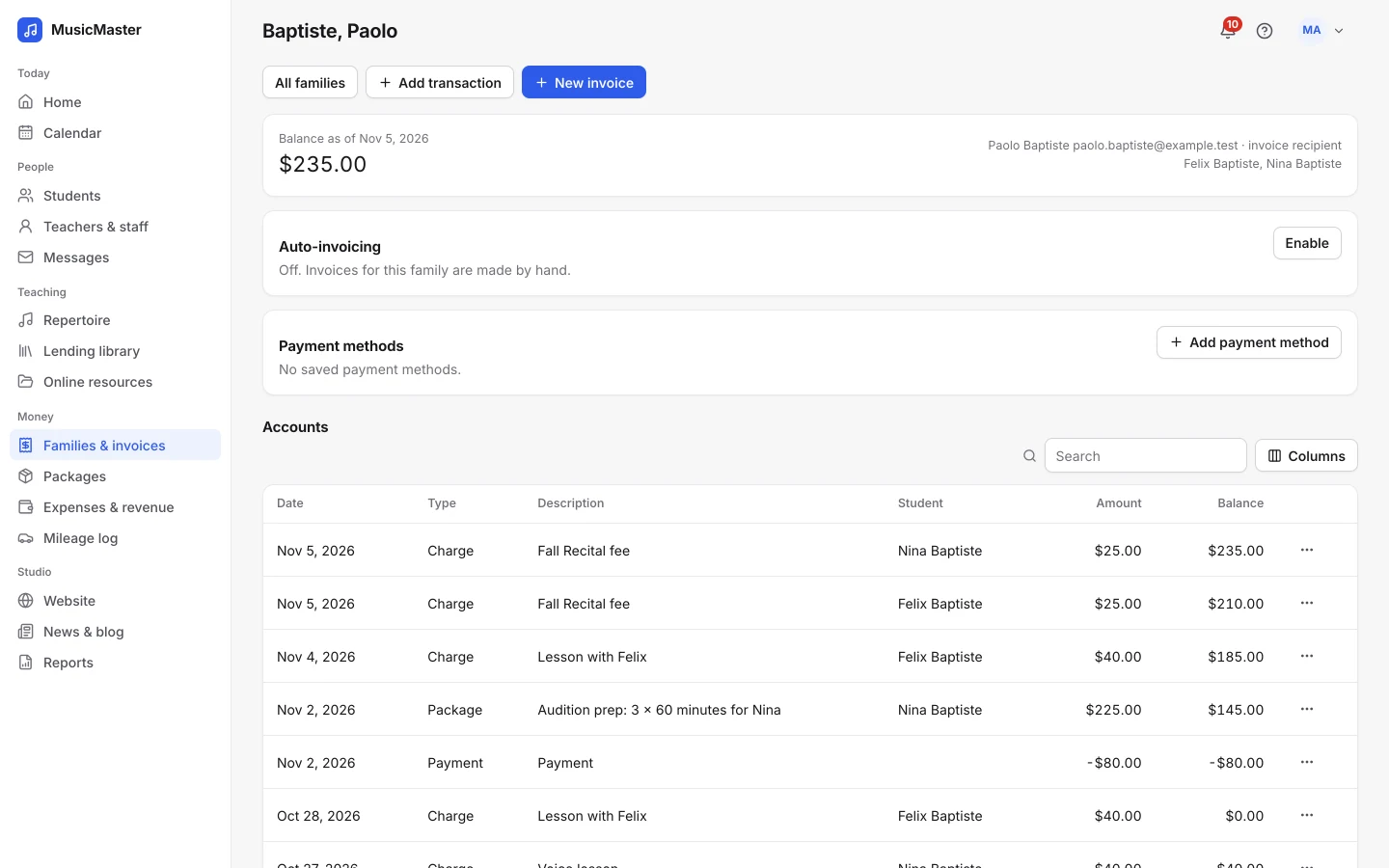
Bank payments cost a fraction of card payments. On a $170 monthly tuition payment, Stripe charges $5.23 for a card and $1.36 for an ACH bank debit, at its published US rates.
| Payment method | Published US rate (November 2026) | Fee on $170 | Fee on $1,000 |
|---|---|---|---|
| Stripe, card | 2.9% + 30 cents | $5.23 | $29.30 |
| Stripe, ACH Direct Debit | 0.8%, capped at $5 | $1.36 | $5.00 |
| PayPal Checkout (PayPal account, Venmo or guest) | 3.49% + 49 cents | $6.42 | $35.39 |
| PayPal, standard credit and debit card | 2.99% + 49 cents | $5.57 | $30.39 |
Over a year the gap adds up. Thirty families paying $170 tuition ten times is 300 payments: $1,569 in Stripe card fees, or $408 by ACH. Stripe adds 1.5% for international cards and 1% for currency conversion, charges $15 per card dispute, and PayPal charges $20 per chargeback in US dollars.
With Sonely, families pay through your own Stripe or PayPal account. Sonely takes no cut, adds nothing on top of your processor’s fees and is free for one teacher. Each processor’s fee is recorded as an expense for you, in the category you choose.
Should you add a convenience fee?
A convenience fee passes some or all of the processing cost to the family who chooses a more expensive way to pay. If you add one because a family pays by credit card, card network rules apply. A fee like that is what Visa calls a surcharge, “an additional fee or charge that a merchant adds to a consumer’s bill for using a particular form of payment,” and its US Q&A requires merchants to:
- notify their acquirer at least 30 days before surcharging,
- surcharge credit cards only, since debit and prepaid cards cannot be surcharged,
- cap the fee at their processing cost for that card or 3%, whichever is lower, and
- disclose the fee before payment and on every receipt.
Visa also says some state laws prohibit or limit surcharging. Check with your processor and a lawyer before you add a card fee. A simpler route is to keep one price and steer families to bank payments, or to offer a small discount for paying by bank. In Sonely, a convenience fee is optional: none, a fixed amount or a percentage, set separately for card and bank payments and shown to families before they pay.
Autopay for music lessons
Autopay means tuition arrives without anyone having to remember it, and schools build their payment plans on it. MacPhail Center for Music requires every payment plan to run on automatic payments. The Community Music School of Springfield gives $50 off a year’s tuition for monthly autopay, cuts the discount to $25 after December 31 and may remove it after two declined payments.
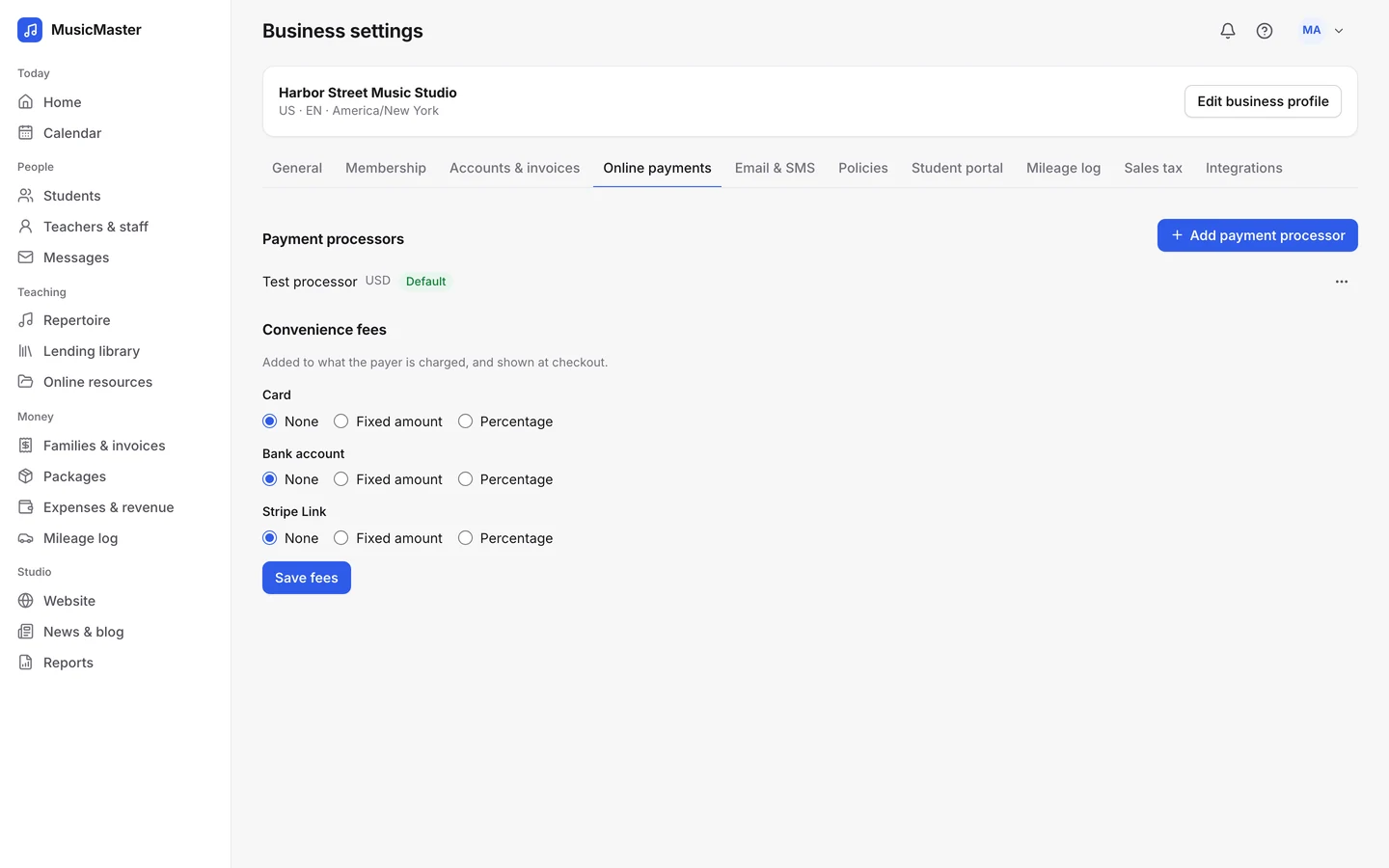
Ask for a saved card or bank account at enrollment, and say in the policy when the charge runs (for example, on the invoice date). In Sonely, families save a card, bank account or PayPal and turn on auto-pay, and each invoice is paid as it is sent. Stripe Link payments can’t be saved for auto-pay.
What tools can you use to bill for music lessons?
Three setups cover most studios. Choose by how many families you bill and how much you want to happen on its own.
| Setup | Cost | Works for | Limits |
|---|---|---|---|
| Spreadsheet, plus checks, cash, Zelle or Venmo | Free | A handful of families | You match every payment and chase late ones by hand |
| Invoices from Stripe or PayPal | Processing fees (table above), plus any invoicing fee; Stripe Invoicing adds 0.4% per paid invoice on its Starter plan | Card and bank payments through a link | No lesson calendar or attendance, so you build each invoice yourself |
| Music studio software | Sonely: free for one teacher. My Music Staff: $16.95 a month for one teacher (as of November 2026) | Studios that want invoices built from the calendar and attendance | An afternoon of setup; check that payments go into your own processor account |
Music lesson invoice template
A good invoice shows who it is for, what each charge is, the total, the due date and how to pay. Every invoice should include:
- Your studio name and contact details
- The family’s name and the student or students it covers
- An invoice number, the invoice date and the due date
- One line per charge, such as “November tuition: Ava, piano, 30 min weekly,” plus fees and discounts
- Any previous balance and the total due
- How to pay, and your late fee or grace period
Copy this one, which works as a music teacher invoice template for piano lessons or any instrument, and replace everything in [brackets].
[STUDIO NAME]
[Address or "Online lessons"] | [Email] | [Phone] | [Website]

INVOICE
Invoice number: [2026-11-014]
Invoice date:   [November 1, 2026]
Due date:       [November 5, 2026]

Bill to: [Parent name], [Family name] family
Email:   [parent@email.com]

DESCRIPTION                                   QTY   RATE       AMOUNT
November tuition: [Ava], piano, 30 min weekly   1   [$150.00]  [$150.00]
November tuition: [Leo], guitar, 45 min weekly  1   [$225.00]  [$225.00]
Sibling discount ([Leo])                        1   [-$15.00]  [-$15.00]
Winter recital fee                              1   [$20.00]   [$20.00]

                                         Subtotal:        [$380.00]
                                         Previous balance:  [$0.00]
                                         TOTAL DUE:       [$380.00]

Lessons this month
[Ava] (Tuesdays 4:00): Nov 3, 10, 17, 24
[Leo] (Thursdays 5:00): Nov 5, 12, 19 (no lesson Nov 26, Thanksgiving)
Tuition is the same every month. See the studio calendar: [link]

Make-up credits: [Ava] has [1] credit, to use by [date].

How to pay
- Online by card or bank account: [payment link]
- Autopay families: your saved payment method is charged on the invoice date
- Check payable to [Your name], or cash at the lesson

Payments received after [November 12] carry a [$15] late fee, as set out
in the studio policy.

Questions? Reply to this email or call [phone]. Thank you!
To use it by hand, paste it into a Google Doc, Word file or spreadsheet, fill in your studio details once and save that as your master. Each month, duplicate last month’s invoice for each family, change the dates and lines, and send it as a PDF with your payment link. Number invoices in order and keep every copy, since they are your record of what each family was billed. If you would rather not build each one, your processor can send invoices for you: Stripe Invoicing charges 0.4% per paid invoice on its Starter plan, on top of the payment fees above, and sends automatic email reminders.
If you take attendance in software, the invoice can come from it. In Sonely, charges come from the lessons on the calendar and the attendance you take: mark a lesson Absent, notice given and its charge comes off, and invoices by lesson, package or month go out as PDFs with your logo. For the rules behind missed lessons, see tracking music lesson attendance and make-ups, and for what families pay elsewhere, how much music lessons cost.
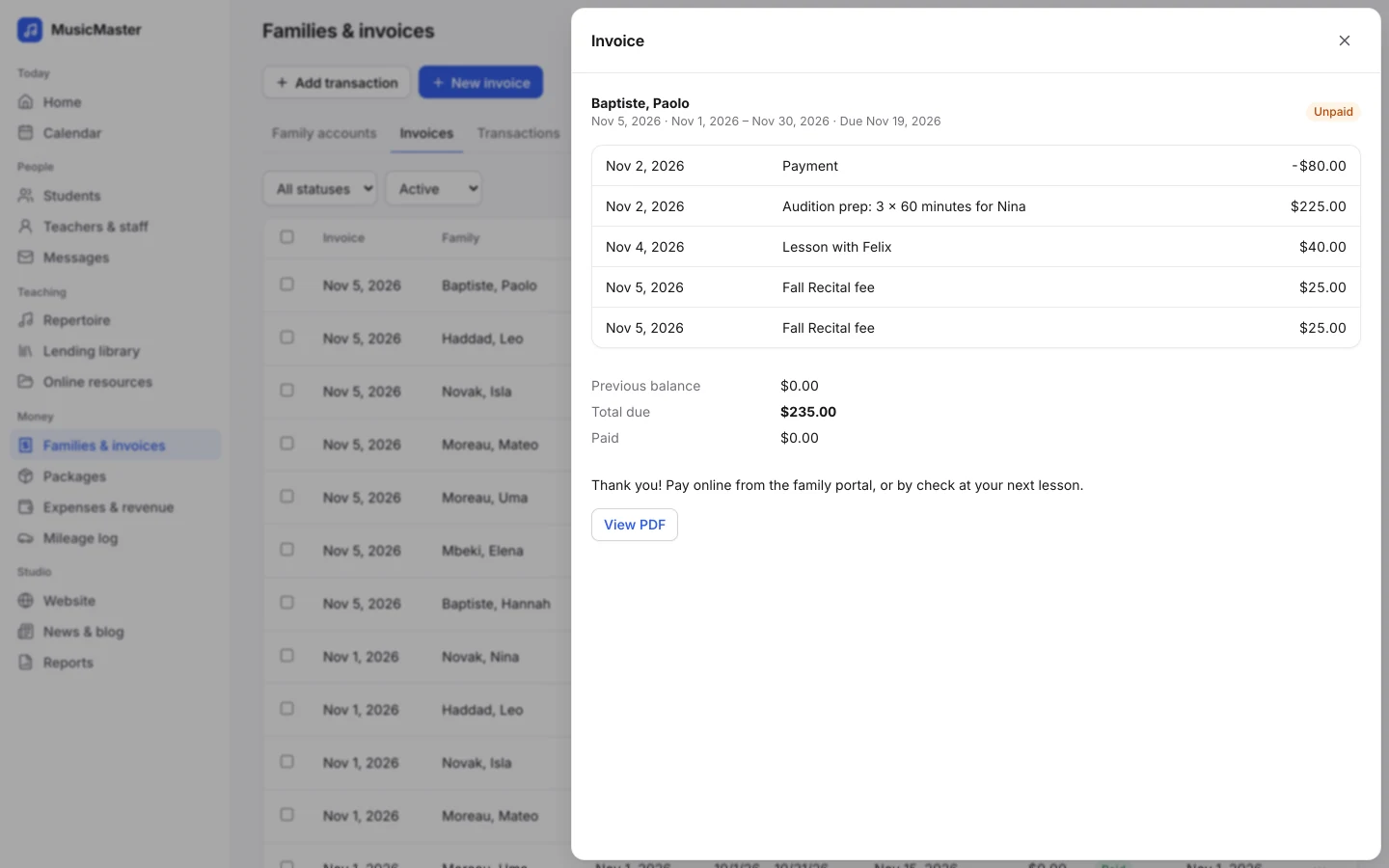
If an invoice carries an amount from last month, label it clearly. What balance forward means shows how families read a carried-over balance or credit.