Quick answer
To run group piano or music lessons, choose a format (pairs, small groups of three to six, larger classes or ensembles), group students by age and level, and plan every class around playing together. Price each seat below your private rate but make the class earn more per hour than a private lesson, and bill each student their own price so siblings and late joiners stay simple.
Key takeaways
- Group music lessons come in five common formats: partner lessons for two, small groups of three to six, classes of seven to twelve, ensembles, and workshops or camps.
- Group piano needs a digital piano and headphones for every student, because with more than two students playing at once, headphones are essential.
- In a worked example with a $60 private rate, four students paying $25 each earn $100 for a 60-minute class, $40 more than one private hour.
- Count preparation as teaching time when you set a minimum: at a $60 rate and $25 a seat, a 1-hour class with 30 minutes of prep needs at least 4 students.
- Run classes in terms of eight to twelve weeks, bill each student separately, and write a make-up rule for classes before the term starts.
On this page
- What formats do group music lessons come in?
- Group vs private piano lessons: which works better?
- What ages and class sizes work best?
- What equipment do you need for group piano lessons?
- How do you teach group piano?
- A sample 8-week group piano curriculum for beginners
- How should you price group lessons compared with private lessons?
- How do you schedule and bill a group class?
- Should you mix group and private lessons?
- Questions
To run group piano lessons, pick one format, group students by age and level, and plan every class around music the whole group plays at once. Charge each student less than a private lesson, but fill enough seats that the hour earns more than a private one. Bill each student separately, and set a make-up rule before the term starts.
What formats do group music lessons come in?
Group music lessons come in five common formats, from two students sharing a lesson to a full ensemble. Each one changes how much individual attention a student gets and how much the hour earns.
| Format | Students | Works best for | Watch out for |
|---|---|---|---|
| Partner lessons | 2 | Siblings, friends, beginners who need company | Two students who drift apart in level |
| Small group | 3 to 6 | Beginner piano, guitar, ukulele, voice | Room for every student to play every few minutes |
| Class | 7 to 12 | Keyboard labs, early childhood music, theory | Needs headphones, a plan for noise and strong routines |
| Ensemble | 4 to 30+ | Rock bands, choirs, chamber groups, jazz combos | Parts for every level, rehearsal space |
| Workshop or camp | Any | Summer, holidays, one-off topics | Filling seats without a term commitment |
Partner lessons are the easiest place to start: two students share a longer slot, each gets some solo time while the other listens, and they finish with a duet.
Group vs private piano lessons: which works better?
Neither is better for every student. Group lessons trade individual attention for a lower price, peers to play with and performing from the first week; private lessons give one student all of the teacher’s time and a pace set just for them. Here is how they compare from both sides of the bench:
| Group piano lessons | Private piano lessons | |
|---|---|---|
| Price per lesson for the family | Lower: each seat costs less than a private lesson | Higher |
| What the teacher earns per hour | More, once the class is full | One fee per hour |
| Individual attention | Shared, with short solo turns | All of it |
| Pace | Set by the class | Set by the student |
| Motivation | Friends, ensemble pieces and an audience every week | Comes from the teacher and the student |
| Schedule | A fixed class time for a term | A weekly slot, easier to move |
| Best for | Young beginners, adults who want company, theory and ensemble skills | Students who need close correction, move fast, or prepare for exams and auditions |
The same trade-off holds for guitar and other instruments. Group guitar suits beginners learning chords and strumming patterns together, while a student who wants a particular style, or wants to move faster than the class, does better in private lessons.
You don’t have to choose one for your whole studio: a student can start in a group and move to private or partner lessons later (see mixing group and private lessons below).
What ages and class sizes work best?
Younger students need smaller groups, shorter classes and more movement. Older students and adults can sit longer and work more independently. These are starting points we suggest, not rules, so adjust them to your room and your students.
| Age | Class length | Suggested size | What the class looks like |
|---|---|---|---|
| 3 to 5 | 30 to 45 minutes | 4 to 8, with a parent | Singing, movement, rhythm instruments, keyboard games |
| 5 to 7 | 30 to 45 minutes | 3 to 6 | Short activities, lots of changes, simple pieces in a five-finger position |
| 8 to 12 | 45 to 60 minutes | 4 to 8 | Reading, ensemble pieces, short solos for the group |
| Teens | 45 to 60 minutes | 4 to 10 | Bands, chord-based playing, songwriting, theory |
| Adults | 60 minutes | 4 to 10 | Steady pace, plenty of questions, music they know |
Group by level as well as age. A class of 8-year-olds where half have played for a year and half are brand new will either bore one half or lose the other. If you can’t split a class, choose ensemble pieces with parts at different levels.
Set a minimum and a maximum for every class before you open registration. The minimum is the number you need to cover your time (the pricing section below shows how to work it out). The maximum is the number your room, instruments and attention can handle.
Group piano lessons for adults
Adult group piano usually runs as a short course with a clear end, which suits busy adults. Worldwide Music School in New Jersey runs its adult class as eight weekly one-hour classes for four to six students, Seattle Jazz Academy teaches adult jazz piano in 12-week quarters, and Alfred’s Group Piano for Adults, a college textbook, has 26 weekly units that fill two semesters. Adults want music they recognize and time for questions, and some are nervous about playing in front of others, so start each class with something everyone can already play.
What equipment do you need for group piano lessons?
Group piano needs one digital piano per student, headphones for everyone, and a way for you to hear one student without the whole room hearing them. Acoustic pianos work for pairs, but with more than two students the noise of everyone practicing at once makes headphones essential.
| Item | Why you need it | Need it? |
|---|---|---|
| Digital pianos, ideally with weighted keys and two headphone jacks | One per student, so everyone plays every minute | Yes |
| Headphones for each student | Students practice a passage without hearing the others | Yes |
| A teacher keyboard | You demonstrate and play the accompaniment | Yes |
| Headphone splitter or a lab system | You listen to one student privately, or link students in pairs | Strongly recommended |
| A screen or whiteboard | Show music, rhythms and note names to everyone at once | Yes |
| A speaker for backing tracks and a metronome | Keep the whole group together | Yes |
| Rhythm instruments and floor space | Movement and rhythm games, especially under age 7 | For young children |
| Benches or chairs at the right height | Posture for every student | Yes |
For group guitar lessons, students bring their own instruments. You need clip-on tuners for everyone, armless chairs, footstools for classical guitar, spare strings and picks, and an amplifier only for yourself. For group voice or choir, a piano and a speaker are enough.
How do you teach group piano?
Teaching group piano is about keeping every student playing as much of the time as possible. A group lesson run like a private one leaves five students waiting while one plays. Plan the class as a sequence of short activities everyone does together, with solo moments kept short.
These habits keep a group class moving:
- Everyone plays at once. Have the whole class play a passage together, then in headphones, then one row at a time.
- Call and response. You play a short pattern and the class answers. It works for rhythm, ear training and new notes.
- Ensemble parts at different levels. A melody, a simple bass line and a one-note part let three levels play the same piece.
- Stations. One group plays in headphones, one works on a theory card, one plays with you, and they rotate.
- Short solos for the group. Each student plays a few bars for the class every week, so performing is normal by the end of term.
- Games for reading. Flashcard races and “find all the Gs” games teach reading faster than drilling one student at a time.
- Team challenges. Pass a melody around the room one bar per student, or split the class into two teams for a rhythm relay, so students listen for each other and keep the beat together.
- Compose together. Each student writes one bar of a class piece, or the class improvises over your chords, and the group performs the result at the end of term.
- Listen and coach. In pairs, one student plays and the other names one thing that went well and one thing to fix, then they swap.
A 45-minute class for ages 8 to 12 might run like this:
| Minutes | Activity | Everyone playing? |
|---|---|---|
| 0 to 5 | Warm-up: finger exercises with a backing track | Yes |
| 5 to 10 | Rhythm: clap, chant, then play the week’s pattern | Yes |
| 10 to 20 | New concept: demonstrate, then the class tries it in headphones | Yes |
| 20 to 32 | Pieces: whole class, then in pairs, then short solos | Mostly |
| 32 to 40 | Ensemble piece or game | Yes |
| 40 to 45 | Practice assignment and a preview of next week | No |
Our music lesson plan template works for group classes too. Write one plan for the class and add a line for each student who needs something different.
What is the best method for teaching piano in class?
There’s no single best method. You can teach a curriculum written for groups, or adapt the method book you already use by adding ensemble parts. Here is how the main group curricula describe themselves on their publishers’ sites:
| Method | Written for | Format |
|---|---|---|
| Harmony Road | Group piano musicianship programs for toddlers to adults | The core course is for ages 4½ to 6: 55 minutes a week for two years, with a parent in each lesson. Piano Street is its small-group program for teens and adults. |
| Musikgarten Music Makers: At the Keyboard | Groups of young beginners from age 6 | Three years of lessons in six 15-week semesters |
| Yamaha Music School | Group lessons with friends from age 3 to 99, with private lessons as part of the curriculum | The Junior Music Course is for 4- and 5-year-olds: one class a week for two years, with a parent |
| Alfred’s Group Piano for Adults | College music majors who don’t play keyboard, and adult students of independent teachers | 26 units, one a week, filling two semesters |
| Faber Piano Adventures | A method many private teachers already use; its Primer Level teacher guide adds group activities, ensemble parts and teacher duets | Fits whatever term you design |
The Music Room in San Francisco, for example, teaches Harmony Road in classes of up to eight children. Check each publisher’s site for how a teacher gets started with its program.
How do you choose a group piano curriculum?
Song choice is what most teachers notice first, but six questions matter more once a class is running:
- Leveled or multi-level? A leveled course keeps the whole class on the same page, which is easier to teach and to hand to another teacher. A multi-level course lets beginners and second-years share a class, but asks more of you during the lesson.
- How does each student progress? Look for checkpoints or assessments, so a student who is ahead or behind shows up before the end of term.
- Who is it written for? Match the age range and class length to your students (the table above has each publisher’s).
- What does each family buy? Books, apps or a kit per student add to your term price.
- What comes with it for you? Teacher guides, lesson plans, training and a community of other teachers make the first term much easier.
- Is it licensed? Some programs are licensed rather than bought. Musikgarten asks teachers to renew a license every year to keep offering its classes and using its name, and Harmony Road says it offers area protection.
Where can you learn to teach group piano?
Most teachers build confidence with groups in small steps, with support from a program or from other teachers:
- Start small. Run partner lessons, a summer camp or a four-week workshop before a full term. A short course with a clear end is easier to plan and easier to fix.
- Take the training that comes with a curriculum. Musikgarten’s path is a teacher training webinar series with assignments, then a certificate for that curriculum that doesn’t expire. Harmony Road lists teacher seminars, online training and start-up help for new teachers.
- Go to a group piano forum. MTNA’s National Group Piano and Piano Pedagogy Forum (GP3) has met since 2000 with a focus on the practical side of teaching. Its 2026 meeting was on August 7 and 8 at the University of Cincinnati College-Conservatory of Music.
- Watch a class. Ask a local music school or a university’s community music program whether you can observe a group class before you plan your own.
- Plan with another teacher. Sharing lesson plans, games and ensemble parts with a colleague splits the preparation, and the first term is the one that takes the most.
Can you teach group piano lessons online?
Yes, in small groups, with one limit: a video call adds a delay, so students can’t play in time with each other. Have everyone play along on mute to your accompaniment, then unmute one student at a time for short solo turns. Ask families to set the camera to one side so you can see hands and keys, and we suggest keeping online groups to four or five students so nobody waits long for a turn. Sonely puts your own Zoom, Meet or Teams link on every lesson but doesn’t create those meetings. With a Lessonspace or Pencil Spaces API key saved on a location, Sonely opens an online lesson room for each lesson there (see Sonely for online teachers).
A sample 8-week group piano curriculum for beginners
This curriculum is for a beginner class of four to six students aged 7 to 10, meeting for 45 minutes a week on digital pianos. It ends with a short showcase for families in week 8. Use it as a frame and fit in the method book you already use.
| Week | Focus | In class | Practice at home |
|---|---|---|---|
| 1 | The keyboard and posture | Black-key groups, high and low, finger numbers, a black-key piece played together | Find every group of two and three black keys, 5 minutes a day |
| 2 | Steady beat | Quarter and half notes, clap and chant, black-key pieces with a backing track | Play the week’s piece with a metronome |
| 3 | White keys | Names of C, D and E, then F and G, call and response, a first white-key piece | Name every C and G on the keyboard |
| 4 | Reading steps and skips | Middle C and landmark notes on the staff, flashcard games, reading in pairs | Flashcards and one new piece |
| 5 | Loud and soft | Forte and piano, whole notes, a two-part ensemble piece | Play the piece loud, then soft |
| 6 | Both hands | Five-finger positions in both hands, a simple hands-together piece, improvising on black keys over your chords | One piece hands together, slowly |
| 7 | Getting ready to perform | Rehearse showcase pieces, practice bowing and starting, play for the class | Run the showcase piece once a day for family |
| 8 | Family showcase | Each student plays a short solo and the class plays the ensemble piece | Next term’s sign-up |
Send a short note home after each class: what the class covered and what to practice. Families who see progress each week have a reason to sign up again. If you end each term with a performance, our guide on how to plan a studio recital covers the details.
How should you price group lessons compared with private lessons?
Price group lessons by the seat, below your private rate for the same length of time, and set the class size so the whole class earns more per hour than a private lesson. That gives families a lower price and you a better hourly income in return for the extra preparation and equipment.
Start from your private rate. Superprof’s 2026 price guide puts private music lessons at $40 to $90 an hour on average, depending on the teacher, location and instrument, and says group classes cost far less per session. Our guide on how much to charge for music lessons shows how to set your own rate.
Here is a worked example, with numbers chosen only to show the math. Say your private rate is $60 an hour and you charge $25 per student for a 60-minute group class:
| Students in class | Price per student | Class earns per hour | Compared with one private hour ($60) |
|---|---|---|---|
| 3 | $25 | $75 | $15 more |
| 4 | $25 | $100 | $40 more |
| 6 | $25 | $150 | $90 more |
| 8 | $25 | $200 | $140 more |
A group class also costs you more: more preparation, printed materials, instruments and headphones, and sometimes a room. To find your minimum enrollment, count the extra preparation as teaching time:
Minimum students = (private hourly rate × (class hours + extra prep hours)) ÷ price per student

Example: ($60 × (1 hour class + 0.5 hours prep)) ÷ $25 = 3.6, so run the class with 4 or more.
A few rules make group pricing hold up:
- Charge by the term, paid up front or monthly. An 8-week term at $25 a class is $200. A seat in a class is reserved for the whole term, so a missed class doesn’t lower the price.
- Set a minimum to run. If fewer than your minimum register by the deadline, merge classes or refund. Say so on the registration form.
- Take a deposit or a registration fee. It holds the seat and covers materials.
- Prorate late joiners. Charge for the classes left in the term, not the whole term.
- Give discounts per student. A sibling or scholarship price should apply to one student’s seat, not to the whole class.
What do schools charge for group piano classes?
Published prices vary widely by city, class length and class size. Here are a few from schools’ own pages in November 2026 (one school each, not averages):
| School | Class | Price |
|---|---|---|
| Coppell Music Academy, Texas | Ages 8 and up, 60 minutes a week, up to 4 students | $180 a month, plus a $100 yearly membership |
| Shock City School of Music, Missouri | Small groups, 45 or 60 minutes a week | $185 or $240 a month, with a 3-month minimum |
| Worldwide Music School, New Jersey | Adults, 1 hour a week for 8 weeks, 4 to 6 students | $199 for the course |
| Faber Piano Institute, Michigan | Adults, 1 hour, small group | $55 per student per class |
| Eastman Community Music School, New York (via Superprof) | Adults, 50-minute introductory class | $261 a semester |
In a four-week month, Coppell’s price works out to about $45 per student per class, so a full class of four brings in about $180 an hour.
How do you schedule and bill a group class?
Schedule group classes in fixed terms with set start and end dates, a maximum size and a registration deadline. Bill each student separately, even when they share a class, so the price, discounts and missed classes stay with the right family.
- Run terms, not open-ended classes. Eight to twelve weeks with a clear start date gives families something to commit to and gives you a natural point to re-enroll.
- Skip holidays when you build the schedule. Count the real number of classes in the term before you set the price.
- Keep a waitlist. A full class with a waitlist tells you when to open a second section.
- Write a make-up rule for classes. Common choices are a seat in another section, a recording of what was covered, or no make-up at all. Our music studio policy template has wording you can use.
- Take attendance for each student. One student’s absence shouldn’t change another’s bill, and families will ask what their child missed.
In Sonely, a group class is an event with several students. You set a maximum size, give each student their own price and repeat the class every week until the term ends, with blocked dates for the holidays new weekly classes skip. A Book from calendar form on your website lets families register into a class with places left, answer your questions, agree to your policy and pay a registration fee or deposit by card. Once a class is full, it stops taking sign-ups.
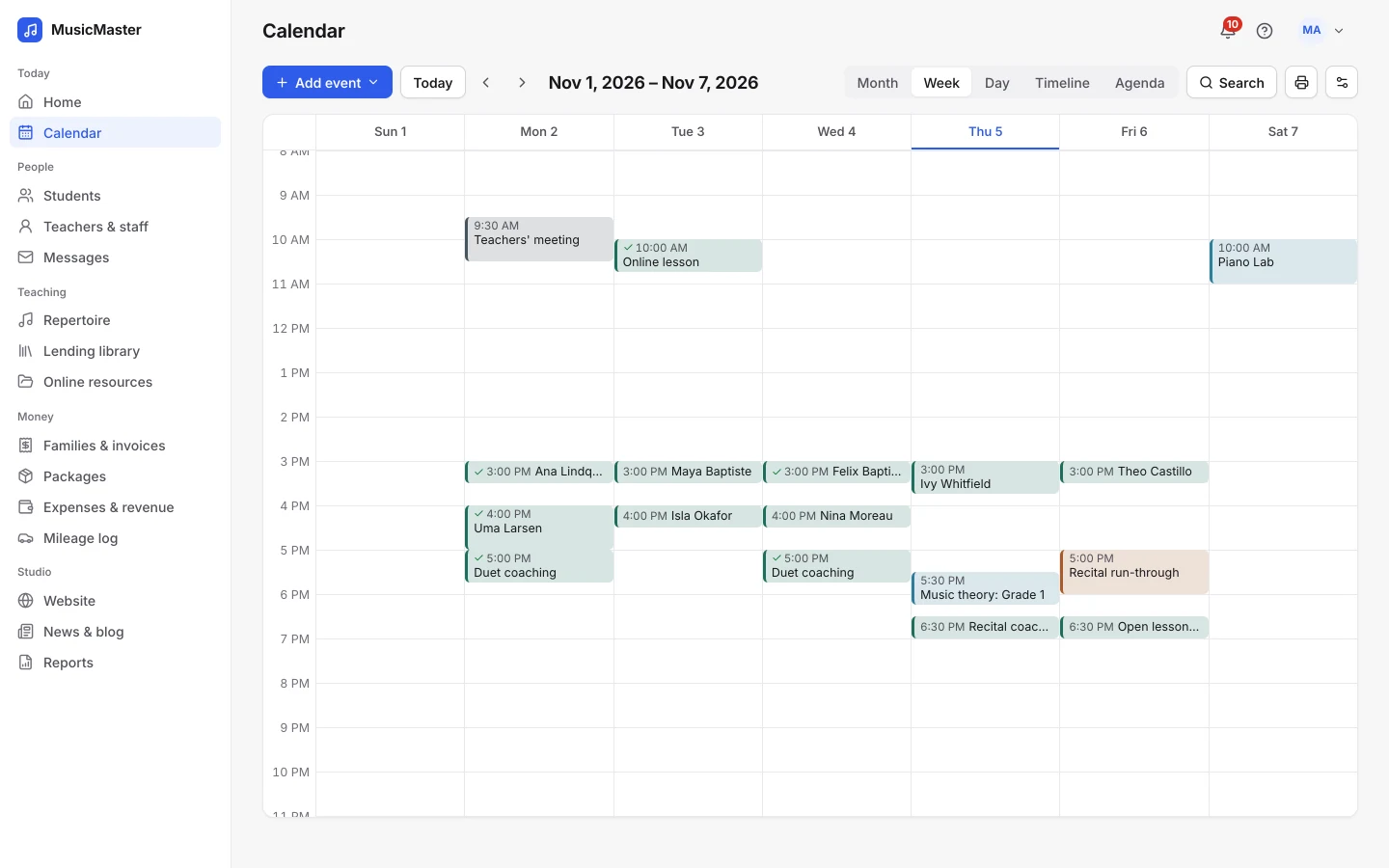
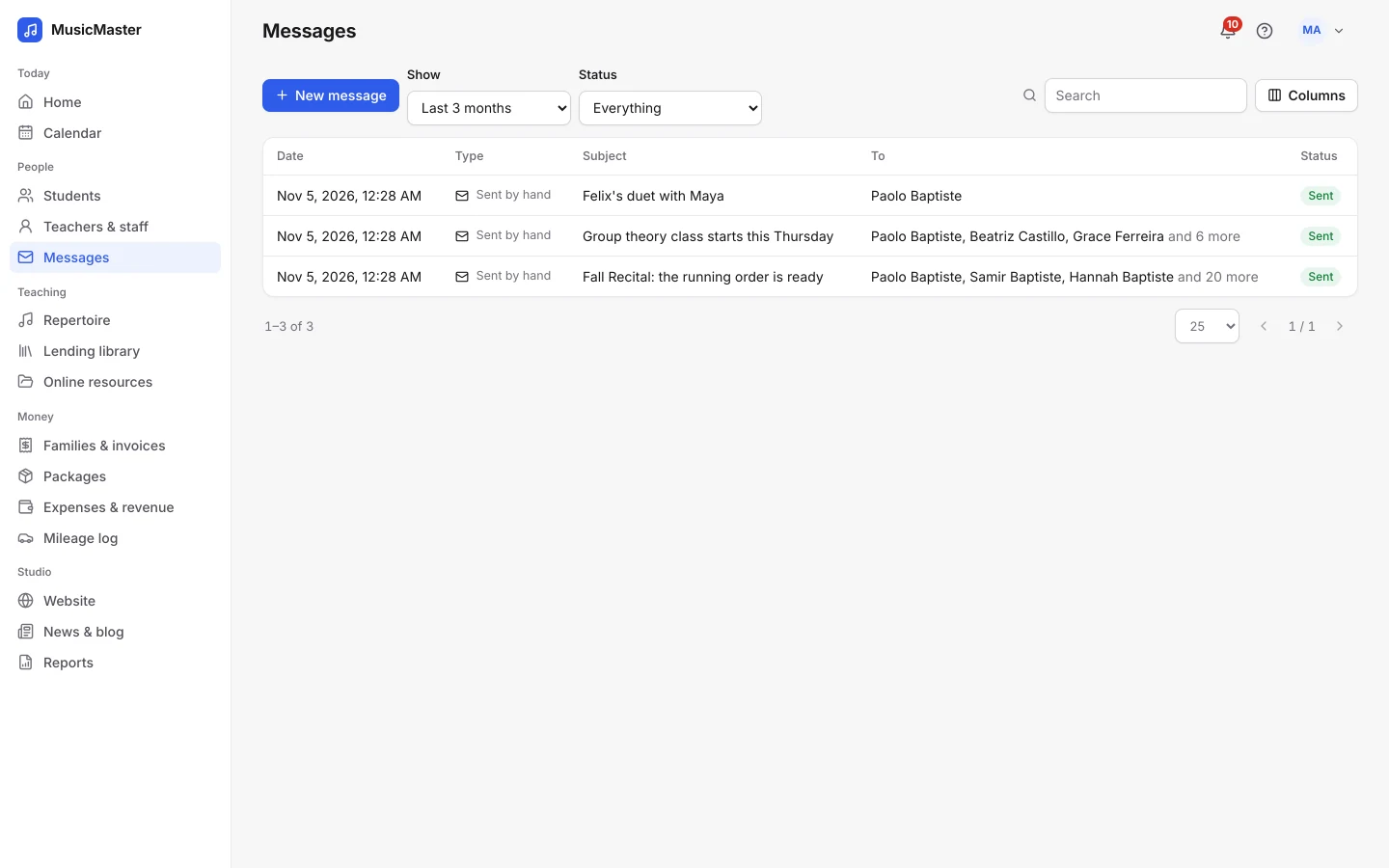
After class, you mark the whole group at once, and each student keeps their own status, bill and make-up credits. You write one note that every student and parent in the class can read, and a private one for yourself. Group tags let you email the whole class, and teachers can be paid per student, per hour or a share of the class’s revenue. See group classes and ensembles or Sonely for group programs.
Should you mix group and private lessons?
Mixing group and private lessons gives students individual attention and the motivation of playing with others, and it can fill hours that private lessons leave empty. Common mixes:
| Model | How it works | Why it works |
|---|---|---|
| Private lessons plus a monthly group class | Weekly private lessons, with a performance or theory class once a month, included in tuition | Students perform for peers often and learn theory together, without extra private time |
| Group first, private later | Beginners start in a group term, then move to private or partner lessons | A lower first price for families, and a steady flow of private students for you |
| Partner lessons | Two students share a longer slot, with solo time and duets | Can earn more per hour than one private lesson, and gives each student a friend to practice with |
| Private lessons plus an ensemble | Students in a band, choir or chamber group alongside their lessons | Gives students a reason to practice and something to perform |
| Workshops and camps | One-off or summer sessions for current and new students | Fills quiet weeks and introduces new families to your studio |
When a student takes both, keep it on one schedule and one bill. In Sonely, group classes share the calendar, attendance, invoices and family portal with private lessons, so a student who does both has one schedule and their family gets one invoice.