Quick answer
Start planning a music recital about eight weeks out: set the date, book a venue with a good instrument, and choose pieces each student can already play comfortably. Send invitations five weeks before, fix the running order and program two weeks before, hold a dress rehearsal in the last week, and collect photo and recording consent before the day. The timeline, invitation and program template (also a PDF and Word file) are below.
Key takeaways
- Start planning about eight weeks before a studio recital, or ten to twelve weeks for a first recital or a school with several teachers.
- Send invitations about five weeks out with an RSVP date, then fix the running order and send the draft program to families two weeks before.
- Allow three to four minutes per performer, about 15 to 20 performers an hour, and keep the recital under an hour if you can.
- Put the youngest beginners first and the most advanced students last, and don’t open with a very nervous student.
- Collect written photo and recording consent before the day, and ask a lawyer before you stream or post music still under copyright.
On this page
- How to plan a music recital, week by week
- How do you choose a recital venue?
- What order should students perform in?
- How long should a recital be?
- Recital theme ideas
- How many rehearsals does a recital need?
- What should students do before a recital?
- Recital invitation template
- What goes in a music recital program?
- How do you format a recital program?
- Recital program template
- Stage etiquette for students
- Recital day checklist and welcome script
- How do you get photo and recording consent for a recital?
- How do you run a virtual or hybrid recital?
- Keeping the recital organized
- Questions
Here’s how to plan a music recital: start about eight weeks before the date. Book a venue with a good instrument, choose a piece each student can already play comfortably, and send invitations about five weeks out. In the last two weeks, fix the running order, print the program and hold a dress rehearsal. Collect photo and recording consent before the day, and send a thank-you the day after.
The rest of this guide is the detail: a timeline you can copy into your calendar, how to choose a venue and order the performers, an invitation, a complete program template, stage etiquette to teach students, and how to run a virtual or hybrid recital.
How to plan a music recital, week by week
Work backward from the recital date. Eight weeks is enough for a studio of up to about 30 students. For a first recital, a school with several teachers or a venue that books up early, start at ten or twelve.
| When | What to do |
|---|---|
| 10 to 12 weeks out (if needed) | Book the venue and pay any deposit. Choose a theme if you want one. Announce the date so families can keep it free. |
| 8 weeks out | Set the date and time. Book the venue and the piano tuning. Decide the format (in person, online or hybrid). Choose a piece with each student. |
| 6 weeks out | Send a save-the-date. Book an accompanist if students need one. Send the photo and recording consent form. Decide memory or score for each student. |
| 5 weeks out | Send invitations with an RSVP date. Ask each family how many guests are coming. |
| 4 weeks out | Pieces should be learned. Start performance practice in lessons: playing straight through without stopping, walking on and bowing. |
| 3 weeks out | RSVPs close. Draft the running order. Rehearse duets and ensembles. |
| 2 weeks out | Fix the running order. Collect exact titles, composers and arrangers. Draft the program and send it to families to check names. Hold a studio run-through. |
| 1 week out | Dress rehearsal, at the venue if you can. Print programs. Send each family the recital-week sheet (below) with arrival time, seat number and dress. Assign helpers for the door, programs, recording and stage. |
| 2 to 3 days before | Confirm the venue and that the piano was tuned. Test any streaming setup. Pack the recital-day kit. Pick up certificates or flowers. |
| Day of | Arrive 60 minutes early. Test the piano, bench and lighting. Set up a check-in table and seat performers in program order near the front, on numbered seats. |
| Day after | Send thanks and share recordings privately. Talk through the performance in each student’s next lesson. Pay the venue and note what to change next time. |
How do you choose a recital venue?
Choose the venue for the instrument first, then the seats. A well-tuned acoustic piano (or the right setup for your instrument) matters more to students than a beautiful hall. Common options:
| Venue | Good for | Watch out for |
|---|---|---|
| Your own studio | Small studios, informal performance classes | Seating more than 20 to 30 guests, parking |
| Place of worship or community hall | Mid-size studios, often low cost | Piano condition, booking around services |
| Library or community center room | Free or cheap rooms, central locations | Often no piano; strict start and end times |
| School auditorium or music room | Large studios, school-age students | Booking lead time, custodial fees |
| Piano store recital hall | Excellent pianos, a proper stage | Availability, rules on outside events |
| Senior living community | Warm audiences, a service to the community | Smaller rooms, residents’ schedules |
Before you sign, ask: When was the piano last tuned, and can it be tuned the week of the recital? How many seats, and is the room accessible? Is there a room or corner where performers can wait? Can you get in an hour early for setup, and for a rehearsal the week before? Are food, flowers and filming allowed? What is the fee, the deposit and the cancellation policy?
What order should students perform in?
Put the youngest beginners first and the most advanced students last. Young children can then relax and watch, their families can leave early if they must, and the recital builds toward its strongest pieces. Within that shape:
- Don’t put a very nervous student first. Open with a confident beginner instead.
- Mix instruments and moods. Two slow pieces in a row feel longer than they are.
- Use duets and ensembles as breaks, especially in the middle of a long program.
- Group siblings with care. Back to back is easier for photos, but split them if one would be compared to the other.
- Leave an accompanist time to move between the piano and their seat.
Number the front-row seats in program order. Each performer sits in their number, walks up when the person before them bows, and nobody has to call names or look for the next player.
How long should a recital be?
A studio recital should run about an hour, and no more than 75 minutes with an intermission. Plan about three to four minutes per performer, including walking on and bowing, which gives you 15 to 20 performers an hour. Student Music Organizer suggests the same range, 60 to 75 minutes, with each performance kept to five minutes or less. If you have more students than that, run two shorter recitals on the same afternoon, grouped by level or age.
College degree recitals are longer, because one student plays the whole program.
| Recital | Typical length |
|---|---|
| Private studio recital | 45 to 60 minutes, up to 75 with an intermission |
| Undergraduate junior recital | 45 to 60 minutes |
| Undergraduate senior recital | 60 to 75 minutes |
| Graduate recital (master’s or doctoral) | 60 to 90 minutes |
The degree recital ranges are from DANSR’s guide to planning a college recital program. Your school’s own handbook sets the rule that counts, so check it before you choose repertoire.
Recital theme ideas
A theme is optional, but it gives students a reason to choose a piece, gives the program a title and makes decorating easy. Pick one broad enough that every level can find music for it.
| Theme | What students play | A touch for the day |
|---|---|---|
| At the movies | Film and TV music, arranged by level | A program styled as a ticket, popcorn at the reception |
| Around the world | Folk songs and pieces from each student’s heritage | A map with a pin for each piece |
| The four seasons | Pieces about weather, nature or a time of year | Each half of the program is a season |
| Animals | Character pieces, from “The Elephant” to “The Swan” | Students introduce their animal before playing |
| Through the decades | One piece per era, from Baroque to pop | Composer dates printed large on the program |
| Composer spotlight | Several students play works by one or two composers | A short fact about the composer in the welcome |
| Storybook | Pieces with a story or a picture in the title | Students read one line about the story first |
| Student composers | Each student plays a short piece they wrote | The composer’s name and age next to each title |
| Requests | Pieces chosen by a grandparent, parent or friend | The program says who requested each piece |
Check your own shelf before you announce a theme. Most method and repertoire books already hold pieces that fit at least one of these, so students won’t need new music.
How many rehearsals does a recital need?
Plan three kinds of rehearsal: performance practice in lessons from four weeks out, a studio run-through two weeks out, and a dress rehearsal in the last week.
Performance practice in lessons. From four weeks out, end each lesson with a performance: the student walks to the instrument, bows, plays straight through without stopping, and bows again. Teach them to keep going after a slip. Students who always stop to fix mistakes at home need to practice not stopping before they play for an audience.
A studio run-through. Two weeks out, gather students for an informal performance class in your studio. Students play for each other in recital order, and you check timing and transitions.
A dress rehearsal. In the last week, rehearse at the venue if you can. Students try the piano, adjust the bench, find the walk from their seat to the stage and practice the bow. Ten minutes per student on the real instrument removes most of the surprises.
Families can help at home: ask them to hold a “living room recital” the weekend before, with the student announcing the piece and bowing.
What should students do before a recital?
In the last week, students should perform the piece rather than practice it: play it straight through for someone every day, slowly once and at tempo once, and stop drilling new details. The night before, they lay out their clothes and music and get a full night’s sleep. On the day, they eat a normal meal, arrive at the stated time and warm up with a scale, not with the piece.
Send families this sheet a week before, filled in for each student. It answers the questions you would otherwise get by text on the morning of the recital.
RECITAL WEEK: WHAT TO KNOW        [Studio name] [Season] Recital

Student: _________________   Piece: ___________________________
Seat number: ____   (performers sit in program order, front row)
Date and time: [Day, date], starts at [time]
Arrive by: [time, 20 to 30 minutes before the start]
Place: [Venue], [address]. Parking: [where]. Enter by: [door]
Wear: [concert dress or Sunday best], and shoes the student has
practiced in. [Piano: flat shoes with a thin sole for pedaling.]
Bring: the music [even if playing from memory], [instrument,
rosin, tuner], a water bottle
Reception: please bring [snack], if you signed up

THIS WEEK AT HOME
- Play the piece all the way through for someone every day.
  Don’t stop for slips: keep going, as on the day.
- Play it once slowly and once at tempo. No new changes now.
- Practice walking to the instrument, bowing and walking back.
- The night before: lay out clothes and music, early to bed.
- On the day: eat a normal meal, arrive on time, warm up with a
  scale. Nerves are normal and mean the student cares.

Questions before the day: [phone or email]
Recital invitation template
Send invitations by email about five weeks before the recital, with an RSVP date two weeks before it. Copy and edit this one.
Subject: You’re invited: [Studio name] [Season] Recital, [date]

Dear [Parent name],

[Student name] will perform in our [season] recital, and we
would love for you and your family to come.

Date:     [Day, month date, year]
Time:     [Start time] (performers arrive by [time])
Place:    [Venue name], [address]
Parking:  [Where to park]
Length:   About [60] minutes, followed by refreshments

[Student name] will play [piece title] by [composer].

Please reply by [RSVP date] with the number of guests coming.
Grandparents, friends and neighbors are welcome.

What to wear: concert dress or Sunday best, and shoes the
student has worn while practicing.

Photos and video: please return the permission form by
[date] if you haven’t already. A recording of the whole
recital will be shared privately with families afterward.

If [student name] can’t make it, please let me know as soon
as you can so I can update the program.

See you there,
[Your name]
[Studio name] · [phone] · [email]
What goes in a music recital program?
A recital program needs the studio name and the event, the date, time and venue, the running order with each student’s name, instrument, piece title and composer, and a few lines of thanks. Add arrangers for arranged pieces, an intermission if you have one, and a short note on etiquette for the audience.
Two choices to make before you print:
- How to print names. First name and last initial (“Ava M.”) is a good default when programs may be photographed and shared. Ask families before printing full names.
- Composer details. Full names and dates (“Robert Schumann, 1810 to 1856”) look polished and teach students a little music history. Check spellings and dates; families will notice.
Send the draft to families two weeks out with one question: “Is everything spelled the way you’d like it?” It catches most mistakes.
How do you format a recital program?
Format the program as a list of works in performance order, with the title on the left, the composer on the right, and the performer’s name and instrument on the line below. The conventions most recital programs follow:
- Titles: the piece’s title, then its opus or catalog number (Op. 68 No. 8, BWV 846, K. 545). Movements go indented on the lines below the work.
- Composers: full name, with birth and death years in parentheses, “(1770-1827)”, or “(b. [year])” for a living composer. Write “Traditional” for folk songs.
- Arrangers: “arr. [name]” under the composer for any arranged or simplified piece.
- Performers: name and instrument, plus “with [name], piano” for an accompanist and the partners’ names for duets.
- Intermission: a centered line where it falls.
For the layout, the University of Oregon’s School of Music and Dance offers three formats: a half sheet (5.5 by 8.5 inches), a single letter sheet folded in the middle, and several sheets for a program with notes. A folded letter sheet gives you a cover, two inside pages for the program and a back page for thanks and news. In Word, set a right tab stop with a dot leader at the right margin to draw the dotted line between title and composer. In Google Docs, a two-column table with the borders hidden keeps titles and composers lined up. If you want a designed cover, a free Canva program template works too: design the front page there and paste the program below into it.
Recital program template
Copy this into Word or Google Docs, replace the bracketed parts, and print it on a folded letter-size sheet. Or download it under the template: a Word file to edit, or a one-page PDF to print with lines to fill in. The example is a mixed program of piano, violin and voice. For a piano recital program, keep the same layout and leave out the instrument after each name.
[STUDIO NAME]
[Season] Recital [Year]

[Day, Month Date, Year] · [Time]
[Venue name] · [Address]

Welcome! Thank you for coming to hear our students.
Every piece today is the result of weeks of practice
at home. Please hold applause until each performer
has bowed.

PROGRAM

Lightly Row ..................................... Traditional
   Mia T., piano

Ode to Joy ......................... Ludwig van Beethoven
                                       arr. [arranger]
   Noah R., violin

The Wild Horseman, Op. 68 No. 8 ......... Robert Schumann
                                            (1810-1856)
   Liam K., piano

Gavotte ............................. François-Joseph Gossec
                                            (1734-1829)
   Sofia P., violin, with [accompanist], piano

Shenandoah ......................................... Traditional
                                            arr. [arranger]
   Ava M., voice, with [accompanist], piano

Duet: [Title] ............................ [Composer] (b. [year])
   Ella and James W., piano four hands

                     ~ Brief intermission ~

Prelude in C major, BWV 846 ......... Johann Sebastian Bach
                                            (1685-1750)
   Grace L., piano

Für Elise, WoO 59 .................... Ludwig van Beethoven
                                            (1770-1827)
   Daniel S., piano

Clair de lune, from Suite bergamasque ...... Claude Debussy
                                            (1862-1918)
   Olivia H., piano

PLEASE
Silence your phone. Take photos without flash, and only
between pieces. A recording of the recital will be shared
privately with families.

THANK YOU
[Venue name], for hosting us
[Accompanist name], collaborative pianist
Our families, for every practice at home

COMING UP
[Next term’s lessons start Month Date. Summer schedule
requests are due Month Date.]

[Studio name] · [website] · [phone]
Stage etiquette for students
Teach stage etiquette as part of the piece, and practice it in lessons as often as the music. Students who know exactly what to do with their hands and feet before and after playing are far less nervous.
- Wait your turn quietly in your seat, with your music ready.
- Walk to the instrument calmly. No running, no rushing.
- Get set before you play. Adjust the bench or stand, place your music, put your hands in your lap and take one breath.
- Play the whole piece. If you slip, keep going. The audience doesn’t have the score.
- Bow at the end. Stand beside the instrument, look at the audience, bow slowly and count “one, two” at the bottom.
- Walk back to your seat and listen to the next performer the way you’d like to be listened to.
Teach the audience too, in the program and at the welcome: stay for the whole recital if you can, clap after each performer, and keep phones silent.
Recital day checklist and welcome script
Pack the kit two or three days before, so a missing item is a shopping trip, not a crisis.
RECITAL DAY KIT
[ ] Programs, plus 10 spare        [ ] Seat numbers and tape
[ ] Running order with timings     [ ] Check-in list and pens
[ ] Photo consent list (who not to post) for the recorder
[ ] Teacher’s copies of duet and accompaniment parts
[ ] Music stand, footstool or pedal extender for small pianists
[ ] Spare strings, rosin, reeds, tuner, as your students need
[ ] Phone or camera, tripod, charger and spare battery
[ ] Certificates or flowers, in program order
[ ] Water for performers, tissues, a small first-aid kit
[ ] Reception supplies: tablecloth, napkins, cups, trash bags
[ ] Welcome script (below)
Keep the welcome to about a minute. Everyone is there to hear the students, so say what the audience needs to know and then start the music.
WELCOME
Good afternoon, and welcome to the [Studio name] [season]
recital. Thank you for coming to hear our students.
Before we begin: please silence your phones, and take photos
without flash, between pieces only. If you need to step out,
please wait for applause. Restrooms are [where], and exits
are [where].
Our performers will play in the order printed in your program.
[Number] students have prepared for weeks, and I’m proud of
every one of them. Let’s begin with [first performer].

CLOSING
Thank you to our performers, and to the families who made
every practice at home possible. Thank you to [venue] for
hosting us and to [accompanist] for playing with our students.
Please join us for [refreshments] in [place]. Performers,
please come up for a group photo first.
How do you get photo and recording consent for a recital?
Ask parents in writing, before the recital, whether their child may be photographed and recorded, and whether those photos and videos may be shared beyond the families who attended. Give them a clear “no” option, and keep a list on the day so your recording helper knows whom to skip in posts. A simple form:
RECITAL PHOTO AND VIDEO PERMISSION

Student: ________________________  Recital: ____________

[ ] Yes, the studio may photograph and record my child’s
    performance and share it privately with recital
    families.
[ ] Yes, the studio may also post photos or video on its
    website and social media, using first name only.
[ ] No photos or video of my child, please.

Parent or guardian: ____________________  Date: ________
This form is a starting point, not legal advice. Rules on photographing and publishing images of children differ by state and country, so check with a lawyer if you post publicly.
For sharing a recording with families only, a private or unlisted video works. According to YouTube’s help center, an unlisted video can be watched by anyone with the link but doesn’t appear in search or on your channel, and a private video can be seen only by the people you invite by email.
Copyright is a separate question. US copyright law has a narrow exemption for live performances of music that are not transmitted, have no commercial purpose, pay nobody to perform or organize, and either charge no admission or use the proceeds only for educational, religious or charitable purposes (17 U.S.C. § 110(4), on the US Copyright Office’s site). A recital that is streamed or posted online is a transmission, which that exemption doesn’t cover, and a studio that runs as a business may not meet its terms in person either. If you plan to stream, post or share recordings of music still under copyright, ask a lawyer first.
How do you run a virtual or hybrid recital?
A virtual recital works when distance, illness or weather keeps families apart. There are two ways to run one.
Pre-recorded. Each student records their piece at home by a deadline, standing to bow at the start and end. You put the videos together in program order and share one private or unlisted link. It’s the least stressful option for students, and the sound is usually better.
Live on a video call. Each student plays from home in turn. On Zoom, every performer should turn on Original sound for musicians, which switches off Zoom’s echo cancellation and audio enhancement. On a computer it’s under Settings, then Audio, and in a meeting under the arrow next to the microphone. On a phone it’s under Settings, then Meetings, then Use Original Sound. Hold a tech rehearsal with each family a week before, mute everyone but the performer, and have a co-host who can spotlight the next player. Our guide on teaching music lessons online covers cameras and microphones in more detail.
Hybrid. Hold the recital in person and stream it for grandparents and relatives who can’t travel. Put a phone or camera on a tripod close to the instrument, test the venue’s Wi-Fi before the day, and give one helper the job of running the stream. Send the link only to families, and check the copyright point above before you stream.
Keeping the recital organized
The planning work is mostly lists: who plays what, in which order, who has paid the recital fee, and who said yes to photos. Keep those lists in one place rather than in emails and paper notes.
In Sonely, a recital goes on the calendar as an event with several students, alongside lessons and rehearsals, and families see it on their own calendar in the portal. Attendance and notes work as for any class, and you can add a recital fee to each family’s account.
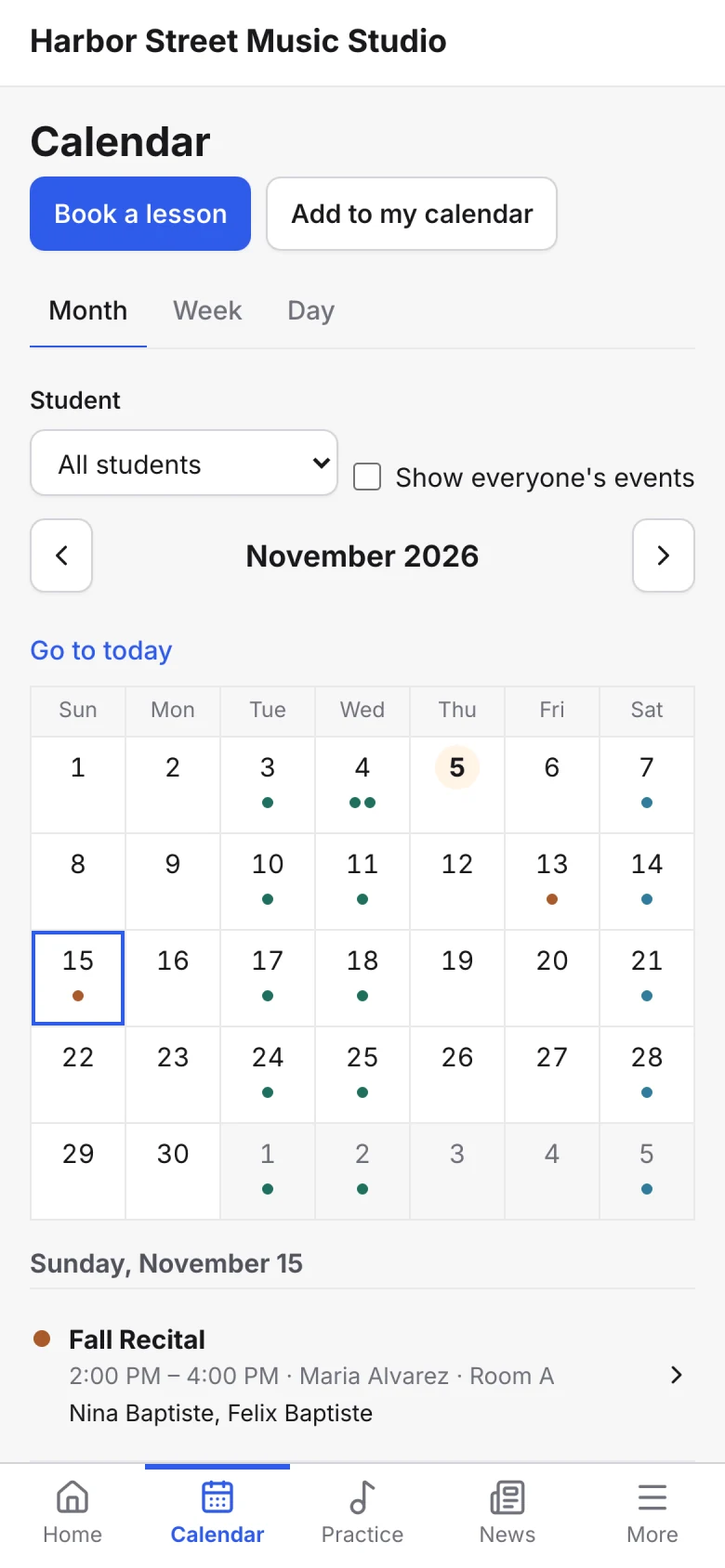
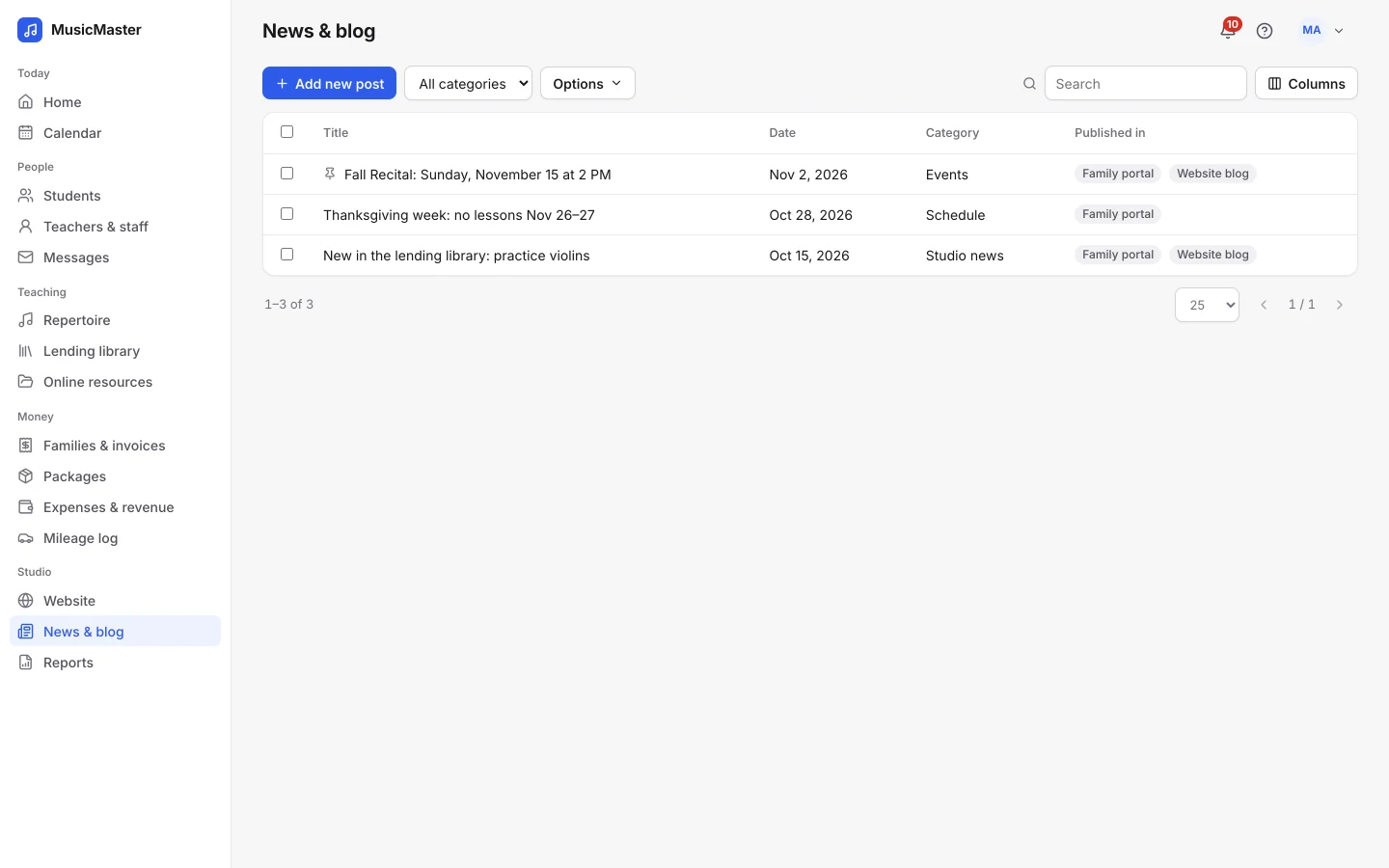
You can post the running order to the family portal as studio news and pin it to the top, and email every family their own copy of the invitation, with names filled in, now or at a time you schedule. After the day, give each performance a grade and comments, and they stay on the student’s Performances tab with the piece they played. See repertoire and performances for the details.
The weeks before a recital are when students practice most, so it’s a good time to bring out a fresh practice log with tempo targets for the recital piece. And if you charge a recital fee, put it in your studio policy at the start of the term.