Quick answer
A private music lesson plan has five parts: a check-in on the week’s practice, a warm-up or technique, work on repertoire, something new (reading, theory, ear training or a new piece), and a clear assignment for the week. Scale each part to the lesson’s length. Copy the templates below for a first lesson, a weekly lesson, a group class, a general music class, lesson notes and a term plan.
Key takeaways
- A private music lesson plan has five parts, in this order: check-in, warm-up and technique, repertoire, something new, and perform and assign.
- Keep the same five parts at every length and let repertoire take the extra time: about 14 minutes of a 30-minute lesson, 19 of 45 and 25 of 60.
- End each piece’s section with correct play-throughs: Duke, Simmons and Cash (2009) found a higher share of correct attempts, not more practice time, went with better playing the next day.
- Lesson notes get read when they are three to six lines, sent the same day, and lead with one specific thing that went well.
- In a 12-week term, put the performance in week 11, so the last week is for looking back and setting next term’s goals.
On this page
- What goes in a music lesson plan template?
- How should you structure a 30, 45 or 60-minute lesson?
- How do you adapt a lesson plan for different students?
- Lesson plan template: first lesson with a new student
- Lesson plan template: regular weekly lesson
- Lesson plan template: elementary general music class
- Lesson plan template: group class
- How do you write lesson notes families actually read?
- How do you plan a term of music lessons?
- Questions
A music lesson plan template gives every lesson the same five parts: a quick check-in on the week’s practice, a warm-up or technique, work on repertoire, something new, and a clear assignment for the coming week. The plan doesn’t need to be long. Five lines written before the lesson keep it from turning into 30 minutes on one piece, and the same five lines after the lesson become the notes you send home. Below are timings for 30, 45 and 60-minute lessons and templates you can copy, for private lessons, group classes and elementary general music.
Every template below is plain text. Paste it into Word or Google Docs, set the font to Courier New so the lines stay even, and save a PDF to print or reuse. The first lesson, weekly lesson and group class plans also come ready to download, as a printable PDF and a Word file, with no sign-up.
What goes in a music lesson plan template?
A useful private music lesson plan covers five things, in this order:
- Check-in. Read the practice log, ask how the week went, and hear the passage the student found hardest.
- Warm-up and technique. Scales, exercises, long tones or rudiments, chosen to serve this term’s pieces.
- Repertoire. The main work of the lesson: one or two pieces, each with one focus for today.
- Something new. Sight-reading, theory, ear training, improvising, or starting a new piece.
- Perform and assign. A play-through of something, then the week’s goals written down.
Above those five sits the term goal (what the student is working toward this term), and below them a private note for yourself about what to pick up next week.
How to make a music lesson plan in five minutes
Start from what you already know about the student, and decide one thing per part rather than writing a script.
- Read the term goal and last week’s private note. They tell you what this lesson is for.
- Check last week’s goals, and the practice log if you can see it before the lesson.
- Choose one focus for each piece, such as “bars 9 to 16, hands together”, not “work on the Minuet”.
- Pick this week’s “something new”, rotating reading, theory, ear training and improvising across the weeks so none of them disappears.
- Draft the three goals you expect to assign, then change them after the lesson to match what you actually heard.
- Write in the timings for the lesson’s length from the table below.
How should you structure a 30, 45 or 60-minute lesson?
Keep the same five parts at every length, and let repertoire take the extra time in longer lessons. These timings are a starting point, not a rule.
| Part | 30 minutes | 45 minutes | 60 minutes | What happens |
|---|---|---|---|---|
| Check-in | 3 | 4 | 5 | Practice log, last week’s goals, the hardest spot |
| Warm-up and technique | 5 | 8 | 10 | Scales, exercises, tone, rhythm |
| Repertoire | 14 | 19 | 25 | One or two pieces, one focus each |
| Something new | 5 | 9 | 12 | Reading, theory, ear, improvising, a new piece |
| Perform and assign | 3 | 5 | 8 | A play-through, then the week’s goals |
A 30-minute lesson suits most young beginners. A 45-minute lesson gives intermediate students time for two pieces and real reading work. A 60-minute lesson suits advanced students and anyone preparing for an exam, audition or recital.
Two habits make any length work better. First, end each piece’s section with a few correct play-throughs at a tempo the student can manage. In a study by Duke, Simmons and Cash (2009), advanced pianists who played a higher share of their practice attempts correctly played the passage better the next day, while total practice time made no significant difference. Second, with older students, move between pieces rather than finishing one before starting the next: in a small study of ten advanced clarinetists, Carter and Grahn (2016) found that music practiced in rotating turns was rated better whenever raters scored the two methods differently.
How do you adapt a lesson plan for different students?
Keep the five parts for every student, and change the size and the order of the activities inside them. A plan that works for a ten-year-old pianist will lose a five-year-old in ten minutes and bore an adult who wants to understand why.
| Student | What to change in the plan |
|---|---|
| Young beginner, 4 to 7 | Five or six activities of three to five minutes. Move between the instrument, the floor and the table. Tell a story about each piece (who is the elephant, and where is it going?) to teach character and dynamics. End on something they can already do. |
| School-age beginner | Keep repertoire short and frequent: two or three small pieces rather than one long one. Put a rhythm or note-reading game in “something new” every week. |
| Teenager | Let them choose one piece a term. Ask them to set one of the week’s goals themselves, and ask how they would practice the hard spot before you tell them. |
| Adult beginner | Explain the reason behind each exercise. Plan around the music they came to play, and expect less practice time than a child with a parent at home. |
| Advanced or exam student | Give repertoire the most time, rotate between pieces, and add a full performance run-through every two or three weeks. Plan backward from the exam or audition date. |
The same plan works online with two changes: allow a minute or two at the start for sound and camera checks, and send any sheet music before the lesson so you aren’t sharing screens mid-lesson. Our guide on how to teach music lessons online covers the setup.
Lesson plan template: first lesson with a new student
The first lesson has three jobs: get to know the student, find out where they are, and send them home able to play something. Leave room for the parent’s questions, and keep the paperwork (policy, payment, schedule) to email before the lesson rather than lesson time.
FIRST LESSON PLAN                    Length: ___ minutes
Student: ________________  Age: ___  Instrument: _______
Parent or guardian: ______________  Contact: ___________
Experience: [ ] none  [ ] some, ___ years with __________

BEFORE THE LESSON
[ ] Studio policy, calendar and payment details sent
[ ] Book or materials ready: ___________________________
[ ] Instrument at home?  Size or setup checked: ________

1. WELCOME (5 min)
   Why do you want to learn? What music do you love?
   What would you like to play by the end of the year?
   ____________________________________________________

2. SHOW AND LISTEN (5 to 10 min)
   [ ] I play something short for them
   [ ] They play anything they know
   Reading ___  Rhythm ___  Ear ___  Technique ___

3. FIRST SKILLS (10 to 25 min)
   Posture and setup: _________________________________
   First sound or first piece: ________________________
   What they can play by the end of today: ____________

4. HOW PRACTICE WORKS (5 min)
   Days a week: ___   Minutes a day: ___
   [ ] Practice log given and explained
   [ ] Parent shown what to listen for at home

5. ASSIGNMENT (3 min)
   1. _________________________________________________
   2. _________________________________________________

AFTER THE LESSON
[ ] Lesson notes sent to the family
[ ] First-term goals written down: _____________________
Spend most of the lesson on “first skills”, even with a student who has played before. A student who leaves able to play one thing, however small, comes back motivated.
Lesson plan template: regular weekly lesson
This is the plan you will use most. Fill in the timings for the lesson length, and write today’s focus for each piece before the student arrives.
WEEKLY LESSON PLAN    Student: ___________  Date: _______
Length: [ ] 30  [ ] 45  [ ] 60 min      Lesson no. ___
Term goal: _____________________________________________

1. CHECK-IN (___ min)
   Practice log: days ___  minutes ___
   Hardest spot this week: ____________________________
   Last week’s goals:  1 ___  2 ___  3 ___
   (done / getting there / not yet)

2. WARM-UP AND TECHNIQUE (___ min)
   Scales or exercises: ___________________  Tempo: ___

3. REPERTOIRE (___ min)
   Piece: _______________  Focus today: _______________
   Piece: _______________  Focus today: _______________

4. SOMETHING NEW (___ min)
   [ ] Sight-reading  [ ] Theory  [ ] Ear training
   [ ] Improvising    [ ] New piece: __________________

5. PERFORM AND ASSIGN (___ min)
   Play-through of: ___________________________________
   This week’s goals:
   1. _________________________________________________
   2. _________________________________________________
   3. _________________________________________________

PRIVATE NOTE FOR NEXT WEEK
________________________________________________________
The week’s goals at the bottom should match the student’s practice log line for line. Our free printable music practice log has the same three goal lines, so you can copy them straight across.
Example: a filled-in piano lesson plan for kids (30 minutes)
Here is the weekly plan filled in for an eight-year-old in her second year of piano, so you can see how short each line can be.
WEEKLY LESSON PLAN    Student: Maya, 8      Date: Nov 10
Length: [x] 30 min                          Lesson no. 9
Term goal: Minuet in G hands together for the winter recital

1. CHECK-IN (3 min)
   Practice log: days 5  minutes 85
   Hardest spot this week: bar 12, the left-hand jump
   Last week’s goals:  1 done  2 getting there  3 done

2. WARM-UP AND TECHNIQUE (5 min)
   G major scale, hands separately, one octave  Tempo: 72

3. REPERTOIRE (14 min)
   Piece: Minuet in G   Focus today: bars 9 to 16, hands together
   Piece: Lightly Row   Focus today: walk on, bow, no stops

4. SOMETHING NEW (5 min)
   [x] Sight-reading: two lines from the level 2 reader

5. PERFORM AND ASSIGN (3 min)
   Play-through of: Minuet in G, bars 1 to 8, no stops
   This week’s goals:
   1. Minuet bars 9 to 16 hands together, 3 times a day
   2. Bar 12 left hand alone, 5 slow times before playing
   3. G major scale, right hand, at 72

PRIVATE NOTE FOR NEXT WEEK
Bar 12 is a fingering problem, not a practice one: try 5 on the G.
Lesson plan template: elementary general music class
A general music class plan adds three things a private lesson plan doesn’t need: the standards and objective the lesson serves, a change of pace to keep 25 children with you, and a quick check of who has the skill. In the US, many districts plan against the National Core Arts Standards, which group music into four artistic processes: Creating, Performing, Responding and Connecting, with eleven anchor standards across them.
GENERAL MUSIC LESSON PLAN   Grade: ___   Classes: _________
Date or week: ________      Length: [ ] 30  [ ] 45  min

STANDARDS
[ ] Creating   [ ] Performing   [ ] Responding   [ ] Connecting
Anchor standard(s): ___   District standard: ______________

OBJECTIVE
Students will ________________________________________________
(for example: keep a steady beat on a drum while singing)

SONGS AND CONCEPTS
Review: ___________________   New: __________________________
Vocabulary: __________________________________________________
Materials: [ ] instruments ______ [ ] recording [ ] projector

LESSON
1. OPENING ROUTINE (___ min): hello song, echo rhythms, warm-up
   ___________________________________________________________
2. MAIN FOCUS (___ min): the new concept or skill
   ___________________________________________________________
3. MOVEMENT OR GAME (___ min): singing game or dance using it
   ___________________________________________________________
4. SECOND FOCUS (___ min): contrast, such as listening or
   instruments if the main focus was singing
   ___________________________________________________________
5. CLOSING (___ min): exit question or goodbye song
   Exit question: ____________________________________________

ASSESSMENT
How: [ ] watch the group  [ ] individual check  [ ] exit question
Not yet: _____________________________________________________

REFLECTION
What worked: _________________________________________________
Change next time: ____________________________________________
Taught to: [ ] class ____ [ ] class ____ [ ] class ____
Suggested timings, ours rather than a rule: for a 30-minute class, about 5 minutes opening, 10 main focus, 5 movement, 7 second focus and 3 closing. For 45 minutes, about 5, 15, 8, 12 and 5. Put the main focus early, while attention is highest, and the movement right after it.
Adjust the plan to the grade, not just the length. The National Core Arts Standards for music are written grade by grade from pre-K to grade 8, then at three high school levels (Proficient, Accomplished and Advanced). Each pre-K to grade 8 standard has a code that names its grade: MU:Cr1.1.2 is the grade 2 version of the first Creating standard. Write that code on the anchor standard line, so the plan shows which grade’s expectation it serves. Within the same five-part plan, our suggested starting points by grade band:
| Grades | Length of each activity | What the lesson leans on |
|---|---|---|
| K to 2 | 3 to 5 minutes, with movement between them | Steady beat, echo singing, singing games, unpitched percussion |
| 3 to 5 | 5 to 10 minutes | Reading rhythm and pitch notation, recorder or barred instruments, rounds and partner songs |
| 6 to 8 | 10 to 15 minutes | Ensemble playing, composing and arranging, listening with discussion, some student choice |
Lesson plan template: group class
A group class needs more structure than a private lesson, because every minute is shared. Plan activities everyone does together, and rotate short individual check-ins across weeks rather than hearing every student every week.
GROUP CLASS PLAN    Class: _______________  Date: _______
Length: ___ min    Students: ___    Level: ______________
Class goal this term: __________________________________

ARRIVAL (5 min)
   Activity while everyone arrives: ___________________

WARM-UP TOGETHER (5 to 10 min)
   Rhythm or technique game: __________________________

REPERTOIRE (15 to 20 min)
   Class piece: ________________  Parts: ______________
   Play in: [ ] unison  [ ] parts  [ ] pairs  [ ] solos
   Individual check-ins today: ________  ________
   (rotate so everyone gets one every two or three weeks)

THEORY OR EAR GAME (10 min)
   Concept: _______________  Game: ____________________

ENSEMBLE PLAY-THROUGH (5 min)
   ____________________________________________________

ASSIGNMENT (3 to 5 min)
   For everyone: ______________________________________
   Personal goals: on each student’s practice log

AFTER CLASS
[ ] Attendance taken
[ ] One class note sent to all families
[ ] Private note on: ___________________________________
For more on running classes, see how to run group piano and music lessons. In Sonely, a group class lets you take attendance for everyone at once and write one note that every student in the class sees, plus a private one for teachers.
How do you write lesson notes families actually read?
Lesson notes get read when they are short, specific, sent the same day, and look the same every week. Families scan them on a phone in the car, so three to six lines is the right length. Lead with one specific thing that went well, then the assignment, then one thing a parent can listen for at home.
[Student]’s lesson, [date]

Today: [one specific thing that went well]

This week:
1. [Piece or skill]: [what to do, how many times or how fast]
2. [Piece or skill]: [what to do]
3. [Optional third goal]

Listen for: [one thing a parent can hear at home]

Next lesson: [day, date, time]. [Any admin, such as a
recital form due Friday]
The difference between a note families read and one they skip:
- Skipped: “Good lesson today. Keep working on the Minuet and scales. Practice every day!”
- Read: “Today: you played the first line of the Minuet with no stops. This week: (1) Minuet bars 9 to 16, hands separately, 3 times a day. (2) G major scale, right hand, slowly. Listen for: a steady beat, no pauses before the hard chord in bar 12. Next lesson: Tuesday at 4:30.”
Start with the win for a reason. In a meta-analysis by Deci, Koestner and Ryan (1999), positive feedback increased people’s interest in a task and their choice to keep doing it, while tangible rewards tended to reduce it. Specific praise in the first line of every note is the cheapest motivation a studio has. Keep business (invoices, schedule changes, policy reminders) out of the lesson part of the note, or at the very end, so the music isn’t buried.
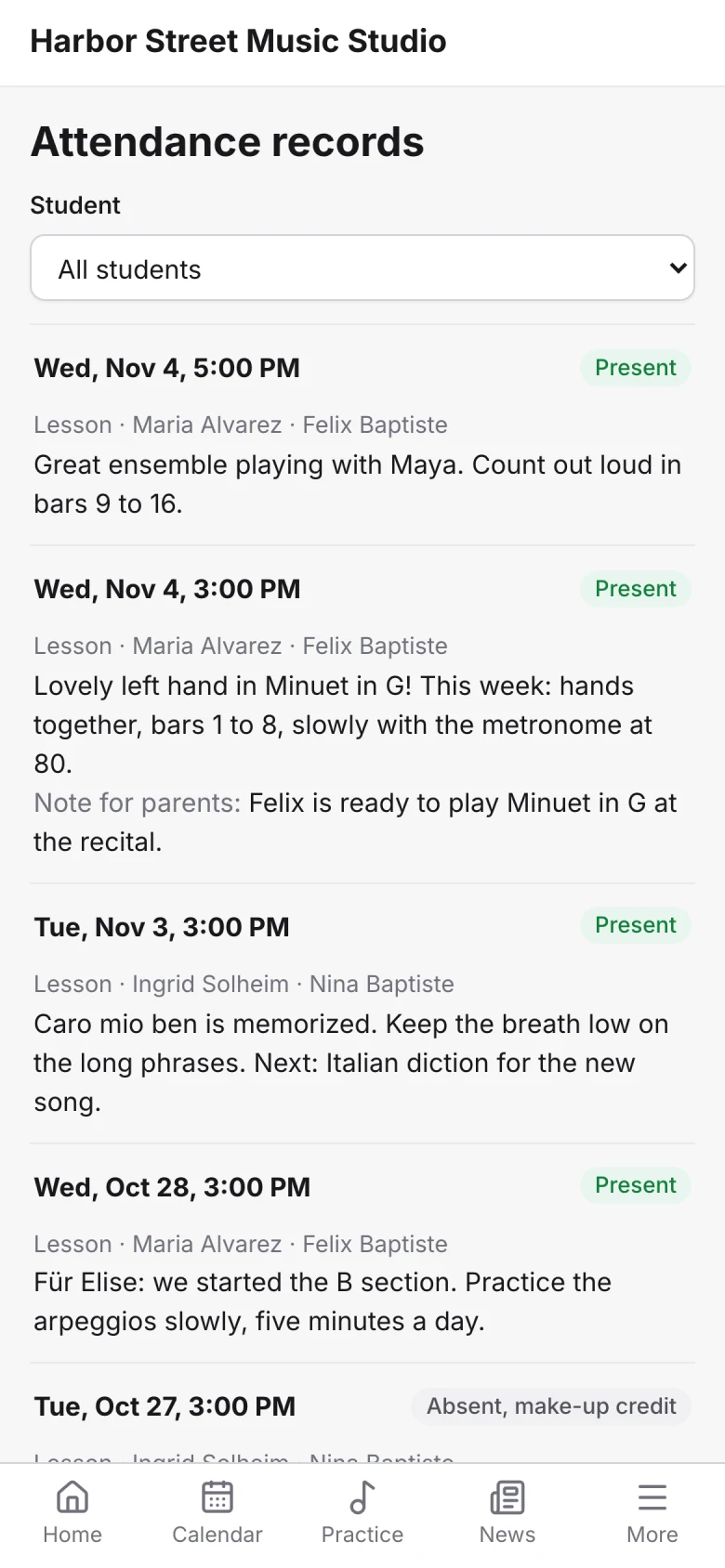
If you take attendance in Sonely, the notes are part of it. Each lesson has notes for the student and family and private notes only teachers see. You can start from a saved template, read the student’s earlier notes in the History tab while you write today’s, and email the notes to the student or parent when you save. Families also read them in the family portal, under each lesson in their attendance records. See attendance and lesson notes for how it works.
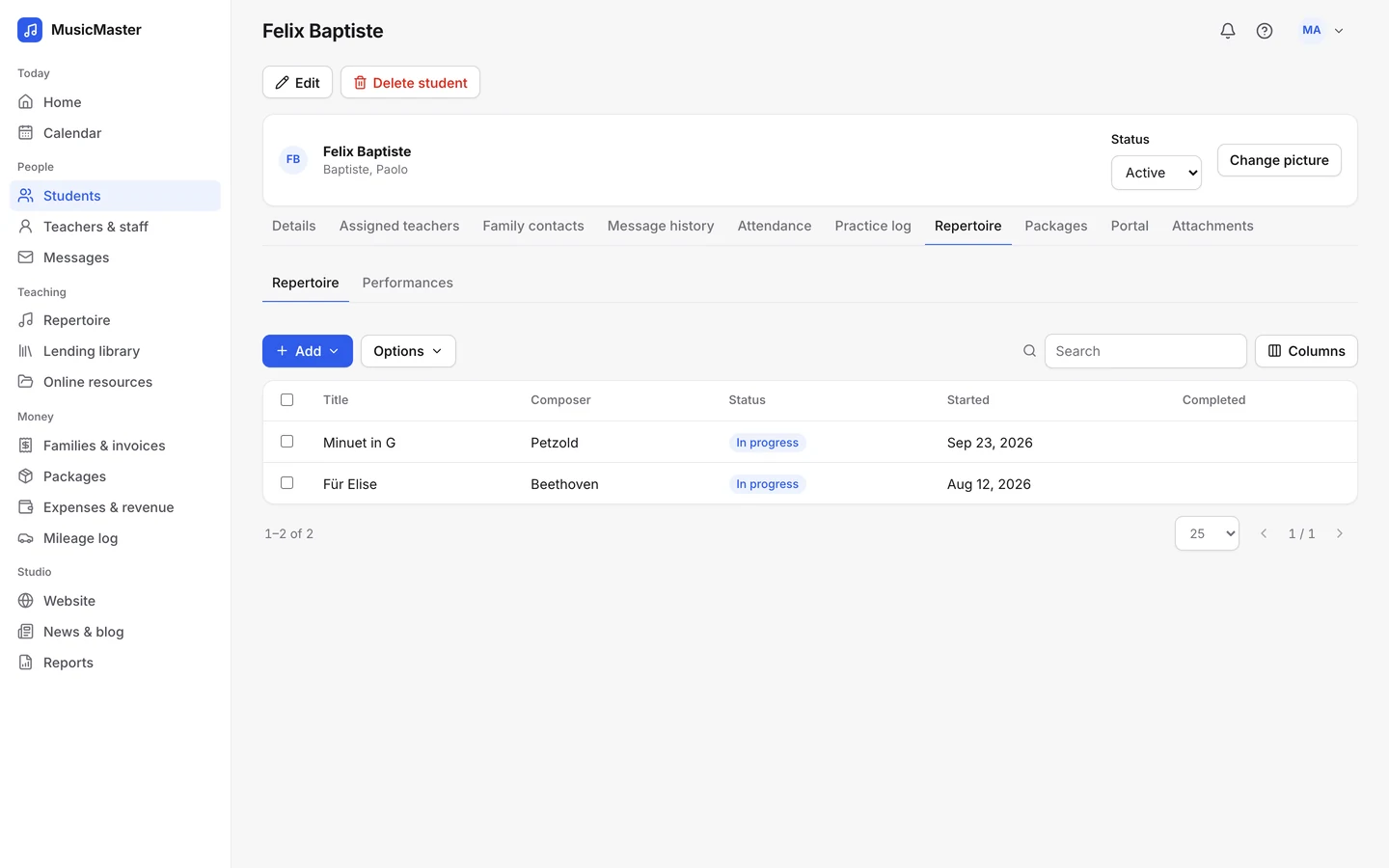
From the same lesson panel you can assign a new piece by typing its title, and it joins the student’s repertoire.
How do you plan a term of music lessons?
A term plan sets the goals and repertoire for 10 to 15 weeks, so each weekly plan has somewhere to go. Write it at the start of the term with the student (and the parent, for children): two or three goals, the pieces that serve them, and the performance the term builds toward.
| Weeks (12-week term) | Focus | How you check it |
|---|---|---|
| 1 and 2 | Set the term’s goals with student and family, choose repertoire, start new pieces | Goals written on the student’s record |
| 3 to 6 | Learn notes and rhythms; technique the pieces need | Practice log reviewed every lesson |
| 7 | Mid-term check: play everything, adjust goals | A short progress note to the family |
| 8 to 10 | Polish, memorize if planned, performance practice in lessons | A recording at home of each piece |
| 11 | Perform: recital, studio class or a recording for family | Feedback on the performance |
| 12 | Review the term, choose next term’s pieces, set new goals | Term summary in the lesson notes |
Put the performance in week 11, not week 12, so the last week is for looking back and planning ahead instead of a last-minute rush. If the term ends in a studio recital, our guide on how to plan a music recital has a timeline that lines up with this one.