Quick answer
The BLS doesn’t track piano teachers alone, but self-enrichment teachers, the group that includes employed music instructors, earned a median $22.50 an hour in May 2025 ($46,800 a year at full time), and the top 10% made $44.63 or more. Self-employed teachers aren’t counted. A private studio of 30 weekly half-hour students at $40 grosses about $50,400 a year before costs and tax.
Key takeaways
- Self-enrichment teachers, the BLS group that includes employed music instructors, earned a median $22.50 an hour in May 2025, or $46,800 a year at full time.
- The top 10% earned $44.63 an hour or more, and among the states compared here, medians ran from $17.38 an hour in Texas to $27.78 in New York.
- BLS wage data leaves out the self-employed, so it does not describe piano teachers who run their own studios.
- A private studio of 30 weekly half-hour students at $40, billed for 42 weeks, grosses $50,400 a year and keeps about $46,048 before tax after card fees and costs.
- Independent teachers in MTNA’s 2024 member survey charged an average of $65.72 for a 60-minute lesson (median $60), and teachers employed by schools kept an average of 63% of the lesson fee.
On this page
How much do piano teachers make? In the US, employed piano and music teachers fall in the Bureau of Labor Statistics group for self-enrichment teachers, which earned a median $22.50 an hour in May 2025, or $46,800 a year at full time. The top 10% earned $44.63 an hour ($92,840 a year) or more, and piano teacher job postings on Indeed averaged $35.91 an hour in November 2026. Self-employed private teachers are not in those figures: their income is students times rate times weeks, minus costs, and a full studio of 30 weekly half-hour students at $40 a lesson grosses about $50,400 a year.
How much do piano teachers make, according to the BLS?
The BLS doesn’t publish a figure for piano teachers alone. Private piano and music instructors fall under self-enrichment teachers (SOC 25-3021), a group O*NET describes as teaching “for the primary purpose of self-enrichment or recreation.” Its sample job titles include Music Instructor and Piano Teacher, alongside art, dance and martial arts instructors.
The latest release is the Occupational Employment and Wage Statistics (OEWS) survey for May 2025:
- Self-enrichment teachers earned a median wage of $22.50 an hour in May 2025, according to the BLS OEWS survey.
- The BLS OEWS survey counted 332,110 self-enrichment teachers on employers’ payrolls in May 2025.
- The top 10% of self-enrichment teachers earned $44.63 an hour or more in May 2025, and the bottom 10% earned $14.45 or less, according to the BLS.
- The mean wage of self-enrichment teachers was $26.32 an hour, or $54,740 a year, in May 2025, according to the BLS.
| Percentile | Hourly wage | Annual wage |
|---|---|---|
| 10th | $14.45 | $30,050 |
| 25th | $17.49 | $36,380 |
| 50th (median) | $22.50 | $46,800 |
| 75th | $30.39 | $63,210 |
| 90th | $44.63 | $92,840 |
| Mean | $26.32 | $54,740 |
Source: BLS OEWS, May 2025, national estimates for 25-3021 Self-Enrichment Teachers (percentiles as published on O*NET OnLine; employment and mean from the BLS’s May 2025 national table).
Read these numbers with two caveats:
- They leave out the self-employed. The BLS says the OEWS survey “does not include the self-employed.” Piano teachers who run their own studios are not in the table; it describes teachers on someone else’s payroll, such as music schools and community programs. The BLS employment projections, which do count self-employed workers, put the whole group at 419,100 in 2025 (as reported on O*NET).
- The annual figure assumes a full-time year. The median annual wage is exactly the hourly median times 2,080 hours (40 hours a week, 52 weeks). Private music teaching is often part-time and happens after school, so the hourly figure is usually the more useful one.
Piano teacher salary by state
Pay follows the local cost of living. Self-enrichment teachers in New York earned a median $27.78 an hour in May 2025, the highest of the ten states below, according to the BLS. Self-enrichment teachers in Texas earned a median $17.38 an hour in May 2025, the lowest of the ten.
| State | Median hourly | Median annual |
|---|---|---|
| New York | $27.78 | $57,790 |
| Georgia | $25.15 | $52,320 |
| California | $23.83 | $49,570 |
| Massachusetts | $23.77 | $49,430 |
| Washington | $23.09 | $48,020 |
| Florida | $22.04 | $45,830 |
| Illinois | $21.26 | $44,230 |
| Arizona | $21.21 | $44,110 |
| Ohio | $17.96 | $37,360 |
| Texas | $17.38 | $36,140 |
| United States | $22.50 | $46,800 |
Source: BLS OEWS, May 2025, state estimates for 25-3021, as published on O*NET OnLine’s state wage pages.
What do job sites say piano teachers make?
Piano teacher job postings on Indeed paid an average of $35.91 an hour in the US, based on about 3,400 salaries posted in the 36 months to November 8, 2026. Indeed’s typical range for piano teachers runs from $23.48 to $54.92 an hour, as of November 2026. Unlike the BLS figures, these are for the job title piano teacher itself. They come from what employers advertise, such as music schools, stores and private schools, not from what studio owners earn.
| City | Average hourly pay on Indeed |
|---|---|
| Boston, MA | $45.69 |
| San Jose, CA | $45.54 |
| New York, NY | $44.92 |
| Denver, CO | $39.29 |
| Houston, TX | $38.00 |
| United States | $35.91 |
Source: Indeed, piano teacher salaries in the United States, updated November 8, 2026.
Where do music teachers earn more?
College music faculty earn the most, but they are a separate occupation. The BLS group for postsecondary art, drama and music teachers (SOC 25-1121) had 93,560 jobs in May 2025, according to the BLS OEWS survey. Postsecondary art, drama and music teachers earned a median $78,620 a year in 2025, according to O*NET’s summary of BLS wage data. Those are faculty jobs, a different career from running a private studio.
For lesson teachers, the employer’s share of the fee matters as much as the rate. Music teachers on the staff of schools, academies and stores in MTNA’s 2024 member survey reported an average fee of $80 for a 60-minute lesson in 2023–24, with a median of $65. Those staff teachers received an average of 63% of the lesson fee in 2023–24, down from 69% in 2020, according to MTNA. Independent teachers in the same survey charged less, an average of $65.72, but kept the whole fee and paid their own costs.
How much does a private piano teacher make?
A private teacher’s income is students times rate times weeks, minus costs and taxes. Start with the rate. The closest thing to a national figure for studio owners is the Music Teachers National Association’s 2024 member survey, which asked independent teachers what they charge. Independent teachers in MTNA’s 2024 survey reported an average of $65.72 for a 60-minute lesson in the 2023–24 school year, up from $56.58 in 2020. The median 60-minute fee in the same MTNA survey was $60 for 2023–24. The respondents are MTNA members, so the figures describe teachers active in a professional association, not every teacher.
Here is a worked example for a home studio. The rate, $40 for a weekly 30-minute lesson, sits between the 2026 half-hour rates at Oberlin Community Music School in Ohio ($36.63 in fall 2026) and the UNCSA Community Music School in North Carolina ($44). Every other input is an example; use your own.
| Line | Example | Amount |
|---|---|---|
| Students | 30 weekly 30-minute lessons (15 teaching hours a week) | |
| Rate | $40 a lesson | |
| Weeks billed | 42 | |
| Gross tuition | 30 × $40 × 42 | $50,400 |
| Card fees | 300 monthly payments of $168 at Stripe’s 2.9% + 30 cents | −$1,552 |
| Other costs | Materials $600, recitals $800, instrument upkeep $400, website and phone $500, training $500 | −$2,800 |
| Profit before tax | $46,048 | |
| Per teaching hour | $46,048 ÷ 630 hours | $73.09 |
| Per working hour | Adding 6 hours a week of prep and admin: $46,048 ÷ 882 hours | $52.21 |
That $52 an hour looks far above the BLS median of $22.50, but the two aren’t directly comparable. An employee’s wage comes after the employer has paid for the room, the marketing and half of Social Security and Medicare. The private teacher pays all of those out of the $46,048, plus income tax, with no paid holidays.
Studio size and rate change the picture quickly. The example’s $40 half-hour is $80 an hour, above the MTNA average, so the table also shows the MTNA median of $60 an hour ($30 a half-hour), both over 42 weeks:
| Weekly students | Teaching hours a week | Gross a year at $40 a half-hour | Gross a year at $30 (MTNA median) |
|---|---|---|---|
| 10 | 5 | $16,800 | $12,600 |
| 20 | 10 | $33,600 | $25,200 |
| 30 | 15 | $50,400 | $37,800 |
| 40 | 20 | $67,200 | $50,400 |
Location moves the result as much as studio size. The same 30 weekly half-hour students, billed for 42 weeks, gross $46,154 at Oberlin’s Ohio rate of $36.63 and $82,530 at the $65.50 the Community School of Music and Arts charges in Belmont, California. A teacher in a high-cost area can earn more from the same schedule, though rent and living costs take more of it.
The limit is not demand alone but the clock. School-age students can only come after school and on weekends, so a teacher adding students eventually runs out of sellable hours. That is why the ways to earn more, below, mostly raise what each hour brings in. To set the rate itself from your costs, see how much to charge for music lessons.
How do piano teachers raise their income?
The biggest gains come from billing for the time you reserve, not from teaching more hours. Each item below uses the studio from the worked example.
Bill tuition, not lessons
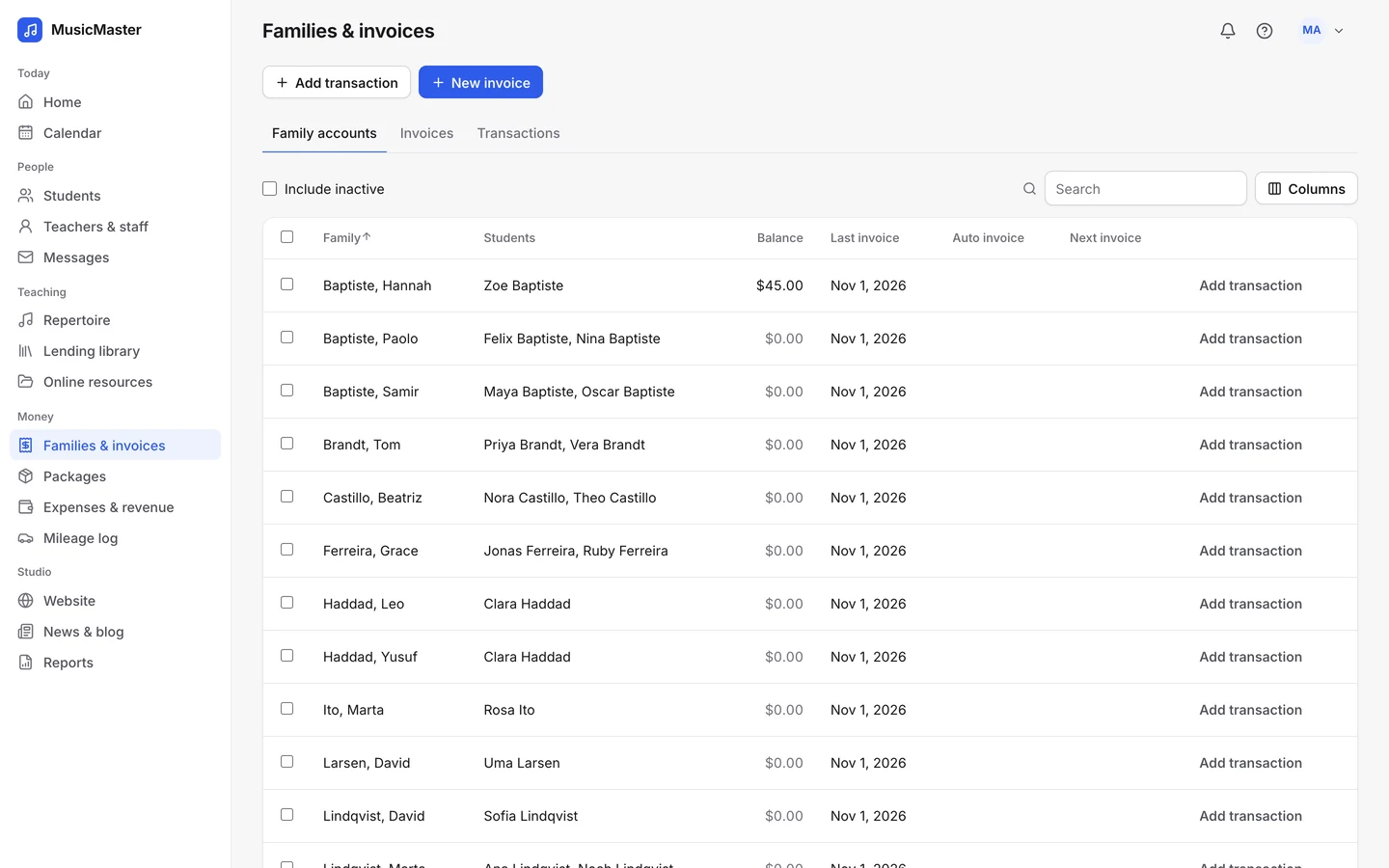
Monthly or term tuition charges for the weekly time a student holds, whether or not they come. It also makes income steadier: the Community Music School of Springfield bills a year of 35 lessons in 10 equal monthly autopayments. In the example studio, 42 lessons at $40 is $1,680 a year per student: $140 a month over 12 months, or $168 over 10. Sonely’s invoices and payments handle monthly rates and auto-pay, so the invoice goes out and the saved card pays it without you counting lessons.
Stop losing money to cancellations
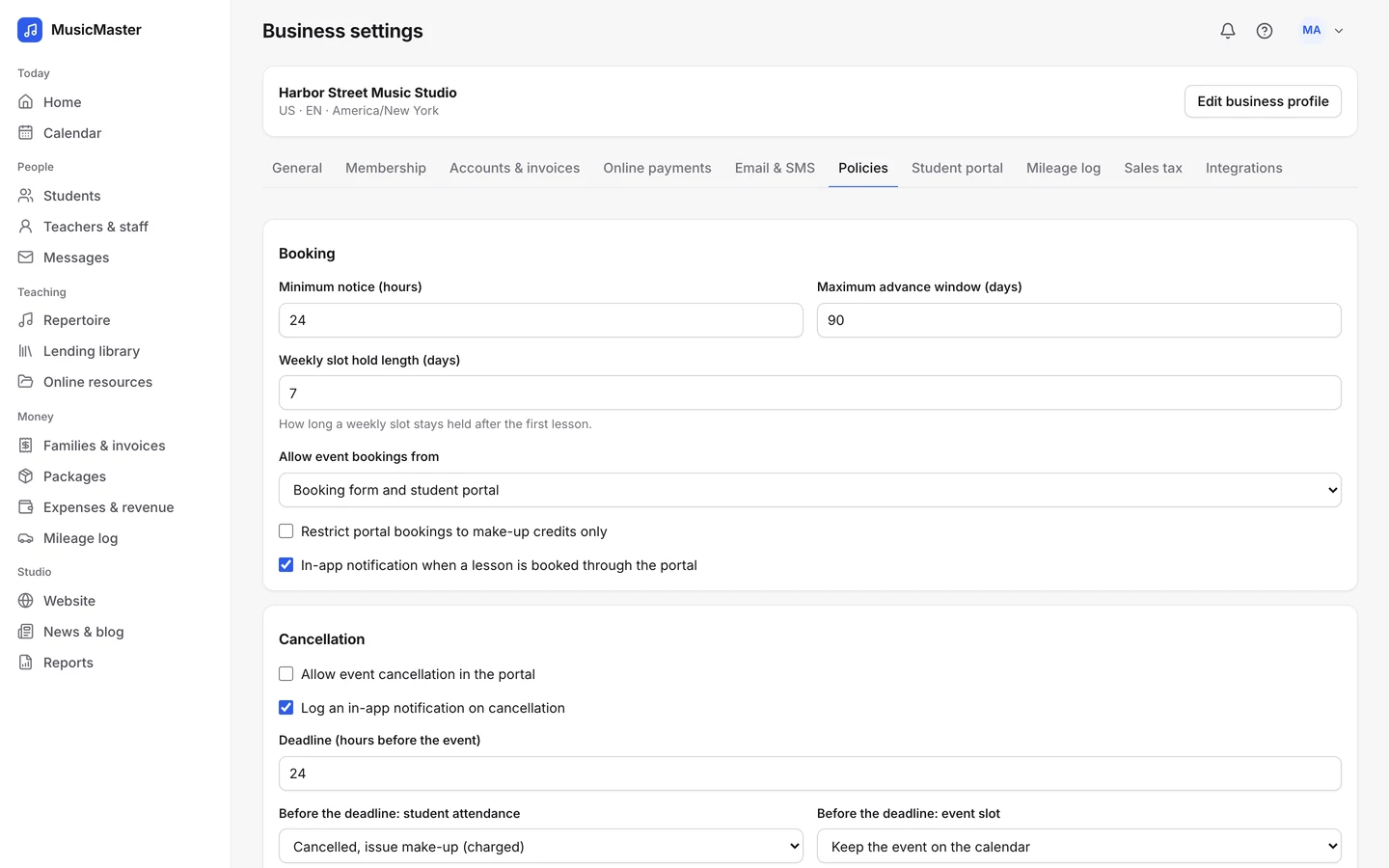
Every lesson cancelled without charge is income gone. If 5% of lessons in the example studio go unbilled, that is $2,520 a year. A written policy with a notice deadline, make-up credits that expire and a cap on credits keeps the cost small and predictable. In Sonely, attendance decides the bill: you set a cancellation deadline for the family portal, limit how many credits cancellations can earn and let unused credits expire.
Add a group class
A group class sells the same hour to several families. A weekly 45-minute class of six students paying $20 each (an example price) brings in $160 an hour, twice the $80 an hour of the private lessons. Thirty weeks of it adds $3,600. Group theory, beginner piano and ensemble classes can also bring in students who later move to private lessons. Sonely’s group classes give each student their own price and bill from attendance like any lesson, and the guide to group music lessons covers running them.
Teach more students per prime-time hour
Afternoon and early evening slots are the scarce ones. From 3:30 to 8:00 on weekdays plus four hours on Saturday is 26.5 hours a week, or 53 half-hour slots, the practical ceiling for a solo studio. Fill those first and offer adults and homeschooled students daytime times. Partner lessons, where two students share a slightly longer slot, raise income per hour without adding hours. A waitlist lets you fill a slot quickly when a student leaves; in MTNA’s 2024 survey, 43% of independent teachers kept one, with seven students on it on average. If your schedule has gaps, how to get more music students covers filling them.
Hire a second teacher
Once your own prime-time hours are full, another teacher’s hours are the way to grow. Schools work this way: in MTNA’s 2024 survey, teachers employed by schools and academies received an average of 63% of the lesson fee in 2023–24. At that split, a teacher with 20 weekly half-hour students at the example’s $40, over 42 weeks, brings in $33,600: $21,168 for the teacher and $12,432 for the studio to cover rooms, admin, marketing and any payroll costs. Sonely’s teacher payroll works out each teacher’s pay, by the hour or as a share of each lesson, from the lessons they teach, and you pay them your usual way; each extra teacher seat is $5 a month.
Raise rates every year
A 5% increase in the example studio adds $2,520 a year for the same hours. Consumer prices rose about 3.7% in the 12 months to September 2026, going by the BLS Consumer Price Index, so a studio that never raises its rate is giving itself a pay cut. Small yearly increases are also easier for families than a large jump.
Cut what you pay to get paid
Card fees in the example come to $1,552 a year. Stripe’s ACH Direct Debit charges 0.8% capped at $5, which on the same 300 payments is about $403, so moving families to bank payments saves roughly $1,150. Sonely is free for one teacher, and payments go into your own Stripe or PayPal account with no cut taken.
Keep records for tax time
Track business costs and mileage as you go. The IRS business standard mileage rate is 72.5 cents a mile for January to June 2026 and 76 cents for July to December, so 2,000 miles driven to students’ homes after July is $1,520 of cost to discuss with your accountant. Sonely’s reports, expenses and mileage log keep revenue, expenses and trips in one place. If you are still setting up, how to start a music studio covers the business basics.