Quick answer
To get more music students, start local: complete your free Google Business Profile, ask current families for referrals with a thank-you reward, and make sure your website lets a parent book a trial lesson in one visit. Then add school and community partnerships, recitals that double as open houses, and honest reviews. Keep the students you have, because every family that stays is one you don’t need to replace.
Key takeaways
- Set up three channels before spending money: a complete Google Business Profile, referrals from current families and a website where a parent can book a trial lesson in one visit.
- Google says your Business Profile name must reflect your real-world business name, without taglines or location details.
- Teachers who travel to students’ homes and don’t serve anyone at their address are a service-area business on Google and should remove the address from the profile.
- Reward referrals, never reviews: Google’s policies prohibit incentives for reviews and selectively asking happy customers for them.
- Keeping a student is cheaper than finding a new one, so send fall re-enrollment in spring, offer a summer option and send lesson notes home.
On this page
- How to get more music students: which marketing works best?
- Before you market: decide who you want to teach
- 1. Set up your Google Business Profile
- 2. Ask for referrals, and thank people who send them
- 3. Make your website book trial lessons
- 4. Partner with schools and community groups
- 5. Use recitals as marketing
- 6. Collect reviews the right way
- 7. Use social media to build trust, not reach
- 8. Write a music lesson flyer that gets calls
- How to get more music students online
- Track where each new student comes from
- Keep the students you already have
- Questions
How to get more music students, in one line: be easy to find and easy to trust in your own town. That means a complete Google Business Profile, referrals from the families you already teach, and a website where a parent can book a trial lesson in one visit. Schools, recitals and reviews build on those, social media helps last, and keeping your current students matters as much as finding new ones.
How to get more music students: which marketing works best?
For a local studio with one teacher or a few, the channels below are ranked by how much they tend to bring for the effort. Your town may differ, but marketing for music teachers on a small budget should start with the first three: set them up before spending money on anything else.
| Rank | Channel | Cost | Effort | Best for |
|---|---|---|---|---|
| 1 | Google Business Profile | Free | One afternoon, then a little each month | Being found by parents searching nearby |
| 2 | Referrals from current families | A small thank-you reward | Asking at the right moments | Every studio |
| 3 | Website with online booking and trial lessons | Low | A weekend to set up | Turning interest into a first lesson |
| 4 | Schools and community partnerships | Your time | Relationships built over a term | Teachers of children |
| 5 | Recitals as marketing | Venue and time | One or two events a year | Studios with students to show off |
| 6 | Reviews | Free | Asking after milestones | Standing out from nearby teachers |
| 7 | Social media | Free, time-heavy | Regular posting | Building trust, not reach |
| 8 | Flyers | Printing | A few hours each season | Neighborhoods, libraries, cafes |
Established teachers lean on the same channels. In the Music Teachers National Association’s 2024 member survey, 85% of independent teachers used word of mouth, 77% referrals from current students, 45% a website, 28% a Facebook page and 10% Instagram. Those figures show what teachers use rather than what works best, but they match the order above: personal recommendations first, then a place online where a parent can check you out.
Before you market: decide who you want to teach
Every channel works better when it names one kind of student. “Piano for beginners aged 5 to 9 in [Town]” tells a parent at once whether you fit, and tells the families who refer you exactly whom to send. “Music lessons for all ages and levels” tells them nothing. Pick one or two audiences to lead with:
| Audience | What they look for | Where to reach them |
|---|---|---|
| Young beginners, about 5 to 9 | A patient teacher, 30-minute lessons, after-school times | Preschools, elementary schools, parent groups |
| Band and orchestra students | Help with school pieces, auditions and festivals | School music teachers and ensemble directors |
| Teens | Music they chose, songwriting, audition preparation | School directors, recitals, short videos |
| Adult beginners and returners | Daytime or late-evening times, a package instead of a term, often online | Libraries, community education programs, workplaces, your website |
| Homeschooled students | Daytime lessons | Homeschool groups and co-ops |
How many other teachers offer the same thing matters too. In MTNA’s 2024 member survey, 32% of teachers said their town had fewer teachers of their instrument than five years earlier, 26% said more and 42% about the same. If few people near you teach what you teach, or teach adults, lead with that.
How to get more piano students
Piano teachers have a few channels of their own on top of the eight below:
- Piano stores and technicians. A family that has just bought a piano may be looking for a teacher next. Leave cards with local piano dealers and tuners, and send your families to them in return.
- Accompanying. Playing for school choirs, church services and student soloists puts you in front of parents and directors every week. In MTNA’s 2024 survey, 53% of member teachers had accompanied soloists or school ensembles in the past five years, and 65% had performed at religious services.
- Returning adults. Name adults who played as children on your website and Google profile, and offer them a short package to restart.
1. Set up your Google Business Profile
A Google Business Profile is the free listing that shows your studio on Google Maps and in local search results, with your photos, reviews and a link to your website. For a local studio it is the single most useful thing to set up first.
Check that you’re eligible. Google’s guidelines say a business qualifies if it “either has a physical location that customers can visit, or travels to customers where they are.” For music teachers, that works out like this:
- Students come to you (a home studio or a rented room): you serve customers at your address, so list it. It will be public on Google, so decide first whether you’re comfortable with that. If you also travel to some students, Google calls you a hybrid business and you enter both your address and a service area.
- You travel to students’ homes: you’re a service-area business. Google says that if you don’t serve customers at your business address, you should remove the address from your profile. Set your service area by city or postal code (not a radius), with up to 20 areas, and keep the whole area within about two hours’ drive of where you are based.
- You teach only online: you don’t have a place customers visit and you don’t travel to them, so the profile isn’t built for you. Put your effort into your website and referrals instead.
- You rent a room in a shared building: Google has separate rules for co-working spaces, including clear signage, so read them before you list that address.
Use your real studio name. Google says your profile name should reflect your business’s real-world name, and it must not include extra details such as taglines or location information. “Maple Street Piano Studio” is fine if that is your name. “Maple Street Piano Studio, Best Piano Lessons in Springfield” is not. If you want the instrument in your listing, put it in your actual name. Our list of music studio name ideas has patterns that do this.
Fill in everything. Choose the most specific category for what you teach, list each lesson type as a service with a price or a “from” price, write a plain description of who you teach, and add photos of your teaching room and of you teaching. Only use photos of students with written consent from their parents. Link the profile to your booking page, not just your home page, and post when you open new times or hold a recital.
2. Ask for referrals, and thank people who send them
Families who already love your lessons are your best marketers, but they rarely think to recommend you until you ask. Referred families also arrive trusting you, because someone they know vouched for you.
Ask at the moments when families are happiest: after a recital, at re-enrollment, when a student finishes a book, and at the start of the school year, when other parents are looking for activities. Make it specific: say which times are open and give a link that books a trial.
A small reward makes asking feel natural. Offer the referring family and the new family the same thing, such as one free lesson or a credit on the next invoice, once the new student has paid for their first month. Keep rewards for referrals only. Google’s policies prohibit offering incentives for reviews (see section 6), so never tie a reward to leaving one.
A bring-a-friend week works too: once a term, invite each student to bring a friend to part of their lesson or to a short group session, and hand the friend’s parent a card with your booking link.
Here is a message you can send by email or text:
Subject: Know a family who’d love lessons?

Hi [Parent name],

It’s been a joy teaching [Student name] this [term]. [One specific line, such as: “Her left hand in the sonatina is so much steadier since October.”]

I have [number] openings on [days and times] starting [date]. If you know a family who might enjoy lessons, I’d be grateful if you passed my name along. They can book a trial lesson here: [booking link]

As a thank-you, when a family you refer enrolls, you’ll both get [one free lesson / $[amount] off your next invoice].

Thank you,
[Your name]
[Studio name] | [Phone]
3. Make your website book trial lessons
Your website’s job is to turn a parent’s interest into a booked first lesson, ideally in one visit. A parent who has to email, wait for a reply and then negotiate a time may book someone else in the meantime.
Answer the questions every parent has at the top of the page: what you teach, which ages and levels, where, roughly what it costs, and who you are. Then give one clear button: Book a trial lesson. The full checklist is in how to build a music teacher website that books students.
Decide how to price the trial:
| Trial lesson | Why choose it | Watch out for |
|---|---|---|
| Free | Removes the last barrier for a nervous family | Some bookings from families who were never going to enroll |
| Discounted | Still easy to say yes to, with a little commitment | Explaining the regular price clearly |
| Full price | Filters for families ready to start | Fewer bookings from undecided families |
Whichever you choose, a short call before the trial helps you and the family check goals and fit. In MTNA’s 2024 member survey, 79% of independent teachers interviewed students before accepting them, up from 74% in 2020.
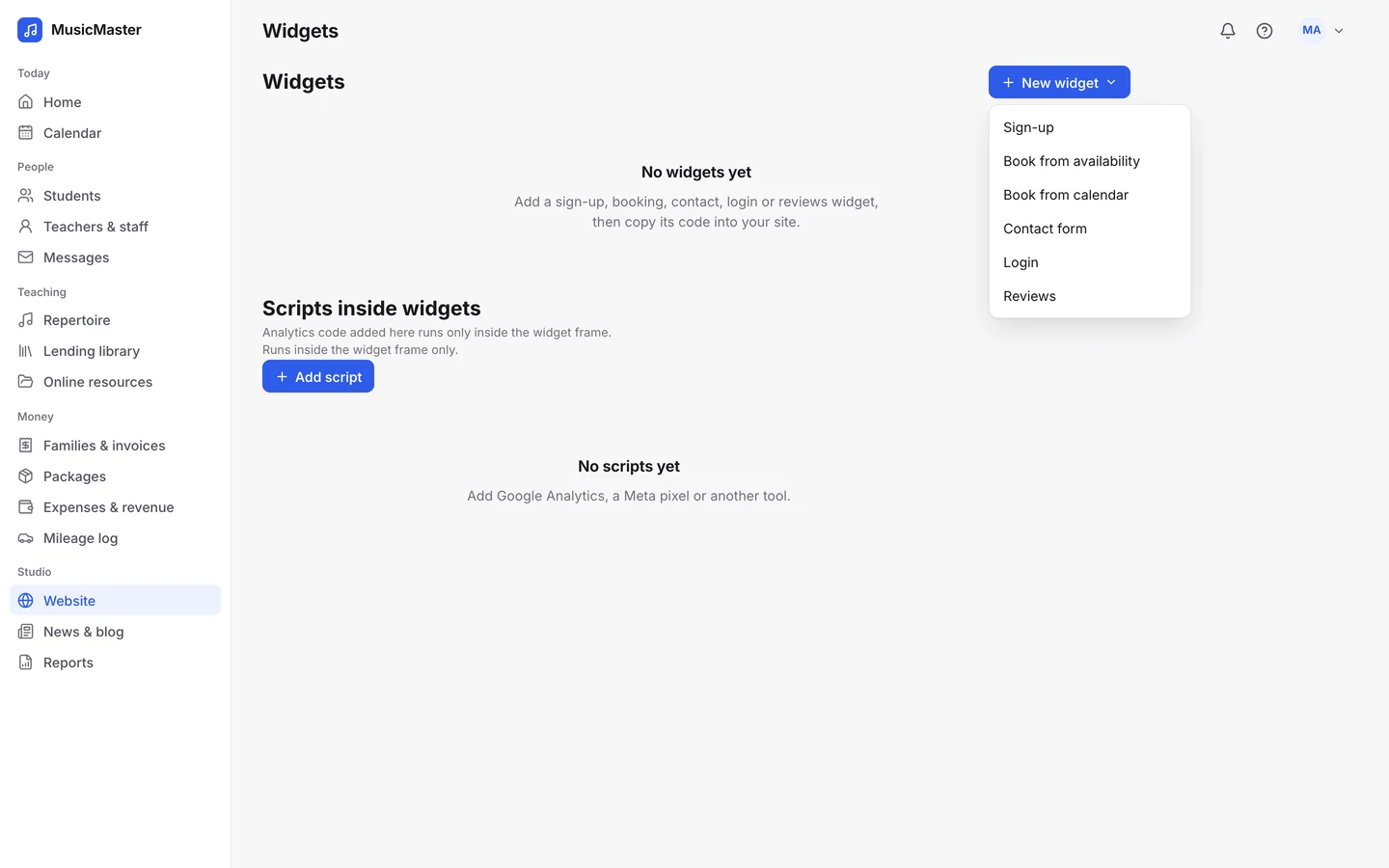
Sonely’s website builder puts a studio site on your own domain, and its booking forms let families pick an instrument, a teacher and a free time from your real availability. You can make the first lesson free, take a percentage off it, or charge for it at booking through your own Stripe or PayPal account. Each booking lands on your calendar, and the family arrives in your students list as a lead or a student.
4. Partner with schools and community groups
Schools and community groups put you in front of many families at once, through people those families already trust. These relationships take a term or two to build, and they can keep sending students for years.
- School music teachers. Introduce yourself to band, orchestra and choir directors and the elementary music teacher. Offer to coach a sectional or help students prepare for auditions. They are the people parents ask when they want a private teacher.
- School newsletters and fairs. Ask the office or the parent association what outside businesses may share. Schools often have rules, so always ask first.
- Libraries and community centers. Offer a free “try an instrument” workshop or a short talk on how to choose a first instrument.
- Homeschool groups. Homeschooled students can take daytime lessons, which fills the hours before school lets out.
- Preschools. A short music and movement visit, or a weekly introductory group class, introduces you to parents of future beginners.
- Music stores and repair shops. Some keep a list of local teachers. Leave cards, get to know the staff and send your students to them for books, rentals and repairs. Some stores also rent teaching rooms, usually for a fee or a share of tuition.
- Other kids’ activities. Dance studios, art classes, martial arts schools and tutoring centers serve the same families without competing with you. Swap flyers, or play for a dance recital.
- Teachers associations. Join MTNA’s state and local affiliates or your local band, orchestra or choir teachers’ group. Teachers there refer students they can’t take, and local festivals and competitions put you in front of families.
5. Use recitals as marketing
A recital is the one event where a prospective family can hear exactly what your students learn. Run it with guests in mind and it becomes your best open house.
- Invite each student to bring a friend, and say so in the invitation.
- Hold it somewhere public, such as a library meeting room, a church or a community hall, where guests feel welcome.
- Print your website and a QR code to your booking page on the program.
- Add a “try it” table after the last piece, where young guests can play a few notes.
- Take photos and short videos of students whose parents have consented, for your website and Google profile.
- Post a recap within a day or two, while families are still sharing it.
For the planning side, with a program template, see how to plan a studio recital.
6. Collect reviews the right way
Reviews help a parent choose between two teachers who appear in the same search. Google suggests asking customers to visit a Google link or scan a QR code to leave one, and replying to reviews so people can see their feedback matters.
Follow Google’s rules when you ask. Its policies prohibit:
- Incentives for reviews, such as free or discounted lessons in exchange for posting one.
- Asking only happy families. Merchants may not selectively solicit positive reviews.
- Reviews with a conflict of interest, such as from people you employ.
The simplest honest system is to ask every family at the same milestones: after their first recital, at the end of their first term or when a student passes an exam. Reply to every review, including the critical ones, briefly and politely.
7. Use social media to build trust, not reach
Social media rarely fills a local studio on its own, but it reassures parents who found you somewhere else. A parent who sees a year of happy students on your page trusts you before the first lesson.
- Pick one platform and post regularly, rather than four platforms now and then.
- Show progress, such as a short clip of a student’s recital piece (with consent), a milestone or a practice tip.
- Join local groups for parents and neighborhoods, such as community Facebook groups and Nextdoor, follow each group’s rules on promotion, and answer questions helpfully.
- Always link to booking, so interest has somewhere to go.
8. Write a music lesson flyer that gets calls
A good music lesson flyer says one thing clearly: who you teach, where, and how to book. Use a large headline with the instrument and town, one line about you, and a QR code that opens your booking page. Post it on library and cafe boards, in music stores and in community centers, and offer it to school newsletters where they allow it.
Copy for a general music lesson flyer:
MUSIC LESSONS IN [TOWN]
[Piano, guitar and voice] for ages [5] to adult

Private lessons with [Your name], [one line about you, such as: “teaching in [Town] since [year]”].
[At my home studio in [neighborhood] / In your home / Online]

- Weekly 30, 45 and 60-minute lessons
- Beginners and returning adults welcome
- A recital every [season]
- Lessons from $[amount] a month

Book a [free / $[amount]] trial lesson:
[Website] | [Phone]
[QR code to your booking page]
Copy for a piano lesson flyer:
PIANO LESSONS FOR BEGINNERS IN [TOWN]
Ages [5] to adult | [Neighborhood] home studio

Learn to read music and play the pieces you love, with [Your name], [one line about you].

- Weekly lessons after school and on [Saturdays]
- A recital every [season]
- First lesson [free / $[amount]]

Scan to book: [QR code]
[Website] | [Phone]

Tear-off tabs: [Studio name] piano lessons | [Website] | [Phone]
How to get more music students online
If you teach online, your market is wider, but Google Maps won’t help much: the Business Profile is built for places customers visit and areas you travel to. Put the effort here instead:
- Website pages for online lessons, with the instrument and the format in the page title (“Online piano lessons for adult beginners”), your time zone and how a lesson works on camera.
- Referrals, which travel well online. A family that moves away can keep its lessons and recommend you in its new town.
- Short videos of teaching tips or student performances (with consent), each linked to your booking page.
- Class marketplaces. Outschool lists live online classes for kids and teens, music among them, and teachers price and schedule their own classes there.
- Adult learners, who are often glad to learn online. Name them on your website and offer daytime times.
Track where each new student comes from
Ask every new family how they heard about you, and keep the answers. After a term you will know which channels bring students and which you can drop. Put the question on your sign-up form, and ask at the trial lesson if the form didn’t. In Sonely, sign-up forms tag new leads automatically, so you can see which form or season each one came from, and forms embedded on your own site report each sign-up to Google Analytics and the Meta Pixel if you use them.
Keep the students you already have
Keeping a student is cheaper than finding a new one. Every new student costs you a trial lesson, a slot left empty while you search and the hours spent marketing, while a student who stays another year costs you nothing extra. Retention is marketing too: long-staying families are the ones who refer.
Students tend to leave at predictable moments: over the summer, when the school year reshuffles schedules, after a plateau, and when practice falls off. Plan for each one.
- Re-enroll early. Send fall re-enrollment in spring, with a deadline, so families commit and you know your openings before the summer.
- Offer a summer option, such as a flexible package of lessons, so the habit doesn’t break.
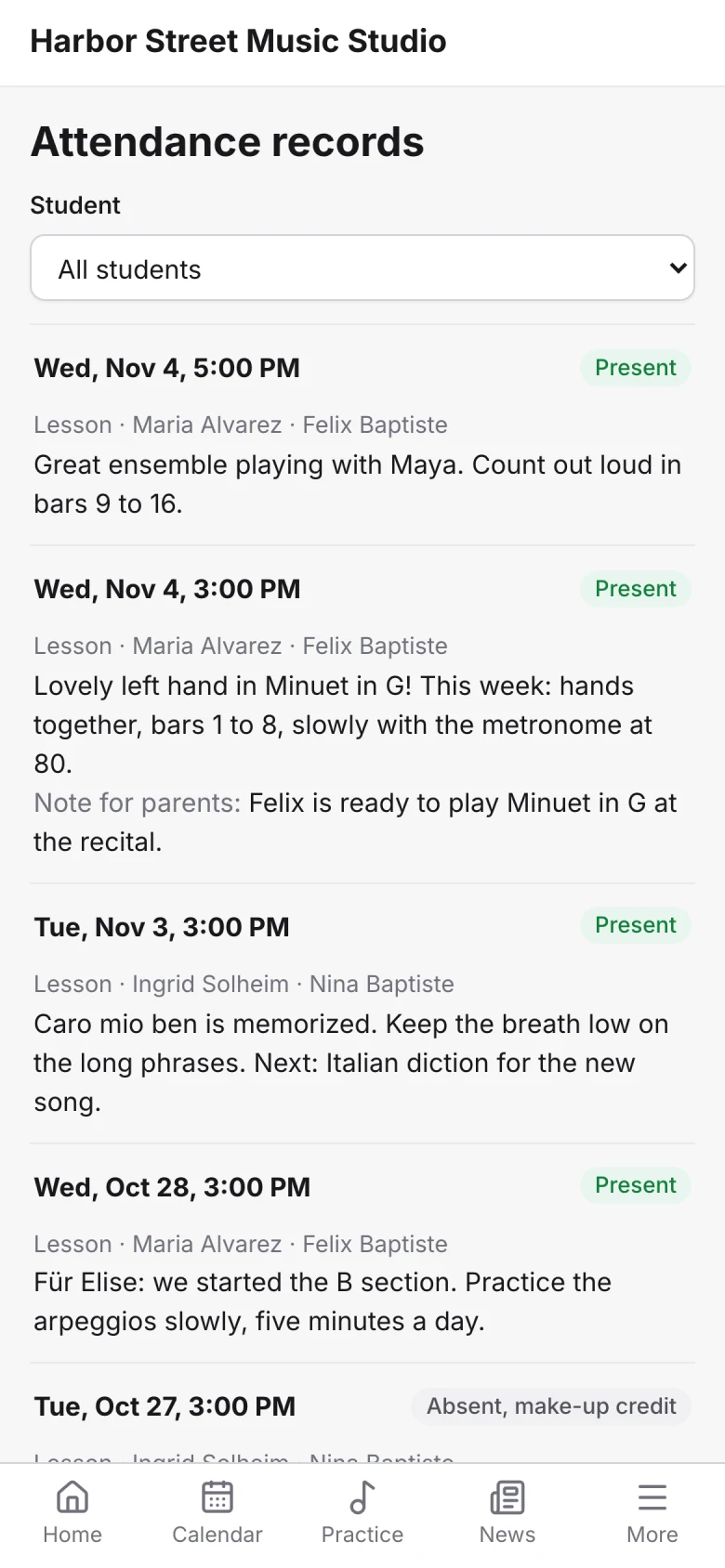
- Send lesson notes home so parents see progress every week. In Sonely, teachers can email notes to the family when they save them, and parents read them in the family portal.
- Set short goals, such as a piece for the next recital or a book to finish by winter break.
- Check in with parents once a term, by phone or a short email, before small problems become a withdrawal.
- Watch the numbers. Sonely’s Student retention report shows how many students stayed, left and joined between two dates, so you can see whether your changes work. See reports.
- Ask why families leave. One honest question at the end tells you more than any survey.
If you are just opening, how to start a music studio covers what to set up before your first marketing push.