Quick answer
A music practice log is a weekly sheet where a student records what they practiced each day, how long, and how it went. Use check boxes for young beginners, minutes and goals for intermediate students, and tempo targets for advanced students. Copy a free weekly log, monthly chart or daily checklist below, print it, and read it together at the start of every lesson.
Key takeaways
- A useful music practice log has six parts: the week and name, the teacher’s goals, a mark for each day, how it went, the hardest spot and a question for the teacher.
- Goals matter more than minutes: in Duke, Simmons and Cash (2009), how long 17 advanced piano students practiced had no significant relationship with how well they played the next day.
- Use check boxes for ages 5 to 8, minutes and goals for intermediate students, and tempo targets for advanced students, raising the metronome only after 3 clean runs in a row.
- Read the log in the first two or three minutes of the lesson and hear the hardest spot first.
- Reward with specific praise and musical goals, not prizes for minutes: a 1999 meta-analysis of 128 studies found task rewards made people less likely to choose the task later.
On this page
- What should a music practice log include?
- Practice log for young beginners (ages 5 to 8)
- Practice log for intermediate students
- Practice log for advanced students, with tempo targets
- Piano practice chart (table version)
- Monthly practice chart (or 30-day challenge)
- Daily piano practice checklist
- How long should a child practice music each day? Goals by age and level
- How do teachers review the practice log in the next lesson?
- What rewards work for practice charts?
- When does a digital practice log beat paper?
- Questions
A music practice log is a weekly sheet where a student writes down what they practiced each day, for how long, and how it went, so the teacher can see the week before the lesson starts. The best logs don’t just count minutes: they list the teacher’s goals for the week and ask how each one went. Below are free templates you can copy and print (weekly logs for young beginners, intermediate and advanced students, a monthly chart and a daily practice checklist), a table version for a document or spreadsheet, and how to use the log in lessons.
The three weekly logs and the monthly chart also come as designed PDFs to print and Word files to edit, under each template, free and with no sign-up. To print any other template, copy it into Word or Google Docs, set the font to Courier New at 11 or 12 point so the columns line up, and print on letter paper. Save it as a PDF once, and you have a printable to reuse every week.
What should a music practice log include?
A useful practice log has six parts: the week and the student’s name, the teacher’s goals for the week, a place to mark each day’s practice, a way to say how it went, the hardest spot of the week, and a question for the teacher. Minutes are optional for young children and useful for everyone else.
The goals matter more than the minutes. In a study by Duke, Simmons and Cash (2009), 17 graduate and advanced undergraduate piano majors practiced a hard passage and played it again the next day. How long they practiced had no significant relationship with how well they played it the next day. How they practiced did: the students who played more of their attempts correctly, and made fewer mistakes along the way, did better. A log that asks “what did you work on, and how did it go?” pushes students toward that kind of practice. A log that only asks for minutes rewards sitting at the instrument.
Practice log for young beginners (ages 5 to 8)
Young beginners need a log they can fill in with a pencil in ten seconds. The teacher writes the pieces and how many times to play each one. The child ticks a box when it’s done, and a grown-up initials the week.
MY PRACTICE WEEK              Name: ___________________
Week of: ______________       Lesson day: _____________

MY PIECES (my teacher writes these)
1. ___________________________  play it ___ times a day
2. ___________________________  play it ___ times a day
3. ___________________________  play it ___ times a day

Tick the box when you have played it enough times.

            Mon  Tue  Wed  Thu  Fri  Sat  Sun
Warm-up     [ ]  [ ]  [ ]  [ ]  [ ]  [ ]  [ ]
Piece 1     [ ]  [ ]  [ ]  [ ]  [ ]  [ ]  [ ]
Piece 2     [ ]  [ ]  [ ]  [ ]  [ ]  [ ]  [ ]
Piece 3     [ ]  [ ]  [ ]  [ ]  [ ]  [ ]  [ ]
Sticker     [ ]  [ ]  [ ]  [ ]  [ ]  [ ]  [ ]

The piece I liked best: ______________________________
Something that was tricky: ___________________________
I played for: [ ] my family  [ ] a friend  [ ] my toy

Grown-up’s initials: ______
A question for my teacher: ___________________________
The “I played for” line is there on purpose: playing a piece for someone at home is a small performance, and children enjoy it more than another repetition.
Practice log for intermediate students
Intermediate students (roughly two to five years of lessons) are ready to log minutes, track goals across the week and notice where things break down. Write the week’s goals at the end of the lesson, in the student’s words if you can.
WEEKLY PRACTICE LOG           Name: ___________________
Week of: ______________       Daily goal: ____ minutes
                              Days I aim to practice: ___

THIS WEEK’S GOALS (from my lesson)
1. ____________________________________________________
2. ____________________________________________________
3. ____________________________________________________

Day   Minutes  What I worked on               How it went
                                               (1 2 3)
Mon   ____     ____________________________   ___
Tue   ____     ____________________________   ___
Wed   ____     ____________________________   ___
Thu   ____     ____________________________   ___
Fri   ____     ____________________________   ___
Sat   ____     ____________________________   ___
Sun   ____     ____________________________   ___
Total minutes: ______     Days practiced: ___ of 7

            Not yet   Getting there   Done
Goal 1      [ ]       [ ]             [ ]
Goal 2      [ ]       [ ]             [ ]
Goal 3      [ ]       [ ]             [ ]

Hardest spot this week (piece and bars): _______________
What I tried to fix it: _______________________________
A question for my teacher: ____________________________
“How it went” on a 1 to 3 scale is enough. The useful line is the hardest spot: it tells the teacher where to start the lesson.
Practice log for advanced students, with tempo targets
Advanced students preparing for a recital, exam or audition need a log that tracks tempo, not just time. For each passage, write the tempo the student can play it cleanly today, the target for this week and the final performance tempo. Raise the metronome only after a set number of clean run-throughs in a row.
PRACTICE LOG: TEMPO TARGETS   Name: ___________________
Week of: ______________       Next lesson: ____________
Performance, exam or audition date: ___________________

PASSAGE (piece, bars)    Clean     Target     Final
                         today     this week  tempo
______________________   ___       ___        ___
______________________   ___       ___        ___
______________________   ___       ___        ___
______________________   ___       ___        ___

Rule: move the metronome up only after 3 clean runs
in a row at the current tempo.

Day  Min  Passage           Tempo  Clean runs  Notes
Mon  ___  ______________    ___    ___ / 3     ________
Tue  ___  ______________    ___    ___ / 3     ________
Wed  ___  ______________    ___    ___ / 3     ________
Thu  ___  ______________    ___    ___ / 3     ________
Fri  ___  ______________    ___    ___ / 3     ________
Sat  ___  ______________    ___    ___ / 3     ________
Sun  ___  ______________    ___    ___ / 3     ________

Practice order today: [ ] one passage at a time
                      [ ] rotating passages

END OF WEEK
Recording made: [ ] yes  Passage: _________  Tempo: ___
What improved: ________________________________________
What still breaks down, and where: ____________________
Plan for next week: ___________________________________
The “rotating passages” box is worth explaining to the student. In a small study by Carter and Grahn (2016), ten advanced clarinetists practiced some music in one 12-minute block per piece and other music in 3-minute turns, alternating between pieces. Whenever professional raters scored the two differently, the music practiced in rotation was rated better, and the players said rotating helped them set goals, focus and catch mistakes. It is one study with ten players, so treat it as something to try, not a rule.
A practice record for each piece
Advanced students with several pieces on the go can also keep one page per piece, in a binder with a tab for each. A weekly log shows one week; a piece record shows how a piece has moved over two or three months, which is what you both need to judge whether it will be ready in time.
At the top of the page, write the piece and composer, the date the student started it, the performance date and the final tempo. Then add one line per lesson or practice session:
| Date | Bars worked on | Clean tempo | What changed | Next step |
|---|---|---|---|---|
Keep a line for interpretation too (where the phrase goes, the dynamics you agreed, the pedaling or bowing), because those decisions get lost between lessons. When the piece is performed, write the date at the bottom and keep the page: it is the student’s record of how they learned it.
Piano practice chart (table version)
If you’d rather paste a chart into a document, a spreadsheet or your studio newsletter, use this table. It works for any instrument: change “Scales” to “Long tones” or “Rudiments” as needed.
| Day | Scales or warm-up | Piece 1 | Piece 2 | Piece 3 | Minutes | Initials |
|---|---|---|---|---|---|---|
| Monday | ||||||
| Tuesday | ||||||
| Wednesday | ||||||
| Thursday | ||||||
| Friday | ||||||
| Saturday | ||||||
| Sunday | ||||||
| Total |
Print it in landscape, write the pieces in the header row at the end of the lesson, and have the student tick or write minutes in each box.
Monthly practice chart (or 30-day challenge)
A monthly chart shows a whole month of practice on one page, which suits students who lose weekly sheets and families who like a fridge chart. The days are numbered rather than tied to weekdays, so it works for any month, or as a 30-day practice challenge that starts on any day.
MONTHLY PRACTICE CHART        Name: ___________________
Month or start date: _________  Instrument: ___________
My goal: practice ___ days, about ___ minutes a day
Goal for the month: ____ minutes (minutes a day x days)

Write your minutes in the box each day you practice
(or color the box in, for young students).

Day  1 [    ]   2 [    ]   3 [    ]   4 [    ]   5 [    ]
Day  6 [    ]   7 [    ]   8 [    ]   9 [    ]  10 [    ]
Day 11 [    ]  12 [    ]  13 [    ]  14 [    ]  15 [    ]
Day 16 [    ]  17 [    ]  18 [    ]  19 [    ]  20 [    ]
Day 21 [    ]  22 [    ]  23 [    ]  24 [    ]  25 [    ]
Day 26 [    ]  27 [    ]  28 [    ]  29 [    ]  30 [    ]
Day 31 [    ]

Days practiced: ___ of ___     Minutes this month: ______

A piece I can now play for someone: ___________________
The best thing I learned this month: __________________
Grown-up’s initials: ______    Teacher’s initials: ______
Set the goal as days first and minutes second. Five days a week for a month is a goal a child can see filling up; a total of 600 minutes is not, until it is nearly over.
Daily piano practice checklist
A daily checklist plans one practice session, so the student knows what to do when they sit down, not just how long to stay. Use it on its own for students who drift, or tape it inside the weekly log. It works for any instrument: swap “posture and scale” for long tones, bowing or rudiments.
TODAY’S PRACTICE              Date: __________  Minutes: ___

[ ] 1. WARM UP
       Posture check, then: ______________ (scale or exercise)
[ ] 2. NEW MUSIC
       Piece and bars: ______________________
       How: [ ] hands separately  [ ] slowly  [ ] metronome at ___
[ ] 3. THE HARDEST SPOT
       Bars ___ to ___: play it 3 clean times in a row
[ ] 4. REVIEW
       Play an older piece all the way through: ___________
[ ] 5. JUST FOR FUN
       Sight-read, play by ear or play a favorite: _________

One thing that got better today: ________________________
How to split the time is our suggestion, not a research finding. Give new music and the hardest spot the most minutes, and always end with something the student enjoys.
| Session length | Warm up | New music | Hardest spot | Review | Just for fun |
|---|---|---|---|---|---|
| 15 minutes | 2 | 5 | 3 | 3 | 2 |
| 20 minutes | 3 | 6 | 4 | 4 | 3 |
| 30 minutes | 5 | 10 | 5 | 5 | 5 |
| 45 minutes | 5 | 15 | 10 | 10 | 5 |
Ear training and sight-reading are the easiest parts to skip at home. If a student needs them, make one of them a written goal for the week (“sing the melody before you play it”, “sight-read two new lines a day”), so it gets practiced and logged like a piece.
How long should a child practice music each day? Goals by age and level
Start young beginners at 5 to 10 minutes a day and build to about 20 to 30 minutes by the early intermediate years, five or six days a week, on piano or any other instrument. Make each goal about what to do, not just how long. These are the starting points we suggest, not research findings. Agree on the number with the family, based on what their week really allows, and raise it as the music gets longer.
| Age or level | Daily practice to start | Days a week | A good weekly goal sounds like |
|---|---|---|---|
| Ages 4 to 6, first year | 5 to 10 minutes | 5 | “Play the right-hand song 3 times, then play it for a grown-up.” |
| Ages 7 to 9, beginner | 10 to 20 minutes | 5 | “Play bars 1 to 8 hands together with no stops, 3 times a day.” |
| Ages 10 to 13, early intermediate | 20 to 30 minutes | 5 to 6 | “Learn the B section hands separately, then together by Friday.” |
| Teens, intermediate | 30 to 45 minutes | 5 to 6 | “Play the run in bar 24 cleanly 3 times in a row at 96.” |
| Advanced, recital or exam | 45 minutes or more, in two sessions | 6 | “Memorize page 2 and record the whole piece on Sunday.” |
| Adult beginner | 15 to 30 minutes | 4 to 5 | “Play the chord changes in the chorus without looking down.” |
Three rules make goals work. Write no more than three per week. Make each one checkable, so the student knows on Thursday whether it’s done. And write it down in the lesson, on the log, not in a text to the parent later.
How do you build a practice routine a child will keep?
Tie practice to something that already happens every day, keep the instrument ready, and give a parent a small, specific job. A routine removes the daily negotiation over whether and when to practice, which is where most practice fights start.
- Same time, after an existing habit. Straight after breakfast, after the after-school snack or before screens go on. Agree on the slot with the family in the lesson and write it at the top of the log.
- The instrument out and ready. Case open, music on the stand, pencil and log beside it. Every step between the child and the first note is a reason to skip.
- Short sessions, most days. Five short sessions a week are easier to keep, and to log, than one long one the night before the lesson.
- A plan for every session. The daily checklist above tells the student what to do first, so practice doesn’t start with “what should I play?”
- A job for the parent, not a lecture. For young children, a parent sits nearby, initials the log and asks to hear one piece. Asking the child to teach the parent one thing from the lesson keeps the parent involved without nagging.
How do teachers review the practice log in the next lesson?
Read the log in the first two or three minutes of the lesson, before the student plays anything. The log tells you where to start, and reading it every week is what makes students keep filling it in.
A simple routine:
- Read it together. Look at the days, the goals and the hardest spot. Say one specific thing you notice: “You practiced five days, and you worked on bar 12 three times.”
- Hear the hardest spot first. Ask the student to play the passage they marked as hardest. It shows you whether the practice worked, and it’s where the lesson is most needed.
- Check each goal. Done, getting there or not yet. Don’t argue with “done”; ask them to show you.
- Answer the question. If the student wrote a question, answer it now. A question that goes unanswered is the last one they’ll write.
- Write next week’s log before they leave. The goals for next week come out of what you just heard. Write them on a fresh log in the last two minutes of the lesson. Our music lesson plan template builds this step into every lesson.
When a log comes back blank, don’t make it a scene. Ask what got in the way, halve next week’s goal, and make the first one something the student can finish in five minutes. If blank logs keep coming, talk to the parent about when practice could happen, not about the log.
What rewards work for practice charts?
The rewards that work best are specific praise and real musical goals, not prizes for minutes. A meta-analysis of 128 studies by Deci, Koestner and Ryan (1999) found that rewards given for doing, finishing or doing well at a task, including tangible and expected rewards, made people less likely to choose the task on their own later. Tangible rewards tended to do more harm to children than to college students. Positive feedback did the opposite: it increased both interest and the choice to keep going.
What that means for a practice chart:
- Praise the specific thing. “You fixed the fingering in bar 6” beats “good job”, and both beat a candy.
- Make stickers a record, not a payment. A sticker that marks a finished day is a picture of the week. A sticker that buys a prize turns practice into a job.
- Give musical rewards. Let the student choose the next piece, play a duet with you, or perform at the studio recital or a family “concert”.
- Keep prizes small and unexpected. If you celebrate a great month with a small surprise, don’t announce it in advance as a deal.
- Celebrate the studio, not the leaderboard. A shared goal (“together we’ll practice 1,000 days this term”) motivates without shaming the student at the bottom of a list.
A recital date is one of the strongest practice motivators a studio has. If you are planning one, our guide on how to plan a music recital works backward from the date.
When does a digital practice log beat paper?
Paper is better for young beginners: it lives on the piano or the fridge, takes stickers, and doesn’t need a screen. A digital log is better once any of these is true:
- Logs keep getting lost or left at home on lesson day.
- You want to see practice before the lesson, not in the first minutes of it.
- Students should send recordings, so you can hear the hard passage during the week.
- You teach many students and want to see who practiced over a term, not one sheet at a time.
- The student is a teenager who has a phone in hand anyway.
Practice apps are one option, and we compare twelve of them in music practice apps compared. If you use Sonely, the practice log is in the family portal: students start a timer when they sit down or type the minutes, add a note on what they worked on, and attach photos, recordings or PDFs to the entry. The log shows minutes in the last seven days, days practiced in the last thirty and the total so far, and you see it before the next lesson.
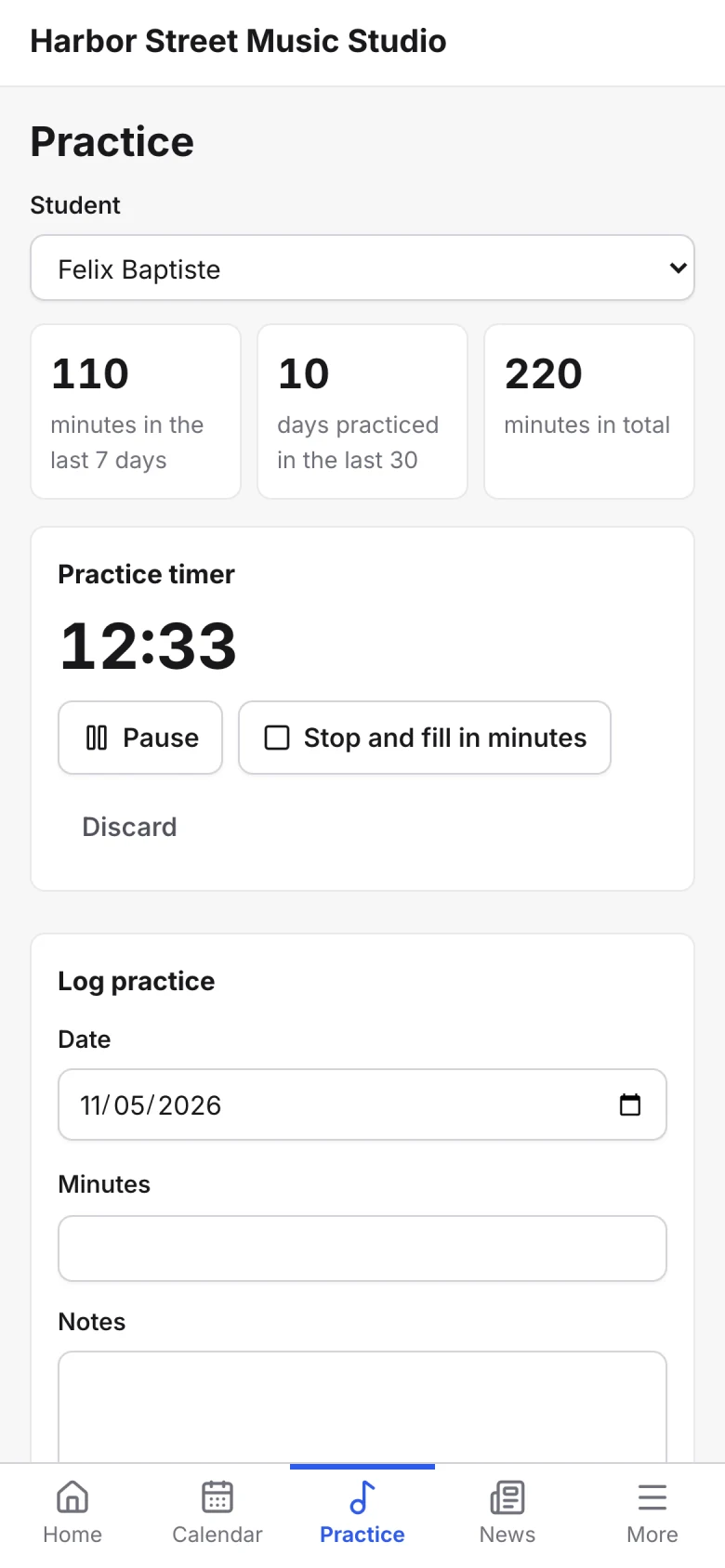
A practice log summary gives you each student’s minutes over the dates you choose, as PDF or Excel. Families use it in any phone’s or computer’s browser, with nothing to download. See repertoire and practice logs for how it works.
You can use both. Print the chart for your youngest students, and share the PDF with families in your studio’s online resources, so a lost log is one download away.